Equilateral Triangle Calculator
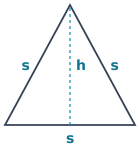
Area equals root three over four s squared
Use this form when the side length is known. All three sides are equal, so a single dimension fully determines the area.
A = (√3 / 4) s²
Use this form for the boundary length — three equal sides times the side length.
P = 3s
Use this form for the altitude (perpendicular from any vertex to the opposite side).
h = s√3 / 2
Use this rearrangement when the area is known and you need the side length.
s = √(4A / √3)
This equilateral triangle calculator solves the formulas for a triangle with three equal sides and three 60° angles. From the side length s, every other property follows: area A = (√3/4)s², perimeter P = 3s, height h = s√3/2, inradius r = s√3/6, circumradius R = s√3/3. The circumradius is exactly twice the inradius for any equilateral triangle.
An equilateral triangle has a side length of 6 cm. Compute its area, perimeter, height, and radii.
Every regular hexagon decomposes into 6 equilateral triangles meeting at the center, which is why the hexagon's apothem equals its inscribed equilateral triangle's height.
An equilateral triangle is a special triangle with all three sides equal and all three angles equal to 60°. It's the only triangle that's both equilateral and equiangular. The height equals s√3/2 by the 30-60-90 right triangle formed when you drop a perpendicular from any vertex to the opposite side. The inradius (apothem) is exactly one-third the height; the circumradius is two-thirds. Equilateral triangles tile the plane perfectly (along with squares and regular hexagons) — they're one of the three regular polygon tilings.
Use A = (√3/4) s². For s = 6 cm, A = 9√3 ≈ 15.588 cm².
h = s√3/2. For s = 6 cm, h = 3√3 ≈ 5.196 cm. This comes from the 30-60-90 right triangle formed by dropping a perpendicular from any vertex.
P = 3s. For s = 6 cm, P = 18 cm.
All three angles equal 60°. This is the only triangle where all angles are equal. The sum of any triangle's angles is 180°, so 3 × 60° = 180° ✓.
A regular hexagon decomposes into 6 equilateral triangles meeting at its center. This is why a regular hexagon's circumradius equals its side length and its apothem equals an equilateral triangle's height.
Inradius r = s√3/6 (inscribed circle, touches all three sides). Circumradius R = s√3/3 (passes through all three vertices). R = 2r — the circumradius is exactly twice the inradius for an equilateral triangle.
Every equilateral triangle is isosceles (because all isosceles triangles have at least two equal sides — equilateral has three). But not every isosceles triangle is equilateral.
No. A right triangle has one 90° angle, but every angle in an equilateral triangle is 60°. The two categories are disjoint.
Reference:
Weisstein, Eric W. "Equilateral Triangle." MathWorld — A Wolfram Web Resource. https://mathworld.wolfram.com/EquilateralTriangle.html
Tiling
An equilateral triangular tile has 6 cm sides. Compute its area.
Area ≈ 15.59 cm² per tile
Equilateral triangles tile the plane perfectly — they're one of three regular polygons that do.
Truss Design
An equilateral truss has 12 m sides. Find its height (altitude from base to apex).
Height ≈ 10.39 m
Equilateral truss heights follow the 30-60-90 right triangle: half the base is s/2, the height is s√3/2, and the slant (full side) is s.
Inverse Solve
Find the side length of an equilateral triangle with area exactly 50 cm².
Side ≈ 10.74 cm
Useful for sizing equilateral cutouts in fabrication or decorative panels.
A single side length s fully determines an equilateral triangle. All three angles are 60°.
Where:


