Right Triangle Calculator
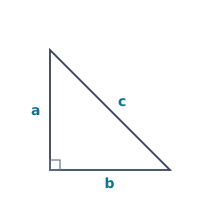
Hypotenuse equals the square root of a squared plus b squared
Use this form when both legs of a right triangle are known and you need the hypotenuse. The Pythagorean theorem is the most famous result in geometry.
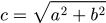
c = √(a² + b²)
Use this form when both legs are known. The two legs serve as base and height because they meet at the right angle.
A = (1/2) a b
Use this rearrangement of the Pythagorean theorem when the hypotenuse and one leg are known and you need the other leg.
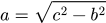
a = √(c² − b²)
Use this rearrangement when the hypotenuse and the first leg are known and you need the second leg.
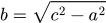
b = √(c² − a²)
This right triangle calculator solves c² = a² + b² (the Pythagorean theorem) and A = (1/2) a b for area. Pick the unknown with the solve-for toggle, enter the remaining values, and the calculator returns the result plus all related quantities — perimeter, both acute angles (atan(a/b) and atan(b/a)), inradius r = (a+b−c)/2, and circumradius R = c/2 (the hypotenuse is the diameter of the circumscribed circle, a special property of right triangles).
A right triangle has legs of 3 m and 4 m. Find the hypotenuse, area, and the two acute angles.
3-4-5 is the smallest 'Pythagorean triple' — integer legs and hypotenuse. Other common triples: 5-12-13, 8-15-17, 7-24-25.
A right triangle has one 90° angle and two acute angles that sum to 90°. The side opposite the right angle is the hypotenuse (always the longest side); the other two sides are legs. The Pythagorean theorem c² = a² + b² relates the three sides — it works in any right triangle. The hypotenuse is also the diameter of the triangle's circumscribed circle, which is why R = c/2. Special right triangles to know: 3-4-5 (and its multiples 6-8-10, 9-12-15), 5-12-13, 45-45-90 (isosceles right, sides in ratio 1:1:√2), and 30-60-90 (sides in ratio 1:√3:2).
Use the Pythagorean theorem c = √(a² + b²), where a and b are the two legs. For a 3-4-5 triangle, c = √(9+16) = 5.
A = (1/2) a b, where a and b are the two legs (the sides meeting at the right angle). For legs 3 and 4, A = 6.
Rearrange the Pythagorean theorem: a = √(c² − b²) or b = √(c² − a²). For a hypotenuse of 5 and a leg of 4, the other leg is √(25−16) = √9 = 3.
A set of three positive integers (a, b, c) satisfying a² + b² = c². The smallest is 3-4-5; others include 5-12-13, 8-15-17, 7-24-25, 20-21-29. Any multiple of a triple is also a triple.
They sum to 90° because the total of all three angles in any triangle is 180° and one angle is 90°. So if α = atan(a/b), then β = 90° − α = atan(b/a).
r = (a + b − c) / 2. For a 3-4-5 triangle, r = (3+4−5)/2 = 1. The inscribed circle touches all three sides from inside.
R = c/2. The hypotenuse is the diameter of the circumscribed circle — a special property of right triangles. For c = 5, R = 2.5.
The same idea extends: for a rectangular box with sides l, w, h, the space diagonal d = √(l² + w² + h²). This calculator handles only the 2D right-triangle case; use the rectangular prism calculator for 3D.
Reference:
Weisstein, Eric W. "Right Triangle." MathWorld — A Wolfram Web Resource. https://mathworld.wolfram.com/RightTriangle.html
Carpentry
A wooden frame is 6 ft tall and 8 ft wide. Compute the diagonal brace needed to square it (6-8-10 triple).
Brace length = 10 ft
6-8-10 is a multiple of the 3-4-5 Pythagorean triple. Carpenters use this trick — a 6-8-10 triangle is a quick way to square a corner.
Ramp Design
A right-triangular ramp has a rise of 5 ft and a run of 12 ft. Compute its area.
Area = 30 ft²; hypotenuse = √(25+144) = 13 ft
5-12-13 is another famous Pythagorean triple. Ramp slope ratio is 5:12 — that's about 22.6° from horizontal.
Distance Calculation
A right triangle has a hypotenuse of 17 m and one leg of 15 m. Find the other leg.
Missing leg = 8 m (8-15-17 Pythagorean triple)
8-15-17 is a Pythagorean triple. Memorizing the common triples — 3-4-5, 5-12-13, 8-15-17, 7-24-25, 20-21-29 — speeds up everyday geometry.
A right triangle has one 90° angle. The two sides meeting at the right angle are the legs (a, b); the side opposite the right angle is the hypotenuse (c) and is always the longest side.
Where: