Calculate Isosceles Triangle Area from Legs and Base
Use this form when both the equal-leg length a and the base b are known. Equivalent to A = (1/2) · b · h where h = √(a² − (b/2)²).
A = (b/4) · √(4a² − b²)
Calculate Isosceles Triangle Perimeter
Use this form for the total boundary length — two equal legs plus the base.
P = 2a + b
Calculate Isosceles Triangle Height (Altitude to the Base)
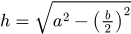
Use this form for the altitude from the apex perpendicular to the base. Drops out of the Pythagorean theorem on the half-triangle.
h = √(a² − (b/2)²)
Calculate Isosceles Triangle Leg from Base and Area
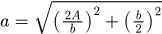
Use this rearrangement when the base and area are known and you need the equal-leg length. Internally finds h = 2A/b, then applies Pythagoras.
a = √((2A/b)² + (b/2)²)
How It Works
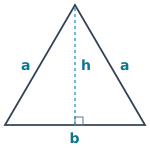
This isosceles triangle calculator solves for area, perimeter, height (altitude to the base), and the equal-leg length from any compatible pair of inputs. An isosceles triangle has two equal sides (the legs, a) meeting at the apex, with a third side (the base, b) opposite that apex. Drop a perpendicular from the apex to the base and you get two congruent right triangles with legs h and b/2 and hypotenuse a, so the Pythagorean theorem gives h = √(a² − (b/2)²) and everything else follows from there.
Example Problem
An isosceles triangle has equal legs a = 5 cm and base b = 6 cm. Find the height, area, perimeter, and the three interior angles.
- Knowns: a = 5 cm (each equal leg), b = 6 cm (base). Two legs are equal — this is the defining property.
- Drop the altitude from the apex to the base midpoint: it splits the isosceles triangle into two congruent 3-4-5 right triangles.
- Height: h = √(a² − (b/2)²) = √(25 − 9) = √16 = 4 cm
- Area: A = (1/2) · b · h = (1/2) · 6 · 4 = 12 cm²
- Perimeter: P = 2a + b = 2 · 5 + 6 = 16 cm
- Apex angle θ = 2 · atan((b/2)/h) = 2 · atan(3/4) ≈ 73.74°; each base angle = (180° − θ)/2 ≈ 53.13°. Verify: 73.74 + 2 · 53.13 = 180 ✓.
The 5-6 isosceles triangle is the 3-4-5 Pythagorean triple in disguise: split it down the middle and each half is a 3-4-5 right triangle. The same trick works for any isosceles triangle — the altitude always cuts it into two congruent right triangles.
When to Use Each Variable
- Solve for Area — when both the equal-leg length and the base are known — gable roof, isosceles sail, decorative panel.
- Solve for Perimeter — when you need the total boundary length — fence, frame, perimeter trim.
- Solve for Height — when you need the apex-to-base altitude — clearance under a peaked roof, inscribed circle sizing.
- Solve for Leg — when the base and the enclosed area are known and you need the slant-side length — common in roof rafter and truss sizing.
Key Concepts
An isosceles triangle has exactly two equal sides (the legs); the third side is the base. The two angles opposite the equal legs (the base angles) are equal — that's the Base Angles Theorem. The altitude from the apex (the vertex between the two equal sides) to the base is also the perpendicular bisector of the base, the angle bisector of the apex angle, and the median from the apex. Cut along this altitude and you split the isosceles triangle into two congruent right triangles with legs h and b/2 and hypotenuse a. An equilateral triangle is a special case of isosceles where all three sides — and all three angles — are equal.
Applications
- Roofing: gable roofs are isosceles triangles; rafter length is the leg, span is the base, ridge height is the altitude
- Trusses: queen-post and king-post trusses are isosceles for symmetric load distribution
- Sails: isosceles triangle sails (lateen, sprit) are widely used in small boats
- Architecture: pediments above doors and windows are usually isosceles for symmetry
- Geometry instruction: isosceles is the first non-equilateral triangle students learn — base angles equal, altitude bisects the apex
Common Mistakes
- Mixing up leg and base — in this calculator, a is the equal-leg length (two of them); b is the base (the one different side)
- Forgetting the triangle inequality — the base must satisfy b < 2a, otherwise the legs can't meet at an apex
- Using base × height with the slant height instead of the perpendicular altitude — area = (1/2) · b · h needs the perpendicular height, not the leg length
- Assuming the apex angle equals the base angle — they're only equal when the triangle is equilateral (a = b)
Frequently Asked Questions
How do you calculate the area of an isosceles triangle?
Use A = (b/4) · √(4a² − b²), where a is each equal leg and b is the base. Equivalently, A = (1/2) · b · h where h = √(a² − (b/2)²). For a = 5 cm and b = 6 cm, A = 12 cm².
What is the formula for the height of an isosceles triangle?
h = √(a² − (b/2)²). It comes from the Pythagorean theorem applied to the right triangle formed when you drop the altitude from the apex to the base midpoint. For a = 5, b = 6: h = √(25 − 9) = 4.
How do you find the perimeter of an isosceles triangle?
P = 2a + b — twice the leg plus the base. For a = 5 and b = 6, P = 16.
What are the angles of an isosceles triangle?
The apex angle θ = 2 · atan((b/2)/h), where h = √(a² − (b/2)²). The two base angles are equal and each equals (180° − θ)/2. For a = 5, b = 6: θ ≈ 73.74° and each base angle ≈ 53.13°.
How do you find the missing leg of an isosceles triangle from its area?
If you know the base b and the area A, then a = √((2A/b)² + (b/2)²). Internally this finds the altitude h = 2A/b and applies Pythagoras on the half-triangle. For b = 6 and A = 12: a = √(16 + 9) = 5.
Is an equilateral triangle isosceles?
Yes. Equilateral is the special case where all three sides — and all three angles — are equal. Every equilateral triangle satisfies the isosceles definition (at least two equal sides); the converse isn't true.
What's the difference between the legs and the base of an isosceles triangle?
The legs are the two equal sides (length a); the base is the third side (length b, opposite the apex). The two base angles — the angles at each end of the base — are equal by the Base Angles Theorem.
Can an isosceles triangle be a right triangle?
Yes — a 45-45-90 triangle is both isosceles and right. The two legs of the right angle are also the two equal sides of the isosceles, with the hypotenuse as the base. Its base angles are each 45°.
Reference: Weisstein, Eric W. "Isosceles Triangle." MathWorld — A Wolfram Web Resource. https://mathworld.wolfram.com/IsoscelesTriangle.html
Worked Examples
Geometry
What is the area of a 5-6 isosceles triangle (3-4-5 family)?
An isosceles triangle has equal legs of 5 cm and a base of 6 cm. Compute its area.
- Knowns: a = 5 cm (each leg), b = 6 cm (base)
- Drop the altitude: it bisects the base, forming two 3-4-5 right triangles (legs 3 and 4, hypotenuse 5).
- Height: h = √(5² − 3²) = √16 = 4 cm
- Area: A = (1/2) · b · h = (1/2) · 6 · 4 = 12 cm²
Area = 12 cm²
The 5-6 isosceles triangle splits into two 3-4-5 right triangles. The altitude (4) plus half the base (3) equals the leg (5) — pure Pythagoras.
Roofing
What is the ridge height of a gable roof with 13 ft rafters over a 10 ft span?
A symmetric gable roof has 13 ft rafters (the equal legs) and a 10 ft span (the base). Find the ridge height above the eaves.
- Knowns: a = 13 ft (each rafter), b = 10 ft (span)
- The rafters and the span form an isosceles triangle with the ridge at the apex. Each half is a 5-12-13 right triangle.
- Height (rise): h = √(13² − 5²) = √(169 − 25) = √144 = 12 ft
- Bonus: roof pitch ≈ atan(12/5) ≈ 67.4° from horizontal — quite steep.
Ridge height = 12 ft
5-12-13 is a Pythagorean triple — the half-span (5), the rise (12), and the rafter (13) all line up as whole numbers.
Inverse Solve
What leg length gives an isosceles triangle with a 6 m base and 12 m² area?
An isosceles triangle has base 6 m and area 12 m². Find the length of each equal leg.
- Knowns: b = 6 m (base), A = 12 m² (area)
- Back out the altitude: h = 2A/b = 24/6 = 4 m
- Apply Pythagoras on the half-triangle: a = √(h² + (b/2)²) = √(16 + 9) = √25
- Leg: a = 5 m
Each equal leg a = 5 m
This is the canonical case in reverse: the 3-4-5 half-triangle reconstructs the same isosceles triangle from base + area.
Isosceles Triangle Formulas
An isosceles triangle has two equal sides (the legs, a) and a third side (the base, b). The altitude from the apex (the vertex between the two legs) to the base is also the perpendicular bisector of the base, which is why every formula reduces to a Pythagorean relation on the half-triangle.
Where:

- a — each equal leg (two of them, meeting at the apex)
- b — the base (the third side, opposite the apex)
- h — altitude from apex perpendicular to the base
- A — area = (1/2) · b · h = (b/4) · √(4a² − b²)
- P — perimeter = 2a + b
- θ — apex angle (between the two legs); base angles are each (180° − θ)/2
- r — inradius = A / s, where s = (2a + b)/2 is the semi-perimeter
Related Calculators
- Equilateral Triangle Calculator — the special case where all three sides are equal
- Right Triangle Calculator — Pythagorean theorem and right-triangle properties (the half of an isosceles)
- General Triangle Calculator — find sides, angles, and area for any triangle (SSS, SAS, ASA, etc.)
- Trigonometry Calculator — general SOH-CAH-TOA and inverse trig functions
- Geometric Formulas Calculator — explore area and side formulas for many shapes
Related Sites
- Temperature Tool — Temperature unit converter
- Z-Score Calculator — Z-score, percentile, and probability calculator
- OptionsMath — Options trading profit and loss calculators
- Medical Equations — Hemodynamic, pulmonary, and dosing calculators
- Dollars Per Hour — Weekly paycheck calculator with overtime
- Percent Off Calculator — Discount and sale price calculator