Engine Displacement Calculator
CID equals N times pi over 4 times bore squared times stroke
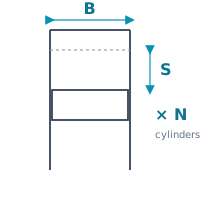
Engine displacement is the total swept volume of every cylinder in one full cycle: CID = N × (π/4) × B² × S, where N is the number of cylinders, B is the bore diameter (cylinder ID), and S is the stroke (the distance the piston travels from bottom dead center to top dead center). The result is in cubic inches (CID); divide by 61.024 for liters or multiply by 16.387 for cubic centimeters. It is a purely geometric quantity — it does not depend on RPM, compression ratio, or volumetric efficiency.
A V8 engine has a 4.00-inch bore and a 3.48-inch stroke. Calculate total engine displacement in cubic inches and liters.
Displacement is the headline spec for combustion engines because it sets the upper bound on how much air the engine can ingest per cycle. A 5.0 L V8 sweeps 5 liters every two crankshaft revolutions (one complete four-stroke cycle), so at 6000 RPM it sweeps 15,000 L/min = 530 CFM if volumetric efficiency were 100%. Real engines fall short of that target — typical naturally aspirated street engines hit 80-90% VE. Bore-to-stroke ratio also affects character: over-square (bore > stroke) engines favor high-RPM horsepower; under-square engines favor low-end torque.
Use CID = N × (π/4) × B² × S where N is the number of cylinders, B is the bore diameter in inches, and S is the stroke in inches. Multiply bore² by 0.7854 (which is π/4) to get bore area, then multiply by stroke and cylinder count.
CID = N × (π/4) × B² × S, equivalent to CID = 0.7854 × N × B² × S. With B and S in inches the result is in cubic inches; divide by 61.024 for liters.
Divide cubic inches by 61.024. For example: 350 in³ / 61.024 ≈ 5.74 L; 454 in³ / 61.024 ≈ 7.44 L; 302 in³ / 61.024 ≈ 4.95 L (often rounded to 5.0 L).
Bore is the inner diameter of the cylinder — how wide it is. Stroke is the distance the piston travels from bottom dead center to top dead center. Bore-to-stroke ratio influences whether an engine favors high-RPM horsepower (over-square) or low-end torque (under-square).
No. Displacement is the swept volume only — the volume the piston actually moves through. The volume above top dead center (the combustion chamber, head gasket, and piston deck) is the clearance volume and is used to compute compression ratio, not displacement.
Ford's 5.0 L V8 displaces 302 in³ (302 / 61.024 ≈ 4.95 L, rounded up to 5.0). Marketing uses metric, engineers use SAE. Chevy's 350 ci is 5.7 L, and the Hemi 426 is 7.0 L.
Reference:
Heywood, John B. 1988. Internal Combustion Engine Fundamentals. McGraw-Hill.
Classic Muscle Car
The iconic 426 Hemi from the late-1960s Mopar muscle era runs a 4.25-in bore and 3.75-in stroke across 8 cylinders. Compute the swept volume and check whether the marketing name matches the actual cubic-inch count.
CID ≈ 425.6 in³ (≈ 6.98 L)
The 'Street Hemi' was sold as a 426 — actual displacement is 425.6 in³, rounded up to match the round-number marketing. Chrysler's NASCAR-spec Hemi used the same 4.25 × 3.75 bottom end.
Aviation Piston
The Lycoming O-320 aircraft flat-four powers a generation of trainers (Cessna 172, Piper Cherokee). Given the published 3.875-in stroke and the 4-cylinder configuration, solve for the bore diameter that delivers the rated 319.8 in³.
B ≈ 5.125 in (130.2 mm)
Aircraft engines are intentionally oversquare (bore > stroke) to keep piston speed low and reliability high. The O-320's 5.125 × 3.875 geometry holds piston speed under 2,500 ft/min at the 2,700 RPM redline.
Stroker Build
An engine builder is fitting a stroker crank into a 4.40-in bore big-block Chevy. The target displacement is 502 in³ — a popular stroker build. Solve for the crankshaft stroke length needed to hit exactly 502 in³.
S ≈ 4.127 in
Real 502 stroker kits use a 4.125-in (4-1/8) stroke — essentially this answer rounded to a standard machined dimension. Going from a stock 4.0-in stroke to 4.125-in is a common '454-to-502' big-block stroker conversion.
Total engine displacement is the swept volume of one cylinder multiplied by the cylinder count. The same relation can be rearranged to solve for either of the geometric inputs:
Where:
Displacement is a pure-geometry quantity — it describes the air the engine moves per revolution and ignores cam timing, compression, and boost. Keep the length units consistent: if bore and stroke are in inches, the result is in cubic inches; multiply by 16.387 to convert in³ to cc, or divide by 61.024 to convert in³ to liters. Engines with oversquare geometry (B > S) tend to rev higher; undersquare designs (S > B) trade peak RPM for low-end torque.
