Compression Ratio Calculator
Compression ratio equals 1 plus 0.7854 times bore squared times stroke divided by the sum of CCV, HGV, and PDV
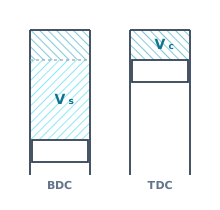
Static compression ratio (CR) compares the cylinder volume at bottom dead center (BDC) to the volume at top dead center (TDC). The formula is CR = 1 + (0.7854 × B² × S) / (CCV + HGV + PDV), where B is bore, S is stroke, CCV is combustion chamber volume, HGV is head gasket volume, and PDV is piston deck volume (sometimes negative for dished pistons). Higher CR squeezes the charge harder, raising thermal efficiency and power — but it also raises peak cylinder pressure and the risk of detonation on low-octane fuel.
A small-block V8 has 4.00-in bore, 3.48-in stroke, 64 cm³ (3.91 in³) chamber, 0.04-in compressed gasket on a 4.00 bore (0.503 in³), and a 0.01 in³ piston deck volume. Calculate static compression ratio.
Static compression ratio is a geometric ratio measured with the engine stopped. Dynamic compression ratio is what the engine actually achieves at running speed, after intake valve closing has trapped the charge — cam timing always reduces effective CR. Compression ratio is dimensionless: the units of swept volume and clearance volume must match, but the answer is just a number. Most pump-gas street engines run 8:1 to 11:1; race engines on high-octane fuel can run 12:1 to 15:1; diesel engines run 14:1 to 23:1 because they rely on compression ignition.
CR = 1 + (swept volume) / (clearance volume). Swept volume per cylinder is 0.7854 × B² × S; clearance volume is the sum of combustion chamber volume (CCV), head gasket volume (HGV), and piston deck volume (PDV).
CR = 1 + (0.7854 × B² × S) / (CCV + HGV + PDV). The 1 accounts for the clearance volume still being above the piston at top dead center.
On 91-93 octane pump gas, naturally aspirated engines typically run 9.5:1 to 11:1 with aluminum heads and 9:1 to 10:1 with iron heads. Forced-induction builds drop to 8:1-9.5:1 because boost adds effective compression on top of the static ratio.
Static CR is a geometric ratio measured with the engine stopped. Dynamic CR accounts for when the intake valve actually closes — long-duration cams close the intake later, dumping some charge back out and reducing effective compression. Two engines with the same static 10:1 CR can have very different dynamic CRs depending on cam timing.
Higher compression raises thermal efficiency, so each pound of fuel makes more power. A rule of thumb: every full point of CR adds 3-4% to peak power. Returns diminish above ~12:1, and detonation risk rises steeply with low octane.
Diesels rely on compression ignition — the air must be compressed enough to reach autoignition temperature for the fuel injected at TDC. Typical diesel CRs are 14:1 to 23:1. Gasoline engines use spark ignition, so they don't need to autoignite the charge and can use much lower CRs.
Reference:
Heywood, John B. 1988. Internal Combustion Engine Fundamentals. McGraw-Hill.
Performance Tuning
A boost-friendly LS-style short block uses 4.000-in bore, 3.500-in stroke, dished pistons (PDV 0.9 in³), a generous 4.5 in³ chamber, and a 0.040-in MLS head gasket (HGV 0.4 in³). What static CR results?
CR ≈ 8.58:1
A common boost-era CR target — low enough to run 12–15 PSI on 91-octane pump gas without detonation, but high enough to keep off-boost driveability snappy.
Motorcycle Racing
A liter-class sportbike piston spec (4-cylinder, 998 cc total) has a 78 mm bore and 52.2 mm stroke — about 3.071 in × 2.054 in. The combustion chamber is 1.20 in³, the head gasket adds 0.05 in³, and the flat-top piston deck volume is 0.02 in³.
CR ≈ 12.98:1
Modern liter-class sportbikes routinely run 12.5:1 to 13.5:1 static CR — high static compression plus aggressive cam overlap and quick burn times pull the dynamic CR back into a safe range on premium pump fuel.
Commercial Diesel
A Cummins-style inline-six diesel has a 4.016-in bore (102 mm) and 4.724-in stroke (120 mm). The bowl-in-piston combustion chamber holds 3.30 in³, the steel head gasket adds 0.30 in³, and the piston deck-clearance volume is 0.14 in³. Compute the static CR.
CR ≈ 17.00:1
Diesels rely on compression ignition: the air charge has to reach roughly 540 °C at top dead center for the injected fuel to autoignite, which requires a static CR in the 14:1–23:1 range depending on chamber design and turbo boost level.
Static compression ratio compares the cylinder volume at bottom dead center (swept volume plus clearance) to the volume at top dead center (clearance alone):
Where:
The numerator (0.7854 × B² × S) is the swept volume of one cylinder. The denominator is the total clearance volume — everything still unswept when the piston reaches top dead center. CR is dimensionless; all lengths and volumes must be in matching unit systems before plugging in. This is static (geometric) CR — dynamic CR also depends on cam timing and intake-valve closing point.
