Ellipsoid Calculator
Volume equals four-thirds pi a b c
Use this form when all three semi-axes (a, b, c) are known and you need the enclosed volume. The formula generalizes sphere volume (4/3)πr³ by replacing the single radius with the three semi-axes.
V = (4/3) π a b c
Knud Thomsen's closed-form approximation. The exact ellipsoid surface area requires elliptic integrals (no elementary closed form). Thomsen's expression has worst-case error under 1.061% across all aspect ratios and recovers the exact value when a = b = c (sphere).
S ≈ 4π · [((aᵖbᵖ + aᵖcᵖ + bᵖcᵖ)/3)]^(1/p), p = 1.6075
Use this rearrangement when the volume and two of the three semi-axes are known. Solving for a is symmetric — same formula structure as solving for b or c, just with different inputs.
a = 3V / (4π b c)
Use this rearrangement when volume and the other two semi-axes are known. Common scenario: a known capacity and two measured outer dimensions, solve for the unmeasured one.
b = 3V / (4π a c)
Use this rearrangement when volume and the first two semi-axes are known. The c-axis is often the depth or polar dimension in real-world cases (planet flattening, fruit shape, optical lens).
c = 3V / (4π a b)
This ellipsoid calculator solves the volume formula V = (4/3) π a b c exactly, and uses Knud Thomsen's approximation for the surface area (the exact value requires elliptic integrals with no elementary closed form). All three inverse solves — semi-axis a, b, or c from V and the other two — use simple rearrangements of the volume formula. Inputs accept any supported length unit per axis (meters, feet, inches, etc.) and any supported volume unit, and the calculator converts to SI internally before computing.
An ellipsoid has semi-axes a = 3 m, b = 2 m, c = 1 m. Compute its volume and surface area, then verify by solving back for a.
The Thomsen approximation is more than enough precision for engineering use — its worst-case 1.061% error is dominated by other real-world uncertainties (manufacturing tolerance, thermal expansion, surface roughness).
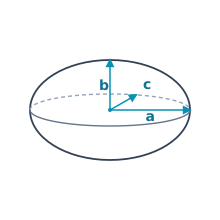
An ellipsoid is the 3D generalization of an ellipse — the locus of all points (x, y, z) satisfying (x/a)² + (y/b)² + (z/c)² = 1. It has three orthogonal semi-axes a, b, c. When all three are equal it becomes a sphere; when two are equal it becomes a spheroid (oblate if the equal axes are longer, prolate if shorter). Volume scales linearly with each axis, so V = (4/3)πabc generalizes (4/3)πr³ smoothly. Surface area, however, requires elliptic integrals in general; Thomsen's approximation gives a closed-form result with sub-1.1% worst-case error.
Multiply (4/3)π by all three semi-axes: V = (4/3) π a b c. For an ellipsoid with a = 3 m, b = 2 m, c = 1 m, V = (4/3) · π · 6 = 8π ≈ 25.13 m³. The formula generalizes sphere volume — when a = b = c = r it reduces to (4/3)πr³.
There's no exact closed-form formula — the surface area is given by an elliptic integral. Knud Thomsen's approximation S ≈ 4π · [((aᵖbᵖ + aᵖcᵖ + bᵖcᵖ)/3)]^(1/p) with p = 1.6075 has worst-case error under 1.061% across all aspect ratios. It also recovers the exact 4πr² value when a = b = c, so it's safe to use uniformly.
A spheroid is a special ellipsoid where two of the three semi-axes are equal. Oblate spheroid: a = b > c (squashed, like Earth). Prolate spheroid: a > b = c (elongated, like a rugby ball). A general ellipsoid has all three semi-axes different (a ≠ b ≠ c), called a triaxial ellipsoid.
Approximately, yes — Earth is best modeled as an oblate spheroid with equatorial radius ≈ 6378.137 km and polar radius ≈ 6356.752 km (a flattening of about 1/298.257). The reference ellipsoid used by GPS is WGS84. Earth's true shape (the geoid) deviates from this ellipsoid by up to ~100 m due to gravity variations, but the ellipsoid is the standard mathematical model for maps and positioning.
Knud Thomsen's 2004 approximation with exponent p = 1.6075 has a worst-case relative error of about 1.061% across all aspect ratios. For typical engineering aspect ratios (axis ratios under 10:1) the error is far smaller — often under 0.1%. The formula recovers the exact sphere case (4πr²) when a = b = c, so the approximation only matters when the axes differ.
Rearrange V = (4/3) π a b c to solve for the unknown axis. For example a = 3V / (4π b c). All three inverse solves follow the same pattern — just put the unknown axis on the left and the product of the other two on the right. The calculator handles all three with separate pills.
Oblate spheroid: the polar axis is SHORTER than the equatorial axes (a = b > c). Earth is oblate — it bulges at the equator due to rotation. Prolate spheroid: the polar axis is LONGER than the equatorial axes (a > b = c). Watermelons, American footballs, and rugby balls are roughly prolate. Both reduce the general 3-axis formulas to two-parameter forms.
Yes — a sphere is just an ellipsoid with a = b = c = r. The volume formula reduces from V = (4/3)π a b c to V = (4/3)π r³, and the Thomsen surface-area formula reduces exactly to S = 4π r² (no approximation error in the degenerate sphere case). Use the dedicated /sphere/ calculator if you only need sphere math — it's slightly faster to enter one number instead of three.
Reference:
Knud Thomsen, 2004, "Surface area of an ellipsoid". See also Weisstein, Eric W. "Ellipsoid." MathWorld — A Wolfram Web Resource. https://mathworld.wolfram.com/Ellipsoid.html
Planetary Geometry
Earth is best modeled as an oblate spheroid with equatorial semi-axes a = b = 6378 km and polar semi-axis c = 6357 km. Compute the volume and surface area.
Volume ≈ 1.083 × 10¹² km³, Surface ≈ 510 million km²
Earth's flattening f = (a − c)/a ≈ 1/298.257 — small but enough that geodesy and GPS use WGS84 ellipsoid coordinates instead of a pure sphere.
Prolate Spheroid
A large watermelon is roughly a prolate spheroid 35 cm long with a 25 cm diameter at the middle. That means a = 17.5 cm (half the length) and b = c = 12.5 cm (half the diameter). Estimate its volume.
Volume ≈ 11.45 L, Surface ≈ 2,538 cm²
Real watermelons have a thin rind (~1 cm) and the seeded/flesh ratio varies, but the prolate-spheroid model gives a usable first estimate for shipping weight or peel area.
Medical Imaging
A radiologist measures a kidney's three orthogonal dimensions on imaging as 11 cm × 5 cm × 3 cm (full lengths). The semi-axes are half each, and the standard ellipsoid-approximation formula gives a rapid volume estimate.
Volume ≈ 86.4 cm³, Surface ≈ 100 cm²
Clinical practice often multiplies the ellipsoid volume by 0.523 (≈ π/6, the ratio between an ellipsoid and its bounding box) when the input is the full bounding box rather than the semi-axes. The radiology shortcut 'π/6 × length × width × depth' produces the same number with one fewer step.
An ellipsoid is the 3D generalization of an ellipse, defined by three orthogonal semi-axes a, b, c — half-lengths along each axis. Volume has a clean closed form; surface area requires an approximation because the exact value involves elliptic integrals.
Where:




