Ellipse Calculator
Area equals pi a b
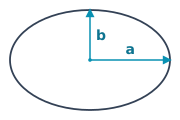
Use this form when the semi-major axis (a, half the longer diameter) and semi-minor axis (b, half the shorter diameter) are known. The formula generalizes circle area πr².
A = π a b
Ramanujan's first approximation for the ellipse perimeter. Accurate to better than 0.4% for any eccentricity. The exact formula requires an elliptic integral — this gives a closed-form result good enough for engineering.
P ≈ π[3(a+b) − √((3a+b)(a+3b))]
Use this rearrangement when the area and minor axis are known and you need the semi-major axis.
a = A / (π b)
Use this rearrangement when the area and major axis are known and you need the semi-minor axis.
b = A / (π a)
This ellipse calculator solves A = πab for area and uses Ramanujan's first approximation for the perimeter (the exact closed form requires an elliptic integral). Inverse solves cover semi-major axis from A and b, and semi-minor axis from A and a. Eccentricity e = √(1 − b²/a²) is always shown — 0 for a circle, approaching 1 as the ellipse becomes very elongated. Inputs accept any supported length and area units.
An elliptical garden bed has semi-major axis 5 m and semi-minor axis 3 m. Compute its area, perimeter, and eccentricity.
Eccentricity 0.8 is fairly elongated. Earth's orbital eccentricity is about 0.0167 (nearly circular); Halley's Comet is about 0.967 (very elongated).
An ellipse is the set of all points where the sum of distances from two fixed points (the foci) is constant. The semi-major axis a is half the longer diameter; the semi-minor axis b is half the shorter diameter. When a = b the ellipse becomes a circle. Eccentricity e = √(1 − b²/a²) measures how much the ellipse deviates from circular: 0 for a circle, approaching 1 for highly elongated shapes. Planetary orbits, oval racetracks, and elliptical machine paths all use ellipse geometry.
Multiply π by the two semi-axes: A = π a b. For an ellipse with a = 5 m and b = 3 m, A = 15π ≈ 47.12 m². The formula generalizes circle area πr², where r = a = b.
There's no exact closed-form formula — the perimeter is given by an elliptic integral. Ramanujan's first approximation P ≈ π[3(a+b) − √((3a+b)(a+3b))] is accurate to better than 0.4% for any eccentricity and matches the exact value for circles.
e = √(1 − b²/a²), where a is the semi-major axis. Eccentricity 0 means a circle (a = b). As e → 1 the ellipse becomes very elongated. For a = 5 and b = 3, e = 0.8.
A circle is a special ellipse where the two semi-axes are equal (a = b = r). Ellipses have two different axis lengths and two foci; circles have one center point. Every circle is an ellipse, but only ellipses with a = b are circles.
Rearrange A = πab to a = A / (π b). For A = 47.12 m² and b = 3 m, a = 47.12 / (3π) ≈ 5 m.
Two fixed points on the major axis, at distance c = √(a² − b²) from the center. Every point on the ellipse has a constant sum of distances to the two foci. For a = 5 and b = 3, c = √(25 − 9) = 4, so the foci are 4 m from the center along the major axis.
The exact circumference is C = 4a · E(e), where E is the complete elliptic integral of the second kind — there's no elementary closed form. Ramanujan derived two approximations in 1914; the second is even more accurate than the first one used here. For most engineering work, the first approximation is well within measurement precision.
No — by definition the eccentricity of an ellipse is in [0, 1). e = 1 gives a parabola (degenerate case), and e > 1 gives a hyperbola. The square root inside √(1 − b²/a²) requires b ≤ a, which limits e to [0, 1).
Reference:
Weisstein, Eric W. "Ellipse." MathWorld — A Wolfram Web Resource. https://mathworld.wolfram.com/Ellipse.html
Garden Bed
An elliptical garden bed measures 10 m across (a = 5 m) by 6 m across (b = 3 m). Compute its area to size the soil order.
Area = 47.12 m² (about 507 ft²)
An elliptical bed of the same major/minor diameters as a rectangle has π/4 ≈ 0.785 of the rectangle's area — useful for comparison.
Running Track
A running track is an ellipse with semi-major axis 60 m and semi-minor axis 40 m. Find the lap length.
Lap length ≈ 317.4 m
Real running tracks use straight sections joined by semicircles, not pure ellipses. A pure-ellipse 400 m track would have different dimensions.
Inverse Solve
An elliptical pond must enclose 100 m² with semi-major axis 6 m. Find the required semi-minor axis.
Semi-minor axis ≈ 5.305 m
Note b < a (5.3 < 6), so the ellipse is only mildly elongated — eccentricity ≈ 0.47. For a perfect circle of the same area, r = √(100/π) ≈ 5.642 m.
An ellipse is defined by two axes: the semi-major axis a (half the longer diameter) and the semi-minor axis b (half the shorter diameter).
Where:



