
Electrostatic Force
The force two point charges exert on each other along the line connecting them. Positive F is repulsive (like signs), negative F is attractive (opposite signs).
F = k × q₁ × q₂ / r²
First Charge
Solve for the unknown source charge when you know the resulting force, the partner charge, and the separation distance.
q₁ = F × r² / (k × q₂)
Second Charge
Solve for the unknown partner charge given the measured force, the first charge, and the separation.
q₂ = F × r² / (k × q₁)
Separation Distance
Solve for the distance between two charges from a measured force. The sign of F must match the sign of q₁ · q₂ — like charges can only repel, opposite charges can only attract.
r = √(k × q₁ × q₂ / F)
How It Works
Coulomb's Law states that two stationary point charges q₁ and q₂ separated by a distance r exert an electrostatic force on each other given by F = k × q₁ × q₂ / r², where k = 8.9875517873681764 × 10⁹ N·m²/C² is Coulomb's constant (also written 1 / (4π ε₀), with ε₀ the permittivity of free space). The force acts along the line connecting the two charges. Like-sign charges repel (F > 0); opposite-sign charges attract (F < 0). This calculator accepts charges in coulombs, millicoulombs, or microcoulombs and distances in meters, centimeters, or millimeters, converts inputs to SI internally, and solves the equation for force, either charge, or the distance.
Example Problem
Find the electrostatic force between a 1 μC point charge and a 2 μC point charge separated by 5 cm in vacuum (both charges positive).
- Write Coulomb's Law: F = k × q₁ × q₂ / r².
- Convert inputs to SI: q₁ = 1 × 10⁻⁶ C, q₂ = 2 × 10⁻⁶ C, r = 0.05 m.
- Substitute Coulomb's constant: k = 8.9875517873681764 × 10⁹ N·m²/C².
- Compute the numerator: k × q₁ × q₂ = 8.9875517873681764 × 10⁹ × 1 × 10⁻⁶ × 2 × 10⁻⁶ ≈ 1.7975 × 10⁻² N·m².
- Compute the denominator: r² = (0.05)² = 2.5 × 10⁻³ m².
- Divide: F ≈ 1.7975 × 10⁻² / 2.5 × 10⁻³ ≈ 7.19 N. Positive sign ⇒ the charges repel each other.
Reverse the sign of one charge (e.g. q₂ = −2 μC) and the same calculation yields F ≈ −7.19 N — a force of identical magnitude but now attractive, since the charges have opposite signs.
Key Concepts
Coulomb's constant k = 1 / (4π ε₀) ≈ 8.9875517873681764 × 10⁹ N·m²/C² is one of the largest physical constants in classical mechanics, which is why electrostatic forces between everyday objects can be enormous compared with their gravitational pull. The functional form F = k × q₁ × q₂ / r² is identical to Newton's law of gravitation F = G × m₁ × m₂ / r²: both are inverse-square, central-force laws, and both fall off identically with distance. The crucial difference is sign — masses always attract, but charges can attract or repel depending on their relative signs. The vacuum permittivity ε₀ = 8.8541878128 × 10⁻¹² F/m relates k to electric-field strength via E = F / q, with k = 1 / (4π ε₀). For two electron charges (q = 1.602 × 10⁻¹⁹ C) at 1 Å (10⁻¹⁰ m), the Coulomb force ≈ 2.3 × 10⁻⁸ N — about 10³⁹ times stronger than the gravitational force between the same pair, which is why electrons in atoms are held by electric, not gravitational, forces.
Applications
- Electrostatic precipitators: industrial flue-gas scrubbers use charged plates to attract suspended particles via Coulomb forces, removing more than 99% of fine particulates from power-plant exhaust.
- Electrophoresis: DNA, proteins, and other charged molecules are separated by size and charge in a gel under an applied electric field — the same Coulomb force that holds molecules together also drives them through the matrix.
- Ion traps and mass spectrometers: oscillating electric fields confine charged ions in space via Coulomb interactions, enabling precision measurements of mass-to-charge ratio.
- Particle accelerators: linear and circular accelerators use Coulomb forces from oscillating electric fields to push charged particles up to relativistic energies for high-energy physics experiments.
- Lightning and atmospheric electricity: charge separation in storm clouds builds Coulomb forces large enough to ionize air across kilometers, producing the visible discharge of a lightning bolt.
- Electrostatic painting and powder coating: charged paint or powder droplets are attracted to oppositely charged metal workpieces, producing uniform coverage with minimal overspray.
Common Mistakes
- Mixing charge units — coulombs, millicoulombs (10⁻³ C), and microcoulombs (10⁻⁶ C) all look similar but differ by factors of 1,000. Always convert to coulombs before substituting into the SI form of the equation.
- Forgetting the sign convention — entering both charges as positive when one is physically negative produces a repulsive force, when the real configuration is attractive. The sign of each charge matters.
- Substituting Earth's surface gravity g (≈ 9.81 m/s²) instead of Coulomb's constant k (8.99 × 10⁹ N·m²/C²) — they have similar single-letter symbols but completely different physical meanings and units.
- Using radius instead of separation — r in the formula is the centre-to-centre distance between the two charges, not the radius of either charge's sphere or the diameter of the system.
- Forgetting that r is squared — doubling the distance reduces the force to one quarter, not one half. The inverse-square dependence is the source of most order-of-magnitude errors in homework problems.
- Treating Coulomb's Law as valid for moving charges — it only applies to stationary (or slowly moving) point charges. For rapidly moving charges you need the full Lorentz force and Maxwell's equations.
Frequently Asked Questions
What is Coulomb's Law?
Coulomb's Law describes the electrostatic force between two stationary point charges: F = k × q₁ × q₂ / r², where k = 8.9875517873681764 × 10⁹ N·m²/C² is Coulomb's constant, q₁ and q₂ are the charges in coulombs, and r is the distance between them in metres. Like-sign charges repel; opposite-sign charges attract.
How do you calculate electrostatic force?
Multiply the two charges together and by Coulomb's constant k (8.9875517873681764 × 10⁹ N·m²/C²), then divide by the square of the separation distance: F = k × q₁ × q₂ / r². Express charges in coulombs and distance in metres before substituting, and keep the algebraic sign of each charge so the resulting force has the correct sign (positive for repulsive, negative for attractive).
What is Coulomb's constant?
Coulomb's constant k = 1 / (4π ε₀) ≈ 8.9875517873681764 × 10⁹ N·m²/C², where ε₀ is the permittivity of free space. It sets the strength of the electrostatic interaction in SI units. The constant is enormous — about 10²⁰ times larger than Newton's gravitational constant G — which is why electric forces dominate inside atoms.
What's the difference between Coulomb's Law and Newton's law of gravitation?
Both laws have the same inverse-square form: F = k·q₁·q₂/r² for electrostatics, F = G·m₁·m₂/r² for gravity. The differences are (1) the constant — k ≈ 9 × 10⁹ versus G ≈ 6.7 × 10⁻¹¹, so electric forces are intrinsically about 10²⁰ times stronger per pair, and (2) sign — masses always attract, but charges can attract or repel depending on their signs.
What is the electrostatic force between two electrons?
An electron carries charge q = −1.602 × 10⁻¹⁹ C. At one ångström (10⁻¹⁰ m) the Coulomb force between two electrons is F = k × q² / r² ≈ 2.31 × 10⁻⁸ N — repulsive, since both charges are negative. At a much shorter distance like one femtometer (10⁻¹⁵ m, the scale inside an atomic nucleus) the same calculation gives ≈ 231 N, which is why nuclear binding forces have to be enormous to hold a nucleus together.
Why is the electrostatic force so much stronger than gravity?
The ratio is set by the two constants. For two protons, F_electric / F_gravity = k · e² / (G · m_p²) ≈ 10³⁶. Coulomb's constant k is huge in SI units while G is tiny, and the electron-proton charge magnitude is many orders of magnitude larger relative to the proton mass than gravity's scale allows. Gravity wins on cosmological scales only because matter is electrically neutral on large scales — positive and negative charges cancel — while gravitational mass always adds.
How does distance affect Coulomb's force?
The force falls off as the inverse square of the distance. Doubling r reduces the force to one quarter; tripling r reduces it to one ninth; halving r quadruples it. This rapid drop-off is why electrostatic shielding is so effective and why the influence of a charged particle becomes negligible at moderate distances, even though Coulomb forces nominally have infinite range.
Does Coulomb's Law apply to moving charges?
Strictly, no — Coulomb's Law is the electrostatic limit of the full electromagnetic interaction. For stationary or slowly moving charges it is an excellent approximation. For charges moving at speeds comparable to the speed of light, you also need the magnetic component of the Lorentz force, F = q (E + v × B), described by the complete set of Maxwell's equations.
Reference:
Griffiths, David J. 2017. Introduction to Electrodynamics. 4th Edition. Cambridge University Press. ISBN 978-1108420419.
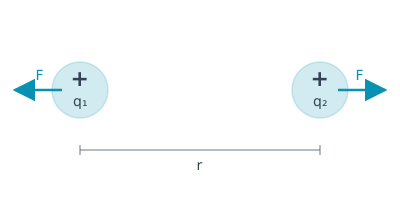
Two-Charge Diagram
Coulomb's Law treats both objects as point charges. The electrostatic force acts along the line connecting them. Two like- sign charges push each other apart (positive F, repulsive); two opposite-sign charges pull each other together (negative F, attractive). The magnitude of the force is identical in either case — only the sign changes.
Repulsive (like charges)
Attractive (opposite charges)
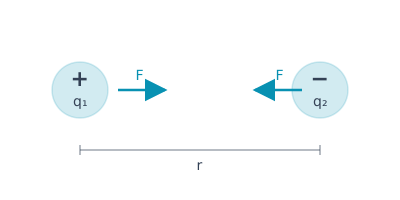
q₁, q₂ — the two point charges (C), carrying algebraic sign · r — centre-to-centre distance (m) · F — Coulomb force on each charge; equal in magnitude, opposite in direction (Newton's third law) · k = 8.9875517873681764 × 10⁹ N·m²/C² — Coulomb's constant.
Worked Examples
Textbook Physics
How much force do two 1 μC charges exert on each other 5 cm apart?
Two small spheres each carry +1 μC and +2 μC and sit 5 cm apart in vacuum — a standard introductory electrostatics problem. The interaction is repulsive because both charges are positive.
- Knowns: q₁ = 1 × 10⁻⁶ C, q₂ = 2 × 10⁻⁶ C, r = 0.05 m
- k = 8.9875517873681764 × 10⁹ N·m²/C²
- F = k × q₁ × q₂ / r²
- F = 8.9875517873681764 × 10⁹ × 1 × 10⁻⁶ × 2 × 10⁻⁶ / (0.05)²
- F = 1.7975 × 10⁻² / 2.5 × 10⁻³
F ≈ 7.19 N (repulsive)
About the weight of a 0.73 kg object on Earth — a substantial force from charges most people would consider 'small'. Coulomb's constant is huge in SI units.
Atomic Scale
What is the Coulomb repulsion between two electrons at 1 ångström?
Two electrons separated by 1 Å (10⁻¹⁰ m, roughly the spacing inside an atom) each carry charge e = −1.602 × 10⁻¹⁹ C. Because both are negative, they repel each other.
- Knowns: q₁ = q₂ = −1.602 × 10⁻¹⁹ C, r = 1 × 10⁻¹⁰ m
- k = 8.9875517873681764 × 10⁹ N·m²/C²
- F = k × q² / r²
- F = 8.9875517873681764 × 10⁹ × (1.602 × 10⁻¹⁹)² / (1 × 10⁻¹⁰)²
- F = 8.9875517873681764 × 10⁹ × 2.566 × 10⁻³⁸ / 1 × 10⁻²⁰
F ≈ 2.31 × 10⁻⁸ N (repulsive)
Tiny in absolute terms — but compared to the gravitational pull between the same pair (~6.7 × 10⁻⁴⁷ N), the Coulomb force is more than 10³⁸ times larger. That ratio is why electric forces, not gravity, govern atomic structure.
Attractive Case
How strong is the pull between a proton and an electron in a hydrogen atom?
Inside a hydrogen atom the electron sits at the Bohr radius a₀ ≈ 5.29 × 10⁻¹¹ m from the proton. The proton carries +e and the electron −e, so the force between them is attractive — this is the force that holds the atom together.
- Knowns: q₁ = +1.602 × 10⁻¹⁹ C (proton), q₂ = −1.602 × 10⁻¹⁹ C (electron), r = 5.29 × 10⁻¹¹ m
- k = 8.9875517873681764 × 10⁹ N·m²/C²
- F = k × q₁ × q₂ / r²
- F = 8.9875517873681764 × 10⁹ × (1.602 × 10⁻¹⁹) × (−1.602 × 10⁻¹⁹) / (5.29 × 10⁻¹¹)²
- F = −2.307 × 10⁻²⁸ / 2.80 × 10⁻²¹
F ≈ −8.24 × 10⁻⁸ N (attractive)
Combined with the electron's orbital momentum, this Coulomb attraction sets the size of the hydrogen atom — about 1 Å in diameter. Quantum mechanics smooths the orbit into a probability cloud, but the underlying force law is still F = k·q₁·q₂/r².
Coulomb's Law Formula
Coulomb's Law states that the electrostatic force between two stationary point charges acts along the line connecting them, with a magnitude proportional to the product of the charges and inversely proportional to the square of the separation.
F = k × q₁ × q₂ / r²
Where:
- F — electrostatic force on each charge; equal in magnitude, opposite in direction (Newton's third law). Positive ⇒ repulsive, negative ⇒ attractive. Measured in newtons (N).
- k — Coulomb's constant, 8.9875517873681764 × 10⁹ N·m²/C² (equivalently k = 1 / (4π ε₀)).
- q₁, q₂ — the two point charges (C), carrying algebraic sign.
- r — centre-to-centre distance between the two charges (m); must be positive.
The functional form is identical to Newton's law of universal gravitation, F = G × m₁ × m₂ / r²; the differences are the constant (k ≈ 10²⁰ × G) and the sign convention (charges can attract or repel; masses can only attract).
Related Calculators
- Gravitational Force Calculator — Newton's law of universal gravitation — the inverse-square analogue for masses
- Force Calculator (F = ma) — Newton's second law: relate force, mass, and acceleration
- Capacitor Calculator — capacitance, voltage, and stored charge for parallel-plate and other capacitors
- Ohm's Law Calculator — voltage, current, and resistance in DC circuits
- Voltage Divider Calculator — output voltage from a two-resistor divider — a foundational DC circuit relationship
Related Sites
- Temperature Tool — Temperature unit converter
- Z-Score Calculator — Z-score, percentile, and probability calculator
- Medical Equations — Hemodynamic, pulmonary, and dosing calculators
- OptionsMath — Options trading profit and loss calculators
- InfantChart — Baby and child growth percentile charts
- CameraDOF — Depth of field calculator for photographers