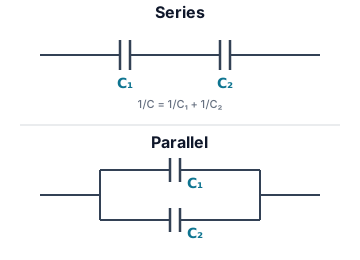
Capacitors in parallel sit across the same two nodes, so every capacitor sees the same voltage. The total stored charge is the sum of each cap's charge, which makes the equivalent capacitance the simple sum. This is the OPPOSITE of resistors, where parallel resistors use the reciprocal sum.
C = C₁ + C₂ + … + Cₙ
Capacitors in Series — Reciprocal Sum
Capacitors in series share a single charge path, so the same charge Q sits on every cap. The voltage divides across them, and the equivalent capacitance is always smaller than the smallest cap in the chain — found by adding reciprocals and inverting. Again the OPPOSITE of resistors, which sum directly in series.
1/C = 1/C₁ + 1/C₂ + … + 1/Cₙ
How It Works
Capacitors combine using the OPPOSITE formulas from resistors — a fact that trips up nearly every student. In parallel, capacitors share the same voltage; charge stored on each cap simply adds (Q = CV), so capacitance ADDS in parallel. In series, the same charge has to flow onto every plate (charge conservation along an isolated wire); the voltage divides, and the equivalent capacitance is the RECIPROCAL sum — always smaller than the smallest cap. Use parallel to get a bigger bulk capacitance (filter caps, decoupling banks) and use series to derate the voltage stress across each cap or to fine-tune the total below a single available value.
Example Problem
You have a 10 μF capacitor and a 20 μF capacitor. Find the equivalent capacitance when they are connected (a) in parallel and (b) in series.
Identify the two capacitances: C₁ = 10 μF and C₂ = 20 μF.
Parallel: C_p = C₁ + C₂ = 10 μF + 20 μF = 30 μF. The bank simply doubles up the plate area, so capacitance grows.
Invert to get C_s: C_s = 20/3 μF = 6.667 μF — smaller than the 10 μF cap, as series combinations always are.
Sanity check with the product-over-sum shortcut for two caps: C_s = C₁·C₂ / (C₁ + C₂) = (10·20) / (10 + 20) = 200/30 ≈ 6.667 μF. ✓
Notice the swap from resistors: 10 Ω and 20 Ω resistors give 30 Ω in series and 6.667 Ω in parallel — exactly the same numbers but in mirror-image circuit positions.
If the same 5 V is applied across both circuits, the parallel bank stores Q = CV = 30 μF · 5 V = 150 μC, while the series bank stores only Q = 6.667 μF · 5 V ≈ 33.3 μC (the same Q sits on each cap, with about 3.33 V across the 10 μF and 1.67 V across the 20 μF).
Key Concepts
Three concepts make the series-vs-parallel choice click. First, charge vs voltage: in parallel the voltage is shared and the charges add; in series the charge is shared and the voltages add. That asymmetry is exactly what flips the formulas relative to resistors. Second, voltage division in series: voltage across each cap is inversely proportional to its capacitance (V_i = Q/C_i), so the smallest cap in a series chain gets the largest share of the total voltage — and is the first to fail if you exceed its rating. Designers either pick caps with margin or add balancing resistors. Third, voltage rating math for series stacks: total rated voltage = N × (lowest cap's rating) in the worst case. Two 100 V caps in series can safely handle about 200 V (ignoring tolerance), which is the whole reason series stacking is used in high-voltage power supplies despite the capacitance penalty.
Applications
Power-supply filter banks — multiple electrolytics in parallel give the bulk capacitance and the lower ESR needed to smooth ripple at high current.
Decoupling networks — pairing a large bulk cap (1 μF) with a small ceramic (100 nF) in parallel covers low-frequency droop and high-frequency noise, because each cap is most effective in its own band.
High-voltage DC links — two or more electrolytic caps in series let a 400 V rail use 250 V parts; balancing resistors keep the voltage split even.
RC timing networks — fine-tuning the time constant when you only have a few standard cap values on hand; combining series/parallel reaches arbitrary C.
AC motor start/run capacitors — sized in microfarads and often combined in parallel for the starting boost.
Snubber networks across switches and relay contacts — pairing a series cap and resistor across the switch to absorb inductive spikes.
Audio crossover networks — series caps form high-pass filters that block DC and low frequencies from the tweeter; parallel caps shape the response curve.
Common Mistakes
Using the resistor formulas — sum-in-series, reciprocal-in-parallel — for capacitors. The capacitor formulas are reversed.
Stacking polarized electrolytics back-to-back without checking polarity. Electrolytics in series must keep their + and − orientations consistent or be paired as a non-polar series stack with both negatives joined.
Ignoring voltage rating when stacking caps in series. The smallest cap takes the largest voltage share; without balancing resistors a stack can fail well below its nameplate sum.
Forgetting tolerance compounds in series — a stack of ±20% electrolytics in series can drift far from the nominal because each cap's voltage share depends on its actual capacitance.
Using 'product over sum' for more than two capacitors in series. The shortcut C = C₁·C₂/(C₁+C₂) only works for two caps; for three or more you must use the full reciprocal sum.
Treating series capacitance like a 'capacity boost' — series combinations always REDUCE total capacitance below the smallest cap. Use parallel if you need more capacitance.
Neglecting leakage and dielectric absorption when stacking caps in series for long-term energy storage; the voltage split will drift over hours unless balanced by resistors.
Frequently Asked Questions
How do you calculate capacitors in parallel?
Add the capacitance values directly: C = C₁ + C₂ + … + Cₙ. Two 10 μF caps in parallel give 20 μF; three 100 nF caps in parallel give 300 nF. Parallel capacitors share the same voltage and their stored charges add, so the equivalent capacitance is the simple sum.
How do you calculate capacitors in series?
Add the reciprocals and invert: 1/C = 1/C₁ + 1/C₂ + … + 1/Cₙ. For two caps the product-over-sum shortcut also works: C = C₁·C₂ / (C₁ + C₂). Series capacitors share the same charge and their voltages add; the equivalent capacitance is always smaller than the smallest cap in the chain.
Why are capacitor formulas the opposite of resistors?
The asymmetry comes from what is shared in each topology. Parallel components share voltage; for resistors that lets currents add (V = IR ⇒ I/V = 1/R sums), while for capacitors it lets charges add (Q = CV ⇒ Q/V = C sums). Series components share current (resistors) or charge (capacitors); the resistor voltage sums directly to give R series, but the capacitor voltage sums as Q/C — making 1/C the additive quantity. Capacitance behaves like the reciprocal of resistance with respect to series-parallel rules.
Does series increase or decrease total capacitance?
Series always DECREASES total capacitance below the smallest cap in the chain. Two identical caps in series give exactly C/2; N identical caps in series give C/N. If you need more capacitance, switch to parallel — that adds the values directly.
How does voltage divide across series capacitors?
The same charge Q sits on every cap in series, and Vᵢ = Q / Cᵢ, so voltage is INVERSELY proportional to capacitance. The smallest cap in the chain takes the largest share of the applied voltage — and is the first to fail if you exceed its rating. High-voltage series stacks usually add balancing resistors in parallel with each cap to keep the voltage split even.
What is the difference between combining capacitors and resistors?
The combination rules are mirror-images. Resistors: SUM in series, RECIPROCAL SUM in parallel. Capacitors: RECIPROCAL SUM in series, SUM in parallel. Numerically, R = 10 Ω with R = 20 Ω gives 30 Ω in series and ~6.67 Ω in parallel; C = 10 μF with C = 20 μF gives 30 μF in parallel and ~6.67 μF in series. Same numbers, swapped topologies.
Can I combine capacitors of different values in series?
Yes — but the voltage will split unevenly. With C₁ = 1 μF and C₂ = 10 μF in series across 110 V, the 1 μF cap sees 100 V while the 10 μF cap sees only 10 V (voltage inversely proportional to capacitance). Check each cap's individual voltage rating, not just the sum, and use balancing resistors for high-voltage applications.
When would I use capacitors in series versus parallel?
Use PARALLEL when you need more total capacitance, lower ESR, or extra filtering bandwidth — typical in power-supply bulk filtering and decoupling. Use SERIES when you need to handle a voltage higher than any single cap can withstand (with balancing), or when you want a smaller equivalent capacitance built from larger available values. Series is also common in DC-blocking applications where you want to derate voltage stress across cheap, high-value caps.
Reference:
Standard electrical-circuit identities: parallel capacitances add (charges sum at common-voltage nodes); series capacitances combine by reciprocal sum (voltages sum across a common-charge path). Inverse of the resistor series-parallel rules.
Capacitor Combination Formulas
The two series–parallel combination rules for capacitors are mirror-images of the rules for resistors — the same shapes, swapped between topologies:
Parallel
C = C₁ + C₂ + … + Cₙ
Series
1/C = 1/C₁ + 1/C₂ + … + 1/Cₙ
Where:
C — the equivalent (combined) capacitance of the network in farads (or any consistent capacitance unit)
C₁, C₂, …, Cₙ — the individual capacitor values, all expressed in the same unit
Parallel — capacitors share the same two nodes and the same voltage; charges add ⇒ capacitance ADDS
Series — capacitors share a charge path; voltages add and the equivalent capacitance is the RECIPROCAL sum, always less than the smallest cap in the chain
Two capacitors in series is common enough that the “product over sum” shortcut applies: C = C₁·C₂ / (C₁ + C₂). For three or more series caps you must use the full reciprocal sum.
Worked Examples
Power Supply Filter Bank
What is the total capacitance of three 1000 μF caps in parallel?
A power-supply designer parallels three 1000 μF electrolytics across the DC rail to drop ESR and raise bulk capacitance.
Identify the three capacitances: C₁ = C₂ = C₃ = 1000 μF.
Parallel formula: C = C₁ + C₂ + C₃.
Substitute: C = 1000 + 1000 + 1000 = 3000 μF.
Convert to a friendlier unit if desired: 3000 μF = 3 mF.
Equivalent capacitance ≈ 3000 μF (3 mF).
Parallel banks of identical caps also drop the equivalent ESR by a factor of N — useful for low-impedance bulk filtering at high currents.
High-Voltage Stacking
How do you handle 600 V with 400 V capacitors?
You need to handle 600 V DC but only have 400 V-rated, 470 μF electrolytics. Stack two in series to share the voltage.
Voltage rating (ignoring tolerance) ≈ 2 × 400 V = 800 V — comfortable margin over 600 V.
Each cap nominally sees half the bus voltage, so add balancing resistors in parallel with each cap (typical: 100 kΩ to 1 MΩ) to keep the split even.
Series stack ≈ 235 μF rated for ~800 V (with balancing).
Series stacks lose half the capacitance to gain double the voltage — the classic tradeoff. Modern film caps simplify HV stacking, but electrolytics still dominate cost-sensitive designs.
Decoupling Network
Why pair a 10 μF cap with a 100 nF cap in parallel?
On a digital board you often see a 10 μF bulk cap parallel with a 100 nF ceramic across every IC power pin.
Two caps in parallel: C₁ = 10 μF, C₂ = 100 nF = 0.1 μF.
Add: C = 10 + 0.1 = 10.1 μF total static capacitance.
The static number isn't the point — at low frequency the 10 μF dominates; at high frequency the 100 nF's lower ESL keeps the impedance low.
The parallel pair has lower impedance across a wider frequency band than either cap alone.
Total static capacitance ≈ 10.1 μF, but the win is bandwidth, not magnitude.
On large parallel cap banks, watch for parallel-resonance peaks between the bulk and bypass caps — pick values an order of magnitude apart and add a small damping resistor if needed.
Resistor vs Capacitor Combination Rules (Side-by-Side)
Topology
Resistors
Capacitors
Series
R = R₁ + R₂ + … (add)
1/C = 1/C₁ + 1/C₂ + … (reciprocal sum)
Parallel
1/R = 1/R₁ + 1/R₂ + … (reciprocal sum)
C = C₁ + C₂ + … (add)
Shared quantity
series: current · parallel: voltage
series: charge · parallel: voltage
The asymmetry comes from what the components share. Parallel elements share voltage in both cases. In series, resistors share current (V sums directly ⇒ R adds), while capacitors share charge (V = Q/C sums ⇒ 1/C adds).
Related Calculators
Capacitor Calculator — compute capacitance, charge, voltage, and stored energy for a single capacitor
Inductor Calculator — inductance of solenoid and flat spiral air-core coils using Wheeler's formula