Annulus Calculator
Area equals pi times the quantity R squared minus r squared
Use this form when both radii of the annulus are known. The annulus is the flat ring between two concentric circles, so its area is just the outer disk's area minus the inner disk's.
A = π(R² − r²)
Use this rearrangement when the ring area and the hole radius (inner) are known and you need the outer radius — for example, sizing a washer to a required bearing surface area around a known bolt hole.
R = √(A/π + r²)
Use this rearrangement when the outer radius and ring area are known and you need the inner radius. The expression under the root must be non-negative — if the requested area exceeds the outer disk's area, no real inner radius exists.
r = √(R² − A/π)
Use this form when you need the radial thickness of the ring — useful for gasket sizing, pipe wall thickness, or washer face width.
w = R − r
An annulus is the flat 2D ring between two concentric circles. Its area is the area of the outer disk (πR²) minus the area of the inner disk (πr²), which factors to A = π(R² − r²). Pick the unknown with the solve-for toggle, enter the remaining values, and the calculator shows the area, outer and inner circumference (2πR and 2πr), and the radial width w = R − r together. The outer radius must be strictly greater than the inner radius — when R = r the ring collapses to a circle of zero area, and when R < r there is no annulus.
A flat steel washer has an outer radius of 5 cm and an inner radius of 3 cm (a 3 cm bolt hole). Compute the face area of the washer, its ring width, and the inner and outer circumferences.
This R > r case is the only valid annulus. When R = r the ring has zero area; when R < r the geometry has no annulus interpretation.
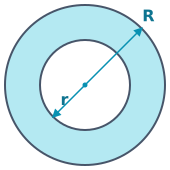
An annulus is defined by two concentric circles with radii R (outer) and r (inner). The area is most easily derived as the difference of the two disk areas: πR² − πr² = π(R² − r²). The ring has two circumferences — an outer one at 2πR and an inner one at 2πr — and a radial width w = R − r. The factored form π(R² − r²) = π(R − r)(R + r) is sometimes useful: it shows that for thin rings (R ≈ r), the area is approximately the width times the mean circumference, A ≈ w · 2π(R + r)/2 = πw(R + r). For a true annulus, R must be strictly greater than r.
An annulus is the flat, two-dimensional ring-shaped region between two concentric circles — like the face of a washer, a CD viewed flat, or a ring road. It is defined by an outer radius R and an inner radius r, with R > r.
Use A = π(R² − r²), where R is the outer radius and r is the inner radius. For R = 5 cm and r = 3 cm, A = π(25 − 9) = 16π ≈ 50.27 cm². You can also factor it as A = π(R − r)(R + r).
Area: A = π(R² − r²). Outer circumference: C_outer = 2πR. Inner circumference: C_inner = 2πr. Ring width: w = R − r. Inverting the area formula gives R = √(A/π + r²) and r = √(R² − A/π).
A circle (or disk) is a filled round region defined by one radius. An annulus is the ring left over when you remove a smaller concentric disk from a larger one. An annulus has a hole in the middle; a disk does not.
Annular geometry appears in washers (the flat ring between the hole and the outer edge), pipe cross-sections (the solid wall between the bore and the outer diameter), flat gaskets, thrust bearings, and any ring-shaped seal or contact surface. Stress, mass, and heat-transfer calculations all start with the annular area.
The ring width is w = R − r — the radial distance between the inner and outer circles. For a washer with R = 5 cm and r = 3 cm, the ring width is 2 cm. This is the dimension you measure across the face of the washer with calipers held radially.
No. By definition R > r for an annulus. If you accidentally swap them, π(R² − r²) becomes negative, which has no geometric meaning for a ring. This calculator rejects inputs where R ≤ r.
Rearrange A = π(R² − r²) to r = √(R² − A/π). The expression under the root must be non-negative — that is, A ≤ πR². If A exceeds the outer disk's area, no real inner radius exists.
Reference:
Weisstein, Eric W. "Annulus." MathWorld — A Wolfram Web Resource. https://mathworld.wolfram.com/Annulus.html
Washer
A plain washer has an outer radius of 5 cm (10 cm OD) and an inner radius of 3 cm (6 cm bolt hole). Compute the contact face area between bolt head and clamped surface.
Face area ≈ 50.27 cm² (≈ 7.79 in²)
This is the canonical example in the Example Problem section above. Bearing-pressure calculations divide the bolt's clamp load by this area.
Pipe Cross-Section
A circular steel pipe has an outer diameter of 75 mm and an inner bore diameter of 60 mm. Compute the solid wall cross-sectional area for stress and mass calculations (use radii, so R = 37.5 mm and r = 30 mm).
Wall area ≈ 1590 mm² (≈ 15.9 cm²)
Multiply by steel density (≈ 7850 kg/m³) and pipe length to get mass per length. Divide axial load by this area for axial stress.
Race Track
A circular running track has an outer kerb at 50 m radius and an inner kerb at 40 m radius. How much surface area does the track itself cover (for resurfacing material estimates)?
Track surface ≈ 2,827 m² (≈ 30,434 ft²)
Tartan and asphalt resurfacing is often priced per m², so this is the headline number. For a single 1.2 m lane on the same track, recompute with R = 41.2 m and r = 40 m.
An annulus is the flat 2D ring between two concentric circles with outer radius R and inner radius r (with R > r).
A = π(R² − r²)
R = √(A/π + r²)
r = √(R² − A/π)
w = R − r
C_outer = 2πR · C_inner = 2πr
Where:
