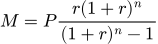
Loan Amortization Formula
Loan amortization splits each monthly payment between interest and principal. Early payments are mostly interest; later payments are mostly principal. The formula ensures the loan is fully paid off by the end of the term.
M = P × r(1+r)ⁿ / ((1+r)ⁿ − 1)
Loan Amount from Payment
Rearranges the amortization formula to find the maximum loan principal you can borrow given a fixed monthly budget, interest rate, and term.
P = M × ((1+r)ⁿ − 1) / (r(1+r)ⁿ)
Loan Term
Back-solves for the number of months needed to pay off a balance given a fixed monthly payment and rate. Useful for debt payoff planning.
n = −ln(1 − Pr/M) / ln(1 + r)
How It Works
Loan amortization splits each monthly payment between interest and principal. Early payments are mostly interest because the outstanding balance is large; as the balance shrinks, more of each payment goes toward principal. The formula M = P × r(1+r)ⁿ / ((1+r)ⁿ − 1) ensures the loan is fully paid off by the end of the term. Total interest paid is (M × n) − P, which often rivals or exceeds the loan amount itself on long-term or high-rate loans.
Example Problem
A $25,000 auto loan at 7% annual interest for 5 years. Calculate the monthly payment and total interest.
- Identify the formula: M = P × r(1+r)ⁿ / ((1+r)ⁿ − 1).
- Convert the annual rate to a monthly rate: r = 7 / 12 / 100 = 0.005833.
- Convert the term to months: n = 5 × 12 = 60.
- Compute (1 + r)ⁿ = (1.005833)^60 ≈ 1.41906.
- Monthly payment: M = $25,000 × (0.005833 × 1.41906) / (1.41906 − 1) ≈ $495.03.
- Total interest over the life of the loan: ($495.03 × 60) − $25,000 ≈ $4,702.
The same loan at a 9% rate would cost $519/month and total $6,137 in interest — a 1-percentage-point difference in rate typically shifts total interest by several hundred dollars on a 5-year note.
When to Use Each Variable
- Solve for Monthly Payment — when you know the loan amount, interest rate, and term, e.g., estimating the monthly cost of a car loan or mortgage.
- Solve for Loan Amount — when you know how much you can afford monthly and want to find the maximum loan size, e.g., setting a home-buying budget.
- Solve for Loan Term — when you know the loan amount, rate, and desired payment and want to find how long the payoff will take.
Key Concepts
Loan amortization splits each payment between interest and principal repayment. Early payments are mostly interest because the outstanding balance is large. As the balance shrinks, more of each payment goes toward principal. The amortization formula M = P × r(1+r)ⁿ / ((1+r)ⁿ − 1) ensures the loan is fully paid off by the last scheduled payment. Total interest cost is highly sensitive to both the interest rate and the loan term — stretching a loan to lower the monthly payment always raises total interest.
Applications
- Home buying: calculating monthly mortgage payments for different loan amounts and terms
- Auto loans: comparing payment amounts for 36, 48, 60, and 72-month financing options
- Student loans: projecting total interest cost under standard, extended, and income-driven repayment plans
- Small business: sizing equipment and working-capital loans against expected cash flow
- Debt payoff planning: determining how extra payments reduce total interest and shorten the payoff timeline
- Loan comparison: evaluating the true cost of offers with different rates, terms, and fees
Common Mistakes
- Using the annual interest rate directly — the formula requires the monthly rate (annual rate divided by 12)
- Forgetting that longer terms mean lower payments but much higher total interest — a 30-year loan pays nearly double the interest of a 15-year loan
- Ignoring property taxes, insurance, and fees — the loan payment formula calculates principal and interest only; the true cost of owning a home or car is always higher
- Comparing only monthly payments between offers — a longer-term loan with a lower monthly payment can easily cost thousands more in total interest
- Confusing APR with interest rate — APR includes origination fees and mortgage insurance, giving a truer comparison between lenders
Frequently Asked Questions
How is a monthly loan payment calculated?
Use the amortization formula M = P × r(1+r)ⁿ / ((1+r)ⁿ − 1), where P is the loan amount, r is the monthly interest rate (annual rate ÷ 12 ÷ 100), and n is the total number of monthly payments (years × 12). For example, $20,000 at 6% for 5 years gives r = 0.005, n = 60, and M ≈ $386.66/month.
How much interest will I pay over the life of a loan?
Multiply the monthly payment by the total number of payments, then subtract the original loan amount: Total interest = (M × n) − P. A $200,000 loan at 6.5% for 30 years carries a $1,264 payment and about $255,089 in total interest — more than the loan itself. Shorter terms and lower rates both dramatically reduce this number.
Does making extra payments reduce total interest?
Yes. Extra payments apply directly to principal, shrinking the balance faster and cutting every future interest charge. Even an extra $50/month on a 30-year mortgage can shave years off the term and save tens of thousands in interest. Check your loan agreement first — most US consumer loans prohibit prepayment penalties, but some business and mortgage products do not.
What is the difference between interest rate and APR?
The interest rate is the cost of borrowing the principal, expressed as a yearly percentage. APR (annual percentage rate) adds origination fees, discount points, and mortgage insurance, giving a more complete picture of the loan's true cost. Use APR when comparing offers from different lenders.
Should I choose a shorter or longer loan term?
Shorter terms have higher monthly payments but far less total interest. A $25,000 auto loan at 7% costs $495/month for 60 months ($4,700 interest) or $395/month for 84 months ($8,200 interest) — the longer term saves $100/month but nearly doubles the interest cost. Pick the shortest term whose payment fits your budget comfortably.
What credit score do I need to get the best loan rates?
Most lenders reserve their best advertised rates for borrowers with FICO scores of 740 or higher. Scores of 670–739 typically qualify for slightly higher rates, while 620–669 is considered subprime and can add 1–3 percentage points. Boosting your score before applying is often the single biggest lever for lowering total interest.
Can I pay off a loan early?
Yes, in most cases. Federal law bans prepayment penalties on residential mortgages for borrowers with qualified loans. Auto and personal loans typically allow early payoff without penalty, but always confirm in writing. Paying off a loan early saves all remaining interest — often thousands of dollars.
Reference:
Brealey, R., Myers, S., & Allen, F. Principles of Corporate Finance. McGraw-Hill Education.
Loan Payment Formula
The loan amortization formula computes the fixed monthly payment needed to fully pay off a loan over a chosen term:
M = P × r(1+r)n / ((1+r)n − 1)
Where:
- M — monthly payment, in dollars ($)
- P — principal (loan amount), in dollars ($)
- r — monthly interest rate (annual rate ÷ 12 ÷ 100), as a decimal
- n — total number of monthly payments (years × 12)
Total interest over the life of the loan is simply (M × n) − P. The formula assumes equal monthly payments and a fixed rate; adjustable-rate loans, balloon payments, and extra principal payments all change the schedule.
Worked Examples
Personal Finance
How much does a $28,000 car loan cost at 6% for 60 months?
A buyer finances $28,000 for a new car at 6% annual interest over 5 years (60 payments). What is the monthly payment and total interest?
- Monthly rate: 6 / 12 / 100 = 0.005
- n = 60 months; (1.005)^60 ≈ 1.34885
- M = $28,000 × (0.005 × 1.34885) / (1.34885 − 1)
- Total interest: $541.32 × 60 − $28,000 = $4,479
M ≈ $541.32/month
Extending to 72 months drops the payment to about $464 but raises total interest to $5,422 — a common trade-off buyers face at the dealership.
Small Business
What is the monthly payment on a $75,000 equipment loan at 9% for 7 years?
A small manufacturer borrows $75,000 to buy a CNC machine at 9% annual interest, amortized over 84 months.
- Monthly rate: 9 / 12 / 100 = 0.0075
- n = 84; (1.0075)^84 ≈ 1.8732
- M = $75,000 × (0.0075 × 1.8732) / (1.8732 − 1)
- Total interest: ≈ $26,340
M ≈ $1,206.43/month
Equipment loans are often a hedge between operating cash and taking on a bigger line of credit. Comparing total interest to the machine's expected additional revenue gives a clean return-on-investment check.
Education
How long will it take to pay off $40,000 in student loans at $450/month?
A graduate owes $40,000 at 6.5% annual interest and can afford $450/month. How many years until the balance reaches zero?
- Formula: n = −ln(1 − Pr/M) / ln(1+r), where r is monthly
- r = 6.5 / 1200 = 0.005417
- Pr/M = $40,000 × 0.005417 / $450 ≈ 0.4815
- n = −ln(0.5185) / ln(1.005417) ≈ 121.5 months
≈ 10.1 years
Adding just $50/month ($500 total) drops the payoff to about 8.5 years and cuts roughly $3,900 in total interest. Small extra payments compound into large lifetime savings.
Related Calculators
- Mortgage Loan Calculator — dedicated mortgage payment calculator
- Interest Rate Calculator — compute simple and compound interest
- Loan to Value Calculator — assess LTV ratio for lending
- Compounding & Discount Factors Calculator — time-value-of-money factors behind loan math
- Rule of 72 Calculator — estimate how quickly debt doubles at a given rate
Related Sites
- Dollars Per Hour — Weekly paycheck calculator with overtime
- OptionsMath — Options trading profit and loss calculators
- Percent Off Calculator — Discount and sale price calculator
- CameraDOF — Depth of field calculator for photographers
- Medical Equations — Hemodynamic, pulmonary, and dosing calculators
- InfantChart — Baby and child growth percentile charts