Wing Lift Calculator
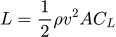
Lift equals one half times density times velocity squared times area times lift coefficient
The lift equation determines the aerodynamic lift generated by a wing. Lift depends on air density (ρ), airspeed (v), wing area (A), and the lift coefficient (C_L). Doubling the airspeed quadruples the lift.
L = ½ρv²AC_L
The lift equation L = ½ρv²AC_L determines the aerodynamic lift generated by a wing. Lift depends on air density (ρ), airspeed (v), wing area (A), and the lift coefficient (C_L). Doubling the airspeed quadruples the lift because lift is proportional to v². Standard sea-level air density is 1.225 kg/m³.
A small aircraft wing has A = 16 m², C_L = 1.2, and flies at 60 m/s at sea level (ρ = 1.225 kg/m³). What lift does it generate?
That is about 4,318 kgf of lift — enough for a light aircraft.
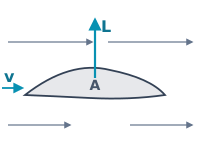
Lift results from the pressure difference between the upper and lower surfaces of a wing. The lift equation combines this into a single coefficient (C_L) that depends on airfoil shape, angle of attack, and Reynolds number. Lift scales with velocity squared, so doubling speed quadruples lift — which is why takeoff requires reaching a specific minimum airspeed.
Four forces act on an airplane in flight: lift (upward, from the wings), weight (downward, from gravity), thrust (forward, from the engines), and drag (rearward, from air resistance). In steady level flight, lift exactly equals weight and thrust equals drag. The lift equation L = ½ρv²AC_L quantifies the upward force from the wings.
Lift is directly proportional to wing area (A). Doubling the planform area doubles the lift at the same speed, density, and angle of attack. That is why short takeoff aircraft use large wings, and why retractable flaps increase wing area at low speeds to enable slower landings.
Stall speed (V_S) is the minimum speed at which a wing can generate enough lift to support the aircraft's weight at the maximum lift coefficient. Cruise speed is typically 1.3–2× V_S, flown at a lower C_L where drag is minimized. A 1,100 kg trainer with A = 16 m² and C_L max = 1.6 stalls near 26 m/s (≈ 51 kt) but cruises at 55–60 m/s.
Wing loading is weight divided by wing area (W/A, typically in kg/m² or lb/ft²). Higher wing loading means higher stall speed and rougher ride in turbulence but better high-speed penetration. Light trainers run ~60 kg/m²; airliners 500–700 kg/m²; fighter jets over 400 kg/m². It is the single most important parameter for sizing a wing.
C_L is a dimensionless number that describes how effectively an airfoil generates lift at a given angle of attack and Reynolds number. Typical cruise values are 0.2–0.5; values near stall are 1.2–1.6 for plain wings and up to 2.5–3.5 with high-lift flaps deployed. It is measured in wind tunnels or computed with CFD.
Lift rises linearly with angle of attack (AoA) up to about 15–18°, then drops sharply as the airflow separates — this is the stall. Pilots control lift primarily by pitching the nose up or down, which changes AoA and therefore C_L. Most of the flight envelope operates at small AoA (2–6°) where the lift curve is linear and drag is low.
Flaps increase both the effective wing area and the lift coefficient by increasing camber (curvature) at the trailing edge. Leading-edge slats delay stall by energizing the boundary layer. Together they can roughly double C_L, allowing takeoff and landing at speeds 30–40% slower than the clean-wing stall speed.
Reference:
Lindeburg, Michael R. 1992. Engineer In Training Reference Manual. Professional Publication, Inc. 8th Edition.
The aerodynamic lift of a wing, rotor, or fin in a fluid flow is:
Where:
Lift scales with velocity squared, so doubling speed quadruples lift — which is why takeoff speed is so specific, and why a low-speed stall can drop the wing suddenly once C_L peaks near 15–18° angle of attack.
Commercial Aviation — Cruise Lift
A narrow-body airliner has A = 125 m², cruises at v = 230 m/s (about Mach 0.78) at 11,000 m where ρ ≈ 0.365 kg/m³, and flies at C_L ≈ 0.5 for level flight.
L ≈ 603,000 N (~61,500 kgf)
That matches the weight of a loaded 737, confirming equilibrium cruise. At lower altitudes the same C_L produces more lift — pilots trim to a lower AoA or fly faster to compensate.
General Aviation — Stall Speed Check
Stall occurs when the wing reaches its maximum lift coefficient. Solve for the speed where lift equals weight (10,791 N) at sea-level density 1.225 kg/m³.
v ≈ 26.2 m/s (~51 kt)
Trainers are typically placarded with a published V_S slightly above this value to give a margin for maneuvering loads.
Wind Turbine Blade Design — Airfoil Sizing
Wind turbines use airfoils optimized at high C_L. A blade-element designer needs a section that generates L = 5,000 N at v = 70 m/s, ρ = 1.225 kg/m³, and C_L = 1.1 (typical for an S-series airfoil).
A ≈ 1.51 m²
For a 1.5 m chord that implies a ~1 m span per element — the designer integrates contributions along the full blade to match turbine torque and power targets.
Reference: Lindeburg, Michael R. 1992. Engineer In Training Reference Manual. Professional Publication, Inc. 8th Edition.