Bernoulli Theorem Calculator
P1 equals rho g times (P2 over rho g plus V2 squared minus V1 squared over 2g plus Z2 minus Z1 plus h)
Bernoulli’s equation balances pressure energy, kinetic energy, and potential energy between two points along a streamline in a steady, incompressible flow. The head loss term captures real-world friction and turbulence losses.
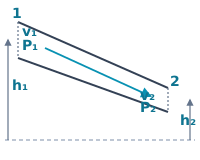
P₁ + ½ρV₁² + ρgZ₁ = P₂ + ½ρV₂² + ρgZ₂ + ρgh
Bernoulli’s equation balances pressure energy, kinetic energy, and potential energy between two points along a streamline in a steady, incompressible flow. When one form of energy increases, the others decrease to keep the total constant. The head loss term captures real-world friction and turbulence losses that the ideal equation ignores.
Water (density 1,000 kg/m³) flows through a horizontal pipe. At point 1 the pressure is 200,000 Pa and velocity is 2 m/s. At point 2 the velocity is 4 m/s. Both elevations are equal and head loss is zero. What is the pressure at point 2?
Bernoulli's equation is an energy conservation statement for fluid flow: the sum of pressure energy, kinetic energy, and potential energy remains constant along a streamline in ideal flow. The head loss term extends the equation to real fluids where friction and turbulence dissipate energy. Density must remain constant (incompressible flow), which is valid for most liquid flows and low-speed gas flows below Mach 0.3.
Bernoulli's principle — faster-moving fluid has lower pressure — explains why airplane wings generate lift, why shower curtains get sucked in when the water runs, why a spinning soccer ball curves (Magnus effect), why two parked semi-trucks pull toward each other as a third rushes past, and why the top of a tornado has dramatically lower pressure than the surrounding air. Anywhere fluid speeds up or slows down, a pressure change comes along for the ride.
Because mass has to be conserved. The continuity equation A₁V₁ = A₂V₂ says that for an incompressible fluid, the volume per second flowing through any cross-section is the same. When the pipe area halves, the velocity must double to carry the same flow rate. Bernoulli's equation then predicts the pressure drop that accompanies this speed-up: pressure energy is literally converting into kinetic energy.
It relates pressure, velocity, and elevation at two points in a fluid flow. Engineers use it to size pipes and pumps, design Venturi and orifice flow meters, predict pressure drops through nozzles and valves, analyze siphons and open-channel flow, and as a first-order model for airfoil lift. Coupled with continuity and head-loss correlations, it is the workhorse equation for most of civil and mechanical fluid engineering.
It works for low-speed gas flows where density changes are negligible — typically below Mach 0.3 (about 100 m/s in air). Above that, density varies significantly with pressure and the incompressible assumption breaks down; you need the compressible energy equation with enthalpy terms instead. For HVAC, low-speed wind engineering, and subsonic aircraft performance at low speeds, Bernoulli's equation is accurate enough.
Head loss varies widely. A 100 m run of 50 mm steel pipe carrying water at 2 m/s may lose 5–15 m of head depending on roughness and fittings. Rules of thumb: 1–5 m per 100 m for smooth plastic, 5–15 m per 100 m for old steel, plus 0.5–3 m per fitting (elbows, tees, valves). Use the Darcy-Weisbach equation with a Moody-chart friction factor for precise estimates.
The equation assumes (1) steady flow — velocities and pressures don't change in time, (2) incompressible flow — density is constant, (3) inviscid flow — no friction (the head-loss term patches this), (4) flow along a streamline — both points are on the same streamline, and (5) no energy added or removed (no pumps, turbines, or heat exchange) between the two points. For pumps/turbines, add an energy term explicitly.
Static pressure (P) is what a pressure gauge flush to the flow reads — the pressure the fluid exerts on its surroundings. Dynamic pressure (½ρV²) is the kinetic energy per unit volume — what a pressure gauge would read if you stagnated the flow. Total (or stagnation) pressure (P + ½ρV²) is their sum and remains constant along a streamline in frictionless flow. Pitot tubes exploit this: the difference between total and static pressure gives the flow velocity.
Reference:
Tipler, Paul A. 1995. Physics For Scientists and Engineers. Worth Publishers. 3rd ed. — fluid dynamics chapter covering Bernoulli's equation.
Bernoulli's equation is a statement of conservation of energy along a streamline in a steady, incompressible, inviscid flow. With an extra head-loss term to handle real-world friction, it takes the form:
Where:
Each term has units of pressure (Pa = J/m³), so Bernoulli's equation is literally an energy balance: static pressure energy plus kinetic energy (½ρV²) plus gravitational potential energy (ρgZ) stays constant along a streamline, minus any energy dissipated as head loss.
Aviation — Wing Lift via Pressure Difference
A Cessna wing cruises at V₁ = 60 m/s free-stream. Over the upper surface, the air accelerates to V₂ = 72 m/s. Air density is 1.225 kg/m³. Both points are at the same altitude (no Z term) and friction losses are negligible. Solve for P₂ given P₁ = 101,325 Pa.
P₂ ≈ 100,355 Pa — a 970 Pa drop
That 970 Pa differential acts over every square meter of wing, so a 16 m² wing sees roughly 15,500 N of total lift from this one mechanism — the essence of Bernoulli-based airfoil theory.
Plumbing — Garden Hose Nozzle Pressure
A garden hose supplies water at P₁ = 300,000 Pa and V₁ = 1 m/s. At the nozzle exit the water discharges to atmosphere (P₂ = 101,325 Pa) at the same elevation (Z₁ = Z₂) with negligible head loss. ρ = 1,000 kg/m³. Solve for V₂.
V₂ ≈ 19.96 m/s (≈ 45 mph)
Real hoses lose 20–40% of this theoretical velocity to friction and turbulence through the narrowing — include a head-loss term of 5–10 m of water to match field measurements.
Meteorology — Wind Funnelling Between Buildings
Wind approaches at 8 m/s through an open plaza (P₁ = 101,325 Pa). It accelerates to 20 m/s between two adjacent skyscrapers. Both points are at the same elevation. Air density is 1.225 kg/m³. Solve for the pressure between the buildings.
P₂ ≈ 101,119 Pa — a 206 Pa drop
That 206 Pa is enough to pull doors open, whistle through gaps, and lift loose paper — the “urban canyon effect” that makes certain downtown corners notoriously gusty. City planners use CFD with Bernoulli's equation as a sanity check during design.
