Venturi Meter Calculator
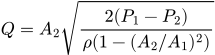
Flow rate equals throat area times the square root of two times pressure difference divided by density times one minus the area ratio squared
The Venturi meter equation derives from Bernoulli's principle and the continuity equation. As fluid speeds up through the narrow throat, its pressure drops. Measuring the pressure difference between the wide section and throat gives the flow rate. This calculator uses the ideal equation (C_d = 1); multiply by 0.95–0.99 for real-world accuracy.
Q = A₂ √(2ΔP / ρ(1 − (A₂/A₁)²))
A Venturi meter measures flow by creating a pressure drop through a pipe constriction. As fluid speeds up through the narrow throat (continuity equation), its pressure drops (Bernoulli's principle). Measuring the pressure difference between the wide section and throat gives the flow rate. This calculator uses the ideal equation (C_d = 1); multiply by 0.95–0.99 for real-world accuracy.
Water (ρ = 1,000 kg/m³) flows through a Venturi meter with pipe area A₁ = 0.01 m² and throat area A₂ = 0.004 m². The pressure difference is 20,000 Pa. What is the flow rate?
The Venturi meter applies Bernoulli's principle and the continuity equation. As fluid enters the narrower throat, velocity increases and static pressure drops proportionally. The pressure differential between the wide section and throat is directly related to flow rate, making it a reliable non-intrusive measurement device.
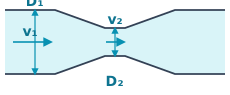
Fluid accelerates through a constriction (the throat), causing pressure to drop per Bernoulli's principle. Two pressure taps — one in the wide section and one at the throat — connect to a differential pressure gauge. The pressure difference is converted to flow rate using the Venturi equation. No moving parts means no wear and minimal maintenance.
Venturi meters have a gradual converging-diverging shape that recovers most of the pressure drop, resulting in only 10–15% permanent pressure loss compared to 40–60% for orifice plates. They also have a higher discharge coefficient (0.95–0.99 vs. 0.60–0.65) and handle dirty or particle-laden fluids better because there are no sharp edges to erode.
Typically 0.95–0.99 depending on manufacturing quality and Reynolds number. A machined Venturi with smooth convergence has C_d near 0.99; a rough-cast version may be 0.95. This calculator uses the ideal value of 1.0 — multiply the result by your meter's C_d for real-world accuracy.
Use the equation Q = A₂ × √(2ΔP / (ρ(1 − (A₂/A₁)²))), where A₁ is the pipe area, A₂ is the throat area, ΔP is the measured pressure difference, and ρ is the fluid density. Multiply by the discharge coefficient C_d for real-world accuracy.
The beta ratio (β = d₂/d₁, the diameter ratio) typically ranges from 0.4 to 0.75. A smaller beta creates a larger pressure drop (easier to measure) but higher permanent loss. Most industrial Venturi meters use β ≈ 0.5–0.6 as a balance between measurement sensitivity and energy efficiency.
Yes, but only for low-speed gas flows where compressibility effects are negligible (Mach number < 0.3). For higher-speed gas flows, you need an expansion factor correction. The basic incompressible equation used in this calculator applies directly to liquids and low-speed gases.
A properly installed Venturi meter achieves ±0.5–1% accuracy for liquid flow measurement. Accuracy depends on adequate straight pipe upstream (10–20 diameters), proper pressure tap placement, and a well-characterized discharge coefficient. Calibration against a reference standard further improves accuracy.
The Venturi meter flow equation derives from Bernoulli's principle and the continuity equation:
Where:
This is the ideal equation with discharge coefficient Cd = 1. For real-world accuracy, multiply the result by the meter's Cd (typically 0.95–0.99).
Water Treatment
A water treatment plant uses a Venturi meter with pipe area A₁ = 0.05 m² and throat area A₂ = 0.02 m². The differential pressure gauge reads 5,000 Pa and water density is 1,000 kg/m³.
Q ≈ 0.0690 m³/s (69 L/s)
With a typical C_d of 0.98, the actual flow is about 0.0676 m³/s.
Oil & Gas
Crude oil (ρ = 850 kg/m³) flows at Q = 0.05 m³/s through a Venturi meter with A₁ = 0.04 m² and A₂ = 0.015 m². What is the expected differential pressure?
ΔP ≈ 4,058 Pa
This moderate pressure drop confirms the Venturi's advantage over an orifice plate, which would waste 40–60% of this energy permanently.
HVAC
An HVAC Venturi meter in a duct has A₁ = 0.1 m², A₂ = 0.04 m², measured ΔP = 200 Pa, and Q = 0.8 m³/s. What is the air density?
ρ ≈ 1.19 kg/m³
This matches the density of air at sea level and about 20°C, confirming the Venturi readings are consistent.