Orifice Flow Design Calculator
Flow rate equals discharge coefficient times orifice area times square root of two times gravity times head
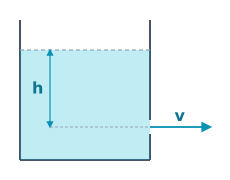
The orifice equation calculates flow through a sharp-edged opening under gravity. The discharge coefficient (Cd) accounts for real-world losses from friction and flow contraction (vena contracta). Sharp-edged orifices typically have Cd ≈ 0.62; rounded entrances reach 0.95–0.99.
Q = Cd × A × √(2gH)
The orifice equation Q = Cd × A × √(2gH) calculates flow through a sharp-edged opening under gravity. The discharge coefficient (Cd) accounts for real-world losses from friction and flow contraction (vena contracta). Sharp-edged orifices typically have Cd ≈ 0.62; rounded entrances reach 0.95–0.99.
A sharp-edged orifice (Cd = 0.62) has a diameter of 50 mm and a head of 3 m. What is the flow rate?
A simpler example: Cd = 0.62, A = 0.01 m², H = 2 m → Q = 0.62 × 0.01 × √(39.24) = 0.0388 m³/s.
The orifice flow equation derives from Bernoulli's principle and Torricelli's theorem. The discharge coefficient (Cd) corrects for real-world effects: flow contraction at the vena contracta and frictional losses. Sharp-edged orifices have Cd around 0.62 because the jet contracts to about 62% of the orifice area. Well-rounded or bell-mouth entrances approach Cd = 1.0 by minimizing contraction.
Flow rate is directly proportional to orifice area. Doubling the orifice area doubles the flow rate (at the same head and Cd). Since area scales with the square of diameter, doubling the orifice diameter quadruples the flow rate.
A sharp-edged circular orifice in a large tank has Cd ≈ 0.61–0.65, with 0.62 being the most commonly used design value. The exact value depends on the Reynolds number and the ratio of orifice size to tank size. Well-rounded entrances can reach Cd = 0.95–0.99.
Cd accounts for energy losses as fluid passes through the opening. A sharp-edged orifice has Cd ≈ 0.61–0.65. Well-rounded entrances approach 0.95–0.99.
An orifice is a thin plate with a hole; a nozzle has a converging profile that guides flow smoothly. Nozzles have higher discharge coefficients (0.95+) because they reduce turbulence and flow separation.
Orifice plates installed in pipelines create a measurable pressure drop proportional to flow rate squared. By measuring the differential pressure, engineers can accurately determine the flow rate using a calibrated Cd.
The vena contracta is the narrowest point of the fluid jet downstream of the orifice, where the streamlines are most contracted. For a sharp-edged orifice, the jet area at the vena contracta is about 62% of the orifice area, which is why Cd ≈ 0.62.
Temperature affects viscosity, which in turn affects the discharge coefficient slightly. For most engineering calculations with water between 5–40 °C, the change in Cd is small (< 2%) and the standard value of 0.62 is adequate. For very viscous fluids or extreme temperatures, apply a Reynolds number correction.
The orifice equation derives from Bernoulli's principle and Torricelli's theorem:
Where:
The discharge coefficient corrects for real-world effects: flow contraction at the vena contracta (where the jet narrows downstream of the orifice) and frictional losses. Sharp-edged orifices have Cd around 0.62; well-rounded entrances approach 1.0.
Dam Outlets
A reservoir has a 300 mm diameter circular outlet (C_d = 0.62) with 5 m of head above the centerline. What is the flow rate?
Q = 0.434 m³/s (434 L/s)
This simple estimate ignores approach velocity and head losses in the conduit. For precise reservoir design, apply a velocity-of-approach correction.
Flow Measurement
An orifice plate (C_d = 0.62) must pass 0.05 m³/s with an available head of 3 m. What area is required?
A = 0.01051 m² (diameter ≈ 116 mm)
In practice, round up to the nearest standard pipe size. Recalculate the actual flow rate with the chosen area.
Tank Drainage
A tank drains through a 50 mm sharp-edged orifice (A = 0.001963 m², C_d = 0.62) at 0.005 m³/s. What head is required?
H = 0.857 m
As the tank level drops, the head decreases and so does the flow rate. For time-to-drain calculations, integrate the flow rate over the changing head.
