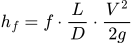
Darcy-Weisbach Equation
The Darcy-Weisbach equation calculates frictional head loss in pipes by combining the friction factor, pipe geometry, and velocity head. Works for both laminar and turbulent flow.
h_f = f × (L/D) × (V²/2g)
How It Works
The Darcy-Weisbach equation calculates frictional head loss in pipes by combining the friction factor, pipe geometry (length and diameter), and the velocity head (V²/2g). It works for both laminar and turbulent flow, making it the most general pipe friction formula available. The friction factor is found from the Colebrook equation or Moody chart.
Example Problem
Water flows at 2 m/s through a 100 m long, 100 mm diameter pipe with a Darcy friction factor of 0.02 and g = 9.81 m/s². What is the frictional head loss?
- Identify the known values: f = 0.02, L = 100 m, D = 0.1 m, V = 2 m/s, g = 9.81 m/s².
- Determine what we are solving for: the frictional head loss h_f.
- Calculate the length-to-diameter ratio: L/D = 100 / 0.1 = 1,000.
- Calculate the velocity head: V²/(2g) = 4 / 19.62 = 0.2039 m.
- Substitute into the Darcy-Weisbach equation: h_f = 0.02 × 1,000 × 0.2039.
- Compute the result: h_f ≈ 4.08 m of head loss. A pump must supply at least this much additional head to overcome friction.
Key Concepts
The Darcy-Weisbach equation h_f = f(L/D)(V²/2g) is the most general pipe friction formula, valid for any Newtonian fluid in both laminar and turbulent flow. Head loss is proportional to pipe length and the square of velocity, and inversely proportional to pipe diameter. The Darcy friction factor f must be determined separately — from f = 64/Re for laminar flow or from the Colebrook equation (or Moody chart) for turbulent flow.
Applications
- Water distribution: calculating pressure losses in municipal water supply networks
- HVAC piping: sizing hot-water and chilled-water piping for building mechanical systems
- Oil and gas: predicting pumping power requirements for long-distance crude oil pipelines
- Chemical processing: determining pressure drops in process piping for reactor feed and product lines
Common Mistakes
- Confusing Darcy friction factor with Fanning friction factor — Darcy f = 4 × Fanning f; using the wrong one gives head loss off by a factor of 4
- Forgetting minor losses — the Darcy-Weisbach equation only covers straight-pipe friction; fittings, valves, and bends add additional head loss
- Using flow velocity when the formula expects mean pipe velocity — velocity must be Q/A, the average over the full cross-section
- Applying the equation to open-channel flow — Darcy-Weisbach is for closed conduits; use Manning or Chezy for open channels
Frequently Asked Questions
What causes pressure drop in a pipe and how do you predict it?
Pressure drop is caused by friction between the flowing fluid and the pipe wall. The Darcy-Weisbach equation h_f = f(L/D)(V²/2g) predicts how much energy the fluid loses to friction. Longer pipes, smaller diameters, rougher surfaces, and higher velocities all increase the loss.
How does pipe diameter affect the Darcy-Weisbach head loss?
Head loss is inversely proportional to pipe diameter. Doubling the diameter reduces head loss by a factor of 2 for the same velocity. In practice the effect is even larger because a bigger pipe carries the same flow rate at a lower velocity, and head loss depends on V².
What is the Darcy-Weisbach equation?
h_f = f(L/D)(V²/2g) predicts pressure loss due to friction as fluid flows through a pipe. It applies to any Newtonian fluid and both laminar and turbulent regimes.
How do I find the Darcy friction factor?
For laminar flow (Re < 2,300), f = 64/Re. For turbulent flow, use the Colebrook equation or Moody chart. Our Colebrook calculator can compute this for you directly.
What is the difference between major and minor losses?
Major losses come from pipe wall friction (Darcy-Weisbach). Minor losses come from fittings, valves, and bends. In long pipelines, major losses dominate; in compact systems with many fittings, minor losses can be equally significant.
Darcy-Weisbach vs. Hazen-Williams: which should I use?
Darcy-Weisbach is more general and works for any fluid and flow regime. Hazen-Williams is simpler but only valid for water near room temperature in turbulent flow. For engineering rigor, Darcy-Weisbach is preferred.
Why does head loss increase with the square of velocity?
Fluid friction is a dynamic process — the drag force on the pipe wall grows roughly as V². This means doubling the flow velocity quadruples the head loss. That is why engineers upsize pipes: a modest diameter increase dramatically reduces pumping costs.
Darcy-Weisbach Formula
The Darcy-Weisbach equation is the most general formula for calculating frictional head loss in pipe flow:
hf = f × (L / D) × (V² / 2g)
Where:
- hf — frictional head loss, measured in meters (m)
- f — Darcy friction factor, dimensionless (from Moody chart or Colebrook equation)
- L — pipe length, measured in meters (m)
- D — pipe inner diameter, measured in meters (m)
- V — average flow velocity, measured in meters per second (m/s)
- g — gravitational acceleration, 9.81 m/s²
Head loss is proportional to pipe length and the square of velocity, and inversely proportional to pipe diameter. The equation is valid for any Newtonian fluid in both laminar and turbulent flow regimes.
Worked Examples
Municipal Water
How much pressure head is lost in a city water main?
A 300 mm diameter ductile iron pipe carries water at 1.5 m/s over a 500 m run. The friction factor is 0.018. What is the head loss?
- L/D = 500 / 0.3 = 1,667
- V²/(2g) = 1.5² / (2 × 9.81) = 0.1147 m
- h = 0.018 × 1,667 × 0.1147
h ≈ 3.44 m
This head loss must be overcome by the pump. Actual system losses include minor losses from valves and fittings.
HVAC Engineering
What is the friction head loss in a chilled water riser?
A 50 mm steel pipe carries chilled water at 0.8 m/s vertically for 30 m. The Darcy friction factor is 0.025. What is the frictional head loss?
- L/D = 30 / 0.05 = 600
- V²/(2g) = 0.64 / 19.62 = 0.0326 m
- h = 0.025 × 600 × 0.0326
h ≈ 0.489 m
For HVAC design, this loss is added to fitting losses and equipment pressure drops to size the circulating pump.
Chemical Process
How much head loss occurs in a reactor feed pipeline?
A 150 mm schedule-40 pipe carries process fluid at 3 m/s over 200 m with f = 0.022. Find the head loss.
- L/D = 200 / 0.15 = 1,333
- V²/(2g) = 9 / 19.62 = 0.4587 m
- h = 0.022 × 1,333 × 0.4587
h ≈ 13.45 m
High head losses indicate the need for a larger pipe diameter or lower flow velocity to reduce pumping costs.
Related Calculators
- Colebrook Equation Calculator — find the friction factor needed for this equation
- Minor Losses Calculator — calculate head loss from fittings and valves
- Bernoulli Theorem Calculator — full energy balance including pressure, velocity, and elevation
- Reynolds Number Calculator — determine flow regime for friction factor selection
- Pressure Converter — convert between Pa, psi, bar, and other pressure units
Related Sites
- Temperature Tool — Temperature unit converter
- LoanChop — Loan prepayment calculator
- Z-Score Calculator — Z-score, percentile, and probability calculator
- InfantChart — Baby and child growth percentile charts
- Dollars Per Hour — Weekly paycheck calculator with overtime
- Medical Equations — Hemodynamic, pulmonary, and dosing calculators