
Wavelength from speed and frequency
Divide wave speed by frequency to get wavelength — the physical distance between successive crests. Works for any wave: light in vacuum (v = c), sound in air, ripples on water, or seismic waves.
λ = v / f
Frequency from speed and wavelength
Divide wave speed by wavelength to get frequency in hertz (cycles per second). Use this to find the pitch of a sound, the frequency of a radio signal, or the colour of a light beam given its wavelength.
f = v / λ
Wave speed from frequency and wavelength
Multiply frequency and wavelength to get propagation speed. For light in vacuum this is the constant c ≈ 2.998 × 10⁸ m/s; for sound it depends on the medium (about 343 m/s in 20 °C air, 1,480 m/s in water).
v = f × λ
Period from frequency
The period is the time for one full cycle, the reciprocal of frequency. A 60 Hz AC line has T ≈ 16.7 ms; a 1 kHz tone has T = 1 ms; visible light (~5 × 10¹⁴ Hz) has T ≈ 2 fs.
T = 1 / f
How It Works
The universal wave equation v = f × λ relates three quantities: wave speed v (m/s), frequency f (Hz), and wavelength λ (m). The period T = 1 / f is the time for one complete cycle. Together these four numbers describe any periodic wave — light, sound, water ripples, radio, seismic, even quantum-mechanical matter waves. Pick a quantity to solve for, enter the other two (just one, for the period), and the calculator returns the answer plus the full supplementary panel showing v, f, λ, T, and the angular frequency ω = 2π × f.
Example Problem
Green light has a wavelength of about 550 nm. Find its frequency, period, and angular frequency, assuming it travels at the speed of light c = 2.998 × 10⁸ m/s in vacuum.
- Identify the knowns: v = c = 2.998 × 10⁸ m/s and λ = 550 nm = 5.5 × 10⁻⁷ m.
- Rearrange v = f × λ to solve for frequency: f = v / λ.
- Substitute: f = (2.998 × 10⁸) / (5.5 × 10⁻⁷) ≈ 5.451 × 10¹⁴ Hz (about 545 THz).
- Compute the period: T = 1 / f ≈ 1 / (5.451 × 10¹⁴) ≈ 1.835 × 10⁻¹⁵ s (about 1.835 fs).
- Compute the angular frequency: ω = 2π × f ≈ 6.2832 × (5.451 × 10¹⁴) ≈ 3.424 × 10¹⁵ rad/s.
- Sanity check: visible light spans roughly 400 THz (red) to 750 THz (violet), so 545 THz lies in the green-yellow band — consistent with a 550 nm wavelength.
When the medium changes — light entering glass, sound entering water — the frequency stays the same but the speed and therefore the wavelength change. The same wave equation v = f × λ holds in each medium, just with different v.
Key Concepts
Frequency is a property of the source; it does not change when the wave moves between media. Wave speed depends on the medium — about 1,480 m/s for sound in water versus 343 m/s in air, or c in vacuum versus c / n in a refractive material. Because v = f × λ and f is fixed across a boundary, wavelength shortens in slower media (which is why light bends when it enters glass). The angular frequency ω = 2π × f appears wherever the wave is described by a sinusoid sin(ωt − kx), and the wavenumber k = 2π / λ pairs with it: v = ω / k. Period and frequency are reciprocals, so a 1 fs period corresponds to a 10¹⁵ Hz (1 PHz) signal.
Applications
- Electromagnetic spectrum: identifying radio, microwave, infrared, visible, ultraviolet, X-ray, and gamma bands by wavelength or frequency.
- Musical acoustics: relating perceived pitch to source frequency (A4 = 440 Hz → λ ≈ 0.78 m in air).
- Medical ultrasound imaging: 1–20 MHz transducers in soft tissue (v ≈ 1,540 m/s) yield sub-millimetre wavelengths and image resolution near λ/2.
- Radar and sonar: known speed and operating frequency set the wavelength, which sets the minimum resolvable target size.
- Optical fibre and free-space optical communication: choosing carrier wavelengths (1310 nm, 1550 nm) to match low-loss windows of the medium.
- Power systems: 50 Hz / 60 Hz AC line frequencies (T = 20 ms / 16.67 ms) and the angular frequency ω = 2π × f appearing in impedance formulas.
Common Mistakes
- Mixing units — entering λ in centimetres while leaving v in m/s. Always normalize through the dropdowns, or convert to SI (m, m/s, Hz) before plugging in.
- Using the speed of light for sound problems (or vice versa). The wave equation is universal, but v is medium-specific.
- Confusing frequency f (Hz) with angular frequency ω (rad/s). They differ by a factor of 2π — ω is what appears in sin(ωt), f is what you read on an oscilloscope.
- Assuming wavelength stays the same when light enters a new medium. Frequency stays constant across a boundary; wavelength scales by v_new / v_old.
- Reporting T in the same units as f without inverting — e.g., calling 0.001 Hz a 0.001-second period. T = 1 / f, so f = 1 kHz gives T = 1 ms (not 1 ks).
Frequently Asked Questions
How do you calculate wavelength?
Divide the wave's speed by its frequency: λ = v / f. For a 1,000 Hz sound in air at 343 m/s, λ = 343 / 1000 = 0.343 m (about 34 cm). For green light at 5.45 × 10¹⁴ Hz in vacuum, λ = 2.998 × 10⁸ / 5.45 × 10¹⁴ ≈ 5.5 × 10⁻⁷ m = 550 nm.
What is the formula v = fλ?
v = f × λ is the universal wave equation: wave speed equals frequency multiplied by wavelength. It rearranges to λ = v / f and f = v / λ, and it applies to every kind of periodic wave — sound, light, water, radio, seismic.
What is the frequency of green light?
Green light has a wavelength near 550 nm, so f = c / λ = 2.998 × 10⁸ / 5.5 × 10⁻⁷ ≈ 5.45 × 10¹⁴ Hz, or about 545 THz. The visible spectrum runs from roughly 400 THz (red, ~750 nm) to 750 THz (violet, ~400 nm).
How do you convert wavelength to frequency?
Divide the wave's speed by its wavelength: f = v / λ. For light in vacuum use v = c = 2.998 × 10⁸ m/s; for sound use the speed in the relevant medium (343 m/s in air at 20 °C, ~1,480 m/s in water). Make sure λ and v are in the same length unit before dividing.
What is the relationship between frequency and period?
Period and frequency are reciprocals: T = 1 / f and f = 1 / T. A 60 Hz signal has period T = 1/60 ≈ 16.67 ms. A 1 GHz signal has T = 1 ns. Doubling frequency halves the period, and vice versa.
How fast does light travel?
In vacuum, light travels at the constant c = 299,792,458 m/s — about 3 × 10⁸ m/s. In a transparent medium of refractive index n, the speed is v = c / n; for example water (n ≈ 1.33) slows light to about 2.25 × 10⁸ m/s, and the wavelength shortens by the same factor while the frequency stays constant.
What is angular frequency?
Angular frequency ω = 2π × f is the rate of phase change in radians per second. It appears naturally in the wave function sin(ωt − kx) and in the impedance of inductors and capacitors. A 60 Hz signal has ω = 2π × 60 ≈ 376.99 rad/s.
What is the wavelength of a 1 kHz sound in air?
At 20 °C the speed of sound in air is about 343 m/s, so λ = v / f = 343 / 1000 = 0.343 m, or about 34 cm. A 100 Hz tone has λ ≈ 3.43 m; a 10 kHz tone has λ ≈ 3.43 cm.
Reference:
Tipler, Paul A. Physics for Scientists and Engineers. Worth Publishers. Halliday, Resnick, Walker. Fundamentals of Physics.
The Universal Wave Equation
Every periodic wave — light, sound, radio, water ripples — obeys the same identity that links wave speed, frequency, and wavelength, plus the reciprocal relationship between frequency and period:
v = f × λ
T = 1 / f
ω = 2π × f
Where:
- v — wave speed in the medium, in m/s
- f — frequency, the number of cycles per second, in hertz (Hz)
- λ — wavelength, the distance between successive crests, in metres
- T — period, the time for one full cycle, in seconds
- ω — angular frequency, the rate of phase change in radians per second
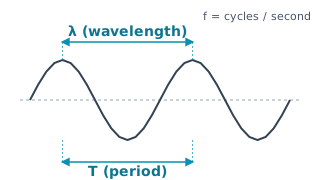
Wave anatomy
Wavelength λ measures the spatial distance between two adjacent crests; period T measures the time between them. Frequency is just the inverse of period — cycles per second.
Worked Examples
Three wave problems spanning optics, radio communications, and power electronics. Click ‘Load this example’ to populate the calculator above.
OPTICS
What is the frequency of green light at 550 nm?
A laser pointer emits green light with wavelength λ = 550 nm in vacuum, where the wave speed equals the speed of light c ≈ 2.998 × 10⁸ m/s. What are the frequency, period, and angular frequency?
- v = c = 2.998 × 10⁸ m/s, λ = 550 nm = 5.5 × 10⁻⁷ m, solve for f
- f = v / λ = (2.998 × 10⁸) / (5.5 × 10⁻⁷)
Frequency f ≈ 5.451 × 10¹⁴ Hz (~545 THz), period T ≈ 1.835 fs, ω ≈ 3.424 × 10¹⁵ rad/s.
545 THz sits in the green-yellow band of the visible spectrum, which spans roughly 400 THz (red) to 750 THz (violet).
RADIO COMMUNICATIONS
What is the wavelength of an FM radio signal at 100 MHz?
An FM radio station broadcasts at 100 MHz. Radio waves travel at the speed of light in air (effectively c). What is the wavelength of the signal?
- v = c = 2.998 × 10⁸ m/s, f = 100 MHz = 10⁸ Hz, solve for λ
- λ = v / f = (2.998 × 10⁸) / (10⁸)
Wavelength λ ≈ 2.998 m (about 3 m).
This is why FM-band antennas are about a metre long — a quarter-wavelength of ~3 m is roughly 0.75 m, the classic whip-antenna length.
POWER ELECTRONICS
What is the period of a 60 Hz AC line signal?
North American household power oscillates at 60 Hz. How long does one full cycle take? What is the angular frequency ω that appears in impedance formulas?
- f = 60 Hz, solve for T
- T = 1 / f = 1 / 60
Period T ≈ 16.67 ms, angular frequency ω = 2π × 60 ≈ 376.99 rad/s.
European 50 Hz mains gives T = 20 ms and ω ≈ 314.16 rad/s. The ω value is what you plug into XL = ωL and XC = 1 / (ωC) for inductor and capacitor impedance.
Related Calculators
- Sound Wave Speed Calculator — v = f × λ specialised for sound in air, water, and solids
- Sound Wave Equations Calculator — intensity level, SPL, wavelength, point source, and noise pollution
- Doppler Effect Calculator — frequency shift for moving sources and observers
- Frequency Unit Converter — convert between Hz, kHz, MHz, GHz, and other frequency units
- Length Unit Converter — convert wavelengths between metres, nanometres, feet, and more
Related Sites
- CameraDOF — Depth of field calculator for photographers
- Temperature Tool — Temperature unit converter
- Z-Score Calculator — Z-score, percentile, and probability calculator
- Percent Error Calculator — Calculate percent error between experimental and theoretical values
- InfantChart — Baby and child growth percentile charts
- OptionsMath — Options trading profit and loss calculators