Frequency Converter
Frequency Conversion =
Solution in Other Units
| Unit | Value |
|---|---|
| Hertz (Hz) | 1 |
| Kilohertz (kHz) | 0.001 |
| Megahertz (MHz) | 1e-6 |
| Gigahertz (GHz) | 1e-9 |
| Cycle / Second | 1 |
| Rotation / Second | 1 |
| Revolutions per Minute (rpm) | 60 |
| Unit | Value |
|---|---|
| Hertz (Hz) | 1 |
| Kilohertz (kHz) | 0.001 |
| Megahertz (MHz) | 1e-6 |
| Gigahertz (GHz) | 1e-9 |
| Cycle / Second | 1 |
| Rotation / Second | 1 |
| Revolutions per Minute (rpm) | 60 |
Converts a frequency value from one unit into all other supported frequency units. Each unit is defined relative to the Hertz (Hz) as the base unit.
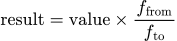
result = value × (from_factor / to_factor)
This converter transforms a frequency value from one unit into all other supported frequency units. Each unit is defined relative to the Hertz (Hz) as the base unit, so conversions multiply by the source factor and divide by the target factor.
Convert 2,400 MHz to GHz.
Frequency measures how many complete cycles occur per second. The SI base unit is the Hertz (Hz), equal to one cycle per second. Larger multiples — kilohertz (kHz), megahertz (MHz), gigahertz (GHz) — describe radio, processor, and optical frequencies. Revolutions per minute (rpm) is common in mechanical engineering and converts to Hz by dividing by 60.
Frequency is the number of complete cycles of a periodic event per unit of time. The SI unit is the Hertz (Hz), equal to one cycle per second.
Divide the MHz value by 1,000. For example, 2,400 MHz = 2.4 GHz, a common Wi-Fi frequency.
Both measure cycles per time, but Hz uses seconds and rpm uses minutes. To convert rpm to Hz, divide by 60.