Sound Wave Speed Calculator
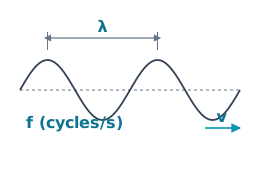
Wavelength equals velocity divided by frequency
The wave equation v = f × λ links three quantities: wave velocity v (m/s), frequency f (Hz), and wavelength λ (m). Knowing any two determines the third. For sound traveling in air at 20 °C, the speed of sound is about 343 m/s; in water it's roughly 1,480 m/s, and in steel it can exceed 5,000 m/s. The same identity rearranges to λ = v / f when solving for wavelength and to f = v / λ when solving for frequency.
A speaker emits a 440 Hz tone (concert A) in air at 20 °C. The speed of sound in air at this temperature is 343 m/s. What is the wavelength of the sound wave?
At 20 °C, the speed of sound in air is approximately v ≈ 331 + 0.6 × T (T in °C), so warmer air carries sound faster and shifts wavelengths upward at fixed frequency.
The wave equation v = f × λ holds for every kind of mechanical and electromagnetic wave — sound in air, ripples on water, seismic P-waves, even light in a vacuum (where v = c). Sound propagates as longitudinal pressure waves in fluids and as both longitudinal and transverse waves in solids. The speed depends on the medium's bulk modulus and density (v = √(K/ρ) for fluids) and rises with temperature in gases. Doubling frequency halves wavelength at fixed velocity; doubling temperature in a gas raises sound speed by roughly √2 in the absolute scale.
Multiply the wave's frequency by its wavelength: v = f × λ. If a sound wave has frequency 440 Hz and wavelength 0.78 m, its speed is 440 × 0.78 ≈ 343 m/s — the speed of sound in air at 20 °C.
v = f × λ, where v is wave velocity, f is frequency, and λ is wavelength. The same identity rearranges to λ = v / f and f = v / λ when you need to solve for the other variables.
At 20 °C the speed of sound in dry air is about 343 m/s (768 mph). The approximate temperature dependence is v ≈ 331 + 0.6 × T, where T is in °C, so it's 331 m/s at 0 °C and 355 m/s at 40 °C.
Sound speed in a medium is v = √(K/ρ), where K is bulk modulus and ρ is density. Water is much stiffer than air (high K) despite being much denser, and stiffness wins — sound travels about 4.3× faster in water (~1,480 m/s) than in air (~343 m/s).
Using v = 343 m/s for air at 20 °C, λ = v / f = 343 / 440 ≈ 0.78 m or about 78 centimeters. Higher pitches give shorter wavelengths in the same medium.
For ordinary sound in air, water, and most solids the speed is essentially the same across the audible range — sound is non-dispersive in these media. Speed does vary with the medium's temperature, density, and stiffness, but not with frequency.
Reference:
Tipler, Paul A. Physics For Scientists and Engineers. Worth Publishers. Halliday, Resnick, Walker. Fundamentals of Physics.
Three sound-wave speed problems across music, medicine, and ocean acoustics. Click 'Load this example' to populate the inputs above.
MUSIC ACOUSTICS
A piano tuner plays concert A at 440 Hz in a room at 20 °C, where the speed of sound is 343 m/s. What is the wavelength of the tone?
Wavelength λ ≈ 0.78 m (about 78 cm).
Bass notes have much longer wavelengths — a 55 Hz low A has λ ≈ 6.2 m, which is why subwoofers couple poorly to small rooms.
MEDICAL ULTRASOUND
A diagnostic ultrasound probe emits 5 MHz pulses through soft tissue where the speed of sound is approximately 1,540 m/s. What is the wavelength?
Wavelength λ ≈ 3.08 × 10⁻⁴ m ≈ 0.31 mm.
Sub-millimeter wavelengths are why ultrasound can resolve organ boundaries — image resolution is roughly λ/2.
OCEAN ACOUSTICS
An ocean sonar system emits pulses with a 5 m wavelength in seawater (v ≈ 1,500 m/s). What is the operating frequency?
Frequency f = 300 Hz.
Low-frequency long-wavelength sonar travels much farther in water but resolves objects more coarsely than high-frequency sonar.
Approximate longitudinal speed of sound through gases, liquids, and solids. Sound travels fastest through stiff, dense solids like aluminum and diamond, and slowest through soft or low-density media like rubber and air. Click a row to load that speed into the velocity field above, keeping your current frequency or wavelength (if you are solving for velocity, the calculator switches to solving for wavelength so the looked-up speed drives a result).
| Medium | Speed of sound (m/s) |
|---|---|
| Rubber | 60 |
| Air (20 °C) | 343 |
| Helium (20 °C) | 1,007 |
| Lead | 1,210 |
| Water (25 °C) | 1,493 |
| Seawater | 1,531 |
| Ice | 3,200 |
| Gold | 3,240 |
| Oak (wood) | 3,850 |
| Copper | 4,600 |
| Glass | 5,640 |
| Steel | 5,960 |
| Aluminum | 6,420 |
| Diamond | 12,000 |
Values at typical conditions (gases ~20 °C). The speed of sound rises with temperature in gases and varies with composition, density, and stiffness in liquids and solids, so treat these as representative figures. Synthesized from standard references (CRC Handbook of Chemistry and Physics; NIST; Engineering ToolBox).
