Sound Intensity (Decibel) Calculator
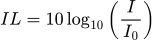
Intensity level equals 10 times log base 10 of intensity divided by reference intensity
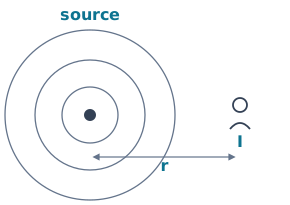
Sound intensity level β (in decibels) is defined as β = 10 × log₁₀(I / I₀), where I is the measured sound intensity in W/m² and I₀ = 10⁻¹² W/m² is the standard reference intensity (the threshold of human hearing at 1 kHz). The decibel scale is logarithmic, which compresses the enormous range of audible intensities (from 10⁻¹² W/m² to over 1 W/m²) into a tidy 0–120 dB range that aligns roughly with how humans perceive loudness changes.
A noise meter at a factory floor reads a sound intensity of 1 × 10⁻³ W/m². What is the intensity level in decibels relative to the standard hearing threshold I₀ = 10⁻¹² W/m²?
Doubling intensity adds 3 dB; multiplying intensity by 10 adds 10 dB. Two 90 dB sources together produce 93 dB, not 180 dB.
Decibels are logarithmic, which has two important consequences. First, dB values cannot be added arithmetically — combining two 60 dB sources gives 63 dB, not 120 dB, because the underlying intensities add and the log of the sum is much less than the sum of the logs. Second, every 10 dB increase corresponds to a 10× increase in intensity, and every 3 dB increase corresponds to a 2× (doubling) increase. The reference intensity I₀ = 10⁻¹² W/m² is fixed by international convention and represents the quietest sound a healthy young adult can hear at 1 kHz.
Take the ratio of the measured intensity I to the reference intensity I₀ = 10⁻¹² W/m², compute its base-10 logarithm, and multiply by 10: β = 10 × log₁₀(I / I₀). For example, I = 10⁻³ W/m² gives β = 10 × log₁₀(10⁹) = 90 dB.
β = 10 × log₁₀(I / I₀), where β is the intensity level in dB, I is the measured intensity in W/m², and I₀ = 10⁻¹² W/m² is the standard reference. Rearranged: I = I₀ × 10^(β/10).
The standard reference intensity is I₀ = 10⁻¹² W/m² (1 picowatt per square meter), which is the threshold of human hearing at 1 kHz. All decibel intensity-level measurements are expressed relative to this baseline.
Yes. A negative intensity level means the measured intensity is below the reference I₀ = 10⁻¹² W/m². For example, I = 10⁻¹⁴ W/m² gives β = −20 dB. Such sounds are inaudible to humans but are well-defined physical quantities.
Roughly the noise of a heavy truck, a kitchen blender at close range, or a factory floor. OSHA's permissible exposure limit at 90 dB(A) is 8 hours; longer exposure without hearing protection risks permanent hearing damage.
Human perception of loudness is approximately logarithmic — doubling perceived loudness corresponds to roughly a 10× increase in intensity. The dB scale compresses 12 orders of magnitude of intensity into a 0–120 dB range that matches perception more naturally than a linear scale would.
Reference:
Tipler, Paul A. Physics For Scientists and Engineers. Worth Publishers. OSHA 1910.95 Occupational Noise Exposure Standard.
Three intensity-level problems across industrial, concert, and laboratory contexts. Click 'Load this example' to populate the inputs above.
INDUSTRIAL NOISE
A sound level meter on a factory floor reads an intensity of 10⁻³ W/m². What is the intensity level in decibels?
Intensity level β = 90 dB.
OSHA requires hearing protection at sustained exposure above 90 dB(A) for 8 hours.
CONCERT ACOUSTICS
A sound engineer measures 110 dB at the front-of-house position. What is the corresponding sound intensity in W/m²?
Intensity I = 10⁻¹ W/m² (0.1 W/m²).
Sustained exposure above 100 dB risks immediate hearing damage; ear protection is essential at concert volumes.
ANECHOIC CHAMBER
A test tone is measured at exactly 0 dB intensity level. What intensity does this correspond to?
Intensity I = 10⁻¹² W/m² (the reference level itself).
0 dB is by definition the threshold of human hearing at 1 kHz — quieter sounds give negative dB readings.
Typical decibel levels for everyday and industrial sounds, with the corresponding intensity in W/m² (reference I₀ = 10⁻¹² W/m²). Click a row to load the dB value into the calculator and solve for the intensity.
| Sound | Decibels (dB) | Intensity (W/m²) |
|---|---|---|
| Threshold of hearing | 0 | 10⁻¹² |
| Rustling leaves | 10 | 10⁻¹¹ |
| Whisper at 1 m | 20 | 10⁻¹⁰ |
| Quiet library | 40 | 10⁻⁸ |
| Refrigerator hum | 50 | 10⁻⁷ |
| Normal conversation at 1 m | 60 | 10⁻⁶ |
| Vacuum cleaner at 3 m | 70 | 10⁻⁵ |
| Heavy city traffic | 80 | 10⁻⁴ |
| Lawn mower | 90 | 0.001 |
| Subway train at 4.6 m | 100 | 0.01 |
| Rock concert (front rows) | 110 | 0.1 |
| Threshold of pain | 120 | 1 |
| Jackhammer at 1 m | 130 | 10 |
| Jet engine at 30 m | 140 | 100 |
| Gunshot at 1 m | 160 | 10⁴ |
Decibel levels of common sounds are textbook/agency averages — real exposure varies with distance, frequency, and acoustic environment; the intensity column is computed from the dB level via I = I₀·10^(dB/10). For noise-exposure hazard levels see CDC/NIOSH; OSHA permits 90 dB for 8 hours, halving the limit for every 5 dB above (95 dB → 4 hr, 100 dB → 2 hr).