Triangular Prism Calculator
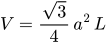
Volume equals the square root of three over four times the edge squared times the prism length
Use this form when the equilateral cross-section edge a and the prism length L are known. Volume equals the cross-section area Atri = (√3/4)·a² extruded along L.
V = (√3 / 4) · a² · L
Total surface area is the two triangular caps (2·Atri = (√3/2)·a²) plus the three rectangular sides (3·a·L). Use this for paint, wrap, or sheet-material estimates.
S = (√3 / 2) · a² + 3 · a · L
Use this rearrangement when the volume and the equilateral edge are known and you need the missing prism length.
L = 4V / (√3 · a²)
Use this rearrangement when the volume and prism length are known and you need the equilateral cross-section edge.
a = 2 · √(V / (√3 · L))
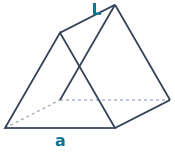
This calculator handles a triangular prism whose cross-section is an equilateral triangle of edge a, extruded along a prism length L. Two inputs fully determine the geometry. The cross-section area is Atri = (√3/4)·a², the cross-section perimeter is Ptri = 3a, and the prism follows the standard extrusion identities V = Atri·L and S = 2·Atri + Ptri·L. Lateral area (the three rectangular sides only) is S_lat = 3·a·L. The calculator also inverts these to solve for L given V and a, or for a given V and L.
A chocolate bar shaped like a triangular prism has an equilateral cross-section of edge a = 2 cm and length L = 5 cm. What are its volume, total surface area, and lateral area?
Two inputs is the minimum for any 3D prism. A general (non-equilateral) triangular prism needs four — two cross-section dimensions plus the prism length, plus typically a base height — so restricting to equilateral cuts the input surface in half without losing the most common real-world shapes (Toblerone bars, tent profiles, optical prisms).
A prism is a 3D solid formed by translating a 2D cross-section along an axis (extrusion). For any prism — triangular, rectangular, pentagonal — volume equals cross-section area times prism length, and total surface area equals twice the cross-section area plus the cross-section perimeter times the prism length. This calculator specializes those identities to an equilateral triangle cross-section. Note the distinction between total surface area S (all five faces) and lateral surface area S_lat (only the three rectangular sides — excludes the two triangular end caps). Painting all sides of a Toblerone bar uses S; wrapping only the long sides like a label uses S_lat.
Volume equals cross-section area times prism length: V = Atri · L. For an equilateral cross-section of edge a, Atri = (√3/4)·a², so V = (√3/4)·a²·L. With a = 2 m and L = 5 m, V = 5√3 ≈ 8.66 m³.
Total surface area is the two triangular caps plus the three rectangular sides: S = 2·Atri + Ptri·L. For an equilateral cross-section that simplifies to S = (√3/2)·a² + 3·a·L. With a = 2 m and L = 5 m, S = 2√3 + 30 ≈ 33.46 m².
Lateral surface area S_lat counts only the three rectangular sides of the prism (3·a·L for an equilateral cross-section) — the two triangular end caps are excluded. Total surface area S adds the two caps back in: S = S_lat + 2·Atri. You want S_lat when wrapping a label around a Toblerone-style bar; you want S when painting every face.
Rearrange V = Atri · L to L = V / Atri. For an equilateral cross-section that is L = 4V / (√3 · a²). With V = 5√3 m³ and a = 2 m, L = 4·5√3 / (√3 · 4) = 5 m.
Toblerone chocolate bars, A-frame tents, lean-to shelters, prismatic shipping crates, optical prisms that disperse white light into a spectrum, triangular timber beams, and the web sections of structural I-beams are all triangular prisms or near-triangular prisms.
No. A triangular prism has two parallel triangular faces connected by three rectangles — five faces total, with a constant cross-section along its length. A triangular pyramid (tetrahedron) has one triangular base and three triangular faces that meet at an apex — four faces total, and the cross-section shrinks to a point. Their volume formulas differ accordingly: V_prism = Atri · L, V_pyramid = (1/3) · Atri · h.
Restricting to equilateral keeps the inputs at just two numbers (edge a and prism length L). A general triangular prism cross-section has three side lengths (or two sides plus an included angle, or base + height), which brings the input count to four. The equilateral case covers the most common real-world triangular prisms — Toblerone, A-frame tents, equilateral optical prisms — without that extra complexity.
Both are prisms — 3D solids formed by extruding a 2D cross-section along a length. A rectangular prism extrudes a rectangle (cross-section area l·w), giving V = l·w·h. A triangular prism extrudes a triangle (cross-section area Atri), giving V = Atri·L. The general identity V = Atri·L, S_total = 2·Atri + Ptri·L applies to any prism, not just triangular ones.
Reference:
Weisstein, Eric W. "Triangular Prism." MathWorld — A Wolfram Web Resource. https://mathworld.wolfram.com/TriangularPrism.html
Toblerone-style Bar
A chocolate bar shaped like a triangular prism has an equilateral cross-section of edge a = 2 cm and length L = 5 cm. Compute the volume.
Volume ≈ 8.66 cm³ (about 8.66 mL of chocolate)
Real Toblerone bars taper at the ends; this treats the bar as a perfect prism.
A-frame Tent
An A-frame tent has an equilateral cross-section of edge 2.4 m and length 3 m. Compute total surface area to size the fabric.
Total surface area ≈ 26.59 m² (about 286 ft²)
Real tents need a flat floor too — for fabric estimates use lateral area only (3·a·L = 21.6 m²) and treat the floor separately.
Inverse Solve
A triangular timber beam of length 4 m must hold 0.05 m³ (50 L) of volume. Find the required equilateral cross-section edge.
Edge ≈ 0.170 m (about 17 cm)
Cross-section area Atri = V / L = 0.05 / 4 = 0.0125 m²; the equilateral edge follows from (√3/4)·a² = 0.0125.
A triangular prism with equilateral cross-section is defined by two numbers: the edge a of the equilateral triangle and the prism length L. From those, the volume, surface area, and inverse identities all follow:
Where: