Trapezoid Calculator
Area equals the quantity a plus b divided by 2 times h
Use this form when both parallel sides and the perpendicular height between them are known. The formula averages the two parallel sides and multiplies by the height.
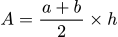
A = (a + b) / 2 × h
Use this rearrangement when the area, bottom side, and height are known and you need the top parallel side.
a = 2A/h − b
Use this rearrangement when the area, top side, and height are known and you need the bottom parallel side.
b = 2A/h − a
Use this rearrangement when the area and both parallel sides are known and you need the perpendicular height.
h = 2A / (a + b)
This trapezoid calculator solves A = (a + b)/2 × h, where a and b are the two parallel sides and h is the perpendicular height between them. The midsegment m = (a + b)/2 — the segment connecting the midpoints of the two non-parallel sides — is always displayed as a supplementary output. Pick the unknown with the solve-for toggle and enter the remaining values in any supported length or area unit.
A trapezoid-shaped concrete slab has top side 4 m, bottom side 6 m, and perpendicular height 3 m. Compute its area.
The midsegment property means trapezoid area equals midsegment × height, exactly like a rectangle of those dimensions.
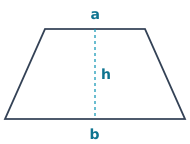
A trapezoid is a four-sided polygon with exactly one pair of parallel sides (the 'bases', conventionally a and b). The non-parallel sides are called 'legs'. The perpendicular height h is the distance between the two parallel bases, measured perpendicular to them. The midsegment m = (a + b)/2 is parallel to both bases and equal to their average. Special cases: when a = b, the trapezoid degenerates into a parallelogram (rectangle if angles are right); when a = 0, it degenerates into a triangle of base b and height h.
Use A = (a + b)/2 × h, where a and b are the parallel sides and h is the perpendicular height. For a trapezoid with a = 4 m, b = 6 m, h = 3 m, A = (4+6)/2 × 3 = 15 m².
A = (a + b)/2 × h. Equivalently, A = m × h where m = (a + b)/2 is the midsegment. The area of a trapezoid is the midsegment times the perpendicular height — the same shape as a rectangle's area formula.
The midsegment is the line segment connecting the midpoints of the two non-parallel sides (the legs). Its length equals the average of the parallel sides: m = (a + b)/2. For a = 4 m and b = 6 m, m = 5 m.
Rearrange A = (a + b)/2 × h to h = 2A / (a + b). For A = 15 m², a = 4 m, b = 6 m: h = 30 / 10 = 3 m.
A trapezoid has exactly ONE pair of parallel sides; a parallelogram has TWO. So a parallelogram is technically not a trapezoid in the exclusive definition (used in the US). The inclusive definition (used in many other countries) considers parallelograms a special case of trapezoid where both pairs of sides are parallel.
Rearrange to a = 2A/h − b or b = 2A/h − a. For A = 15 m², h = 3 m, b = 6 m: a = 2·15/3 − 6 = 10 − 6 = 4 m.
An isosceles trapezoid has the two non-parallel sides (legs) equal in length. This gives it a line of symmetry perpendicular to the parallel bases. The area formula is the same — A = (a + b)/2 × h — but the legs and base angles are constrained.
Yes. A right trapezoid has two right angles, so one leg is perpendicular to the bases — that leg equals the height h. The area formula A = (a + b)/2 × h applies unchanged; the additional structure just makes the height measurable directly along one leg.
Reference:
Weisstein, Eric W. "Trapezoid." MathWorld — A Wolfram Web Resource. https://mathworld.wolfram.com/Trapezoid.html
Concrete Pour
A trapezoid-shaped concrete pad has top side 4 m, bottom side 6 m, perpendicular height 3 m, and a 0.15 m depth. Find the surface area first, then the volume.
Surface area = 15 m²; concrete volume ≈ 2.25 m³
Add 5–10% waste for trim cuts and pump losses.
Roof Section
A roof panel has parallel edges 8 ft and 12 ft and a slope distance giving a 5 ft perpendicular height between the edges. Compute the area to estimate sheathing.
Area = 50 ft² (about 4.65 m²)
Sheathing material is usually ordered in 4 × 8 ft sheets — for 50 ft² that's about 1.6 sheets.
Inverse Solve
An irrigation channel cross-section is a trapezoid with top width 6 m, bottom width 2 m, and a target cross-section area of 24 m². Find the required depth.
Required depth = 6 m
Channels are often designed with the trapezoid inverted (narrow bottom, wider top) for stability; the formula is symmetric so top/bottom are interchangeable.
A trapezoid is defined by two parallel sides a (top) and b (bottom) and the perpendicular height h between them. Area follows directly:
Where: