Slope Calculator
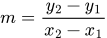
Slope m equals the change in y divided by the change in x.
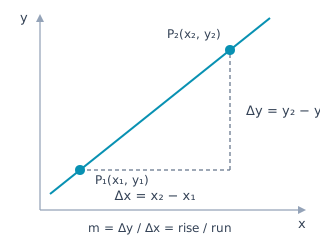
The slope m of a straight line through two points (x₁, y₁) and (x₂, y₂) is the change in y divided by the change in x — rise over run. It tells you how steeply the line climbs (positive slope) or falls (negative slope) for every unit of horizontal travel.
m = (y₂ − y₁) / (x₂ − x₁)
Slope measures how steeply a line rises or falls as you move across it. The slope formula m = (y₂ − y₁) / (x₂ − x₁) takes the vertical change (rise, Δy) between two points and divides by the horizontal change (run, Δx). A larger absolute value means a steeper line; a positive value means the line goes up from left to right, a negative value means it goes down, and zero means the line is flat. When the two points share the same x-coordinate the formula divides by zero — the line is vertical and the slope is undefined.
Find the slope of the line through the points (1, 2) and (4, 8), and convert that slope to an angle from the horizontal and a percent grade.
Swapping the order of the points does not change the answer — both numerator and denominator flip sign, and the negatives cancel: (2 − 8) / (1 − 4) = −6 / −3 = 2.
Positive slope means the line rises from left to right; negative slope means it falls. A slope of zero is a horizontal line (no rise), and an undefined slope is a vertical line (no run — division by zero). Slope can be expressed three equivalent ways: as a pure ratio (m = 2), as an angle from the horizontal (θ = arctan m, so m = 2 corresponds to about 63.43°), and as a percent grade (m × 100, so m = 0.05 is a 5% grade). In calculus, slope generalises to the derivative — the slope of the tangent line at a single point on a curve.
Pick two points on the line, (x₁, y₁) and (x₂, y₂), then divide the change in y by the change in x: m = (y₂ − y₁) / (x₂ − x₁). For example, the points (1, 2) and (4, 8) give m = (8 − 2) / (4 − 1) = 6 / 3 = 2. The result is the line's slope — a single number that describes its steepness and direction.
The slope formula is m = (y₂ − y₁) / (x₂ − x₁), often summarised as 'rise over run'. The numerator is the vertical change between the two points, and the denominator is the horizontal change. The formula works for any two distinct points on a non-vertical straight line.
Slope is a number that measures how steeply a straight line rises or falls. Geometrically it is the tangent of the angle the line makes with the positive x-axis. A slope of 1 corresponds to a 45° line, a slope of 0 is horizontal, and an undefined slope is vertical.
Subtract the y-coordinates of the two points (rise), subtract the x-coordinates in the same order (run), and divide. Symbolically, m = (y₂ − y₁) / (x₂ − x₁). The answer is independent of which point you label first as long as you subtract consistently in the numerator and denominator.
A negative slope means the line falls from left to right — y decreases as x increases. For example, the line through (0, 5) and (5, 0) has slope (0 − 5) / (5 − 0) = −1, a 45° downhill. The more negative the value, the steeper the descent.
An undefined slope occurs when the two points have the same x-coordinate. The run x₂ − x₁ is zero, and dividing by zero is not defined. Geometrically the line is vertical, so it has no finite steepness — it climbs infinitely fast.
Multiply the slope by 100 to get the percent grade. A slope of 0.05 is a 5% grade (a typical highway maximum), a slope of 0.0833 is the ADA wheelchair ramp limit of about 8.33% (1:12), and a slope of 1 is a 100% grade (45°). Engineers and builders use grade percentage because it is more intuitive than raw slope for shallow inclines.
For a curve, the derivative at a point is the slope of the tangent line at that point — the limiting case of the slope formula as the two points are brought together. For a straight line the derivative is constant and equals the slope; for a general curve the slope changes from point to point, which is exactly what the derivative captures.
Reference:
Stewart, James. 2015. Calculus: Early Transcendentals. Cengage Learning. 8th ed.
The slope of a non-vertical straight line through two points (x₁, y₁) and (x₂, y₂) is defined as the change in y divided by the change in x:
Where:
Two related quantities follow directly from the slope: θ = arctan(m) is the angle the line makes with the positive x-axis (in degrees), and the percent grade is m × 100.
Two points on a Cartesian plane with a right-triangle showing the rise (Δy) and run (Δx). The slope m equals rise over run.
Coordinate Geometry
The reference example used throughout this page — two integer-coordinate points with a clean rise-over-run answer.
m = 2 (angle ≈ 63.43°, grade = 200%)
A slope of 2 is steep — much more than a typical roadway. Roads and ramps are usually expressed as a percent grade rather than a raw slope.
Accessibility Design
The Americans with Disabilities Act caps accessible-ramp slope at 1 unit of rise per 12 units of run — the steepest gradient still considered safe for unassisted wheelchair use.
m ≈ 0.0833 (angle ≈ 4.76°, grade ≈ 8.33%)
Builders usually verify the ramp by measuring rise and run directly with a tape measure — the slope formula confirms the design meets the ADA limit.
Highway Engineering
U.S. interstate guidelines recommend a maximum sustained grade of about 6%. Translate that grade into a slope and an angle.
m = 0.06 (angle ≈ 3.43°, grade = 6%)
Mountain interstates occasionally exceed 6% on short sections, but anything over 7% triggers special signage and runaway-truck design rules.