Quadratic Equation Calculator
x equals negative b plus or minus the square root of b squared minus 4ac, all divided by 2a
The quadratic formula solves any equation of the form ax² + bx + c = 0. The discriminant b² − 4ac determines whether the roots are real, repeated, or complex. Enter the three coefficients and get both solutions instantly.
x = (−b ± √(b² − 4ac)) / 2a
The quadratic formula x = (−b ± √(b² − 4ac)) / 2a solves any equation of the form ax² + bx + c = 0. First compute the discriminant b² − 4ac. A positive discriminant gives two real roots, zero gives one repeated root, and a negative discriminant gives a complex-conjugate pair. This calculator evaluates all three cases automatically and also shows the corresponding parabola so you can see whether the graph crosses, touches, or misses the x-axis.
Solve 2x² + 3x − 5 = 0:
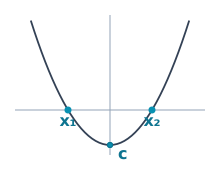
A positive discriminant means the parabola crosses the x-axis twice, once at each real root.
A quadratic equation has the form ax² + bx + c = 0 where a ≠ 0. The discriminant (b² − 4ac) determines root type: positive gives two real roots, zero gives one repeated root, and negative gives two complex conjugate roots. The quadratic formula works universally, while factoring and completing the square are alternatives for simpler cases.
The discriminant b² − 4ac reveals the root type. If it is positive, there are two real roots. If zero, one repeated root. If negative, two complex conjugate roots. For 49 the roots are real and distinct.
You can factor the expression (if the roots are rational), complete the square, or graph the parabola. The quadratic formula works for all cases, including irrational and complex roots.
Complex roots occur when the discriminant is negative. They come in conjugate pairs like 2 + 3i and 2 − 3i. The parabola does not cross the x-axis in this case.
If a = 0 the equation becomes linear (bx + c = 0), not quadratic. A quadratic must have an x² term, so a must be non-zero.
A zero discriminant means both formula branches give the same answer, so the quadratic has one repeated root. Graphically, the parabola touches the x-axis at exactly one point, which is also the vertex.
No. Some quadratics factor cleanly over the integers, but many have irrational or complex roots. The quadratic formula works in all cases, which is why it is the most reliable universal method.
The graph shows how the algebra connects to the parabola. Two real roots mean the curve crosses the x-axis twice, a repeated root means it just touches once, and complex roots mean the curve stays entirely above or below the axis.
If the coefficients are simple and the factors are easy to spot, factoring is faster. If not, the quadratic formula is usually the safest choice because it always works as long as a is not zero.
Reference:
Sullivan, Michael. Algebra and Trigonometry. Pearson.
The quadratic formula solves any equation of the form ax² + bx + c = 0 when a ≠ 0. The discriminant decides whether the roots are real, repeated, or complex.
Where:
Two Real Roots
This classic factoring-friendly quadratic is also a good quadratic-formula example because the discriminant is positive and gives two distinct real roots.
Double Root
When the discriminant is zero, both quadratic-formula branches collapse to the same value and the parabola just touches the x-axis.
Complex Roots
A negative discriminant means the parabola never crosses the x-axis, but the quadratic formula still returns a valid complex-conjugate pair.
