Line Equation Calculator
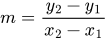
m equals the quantity y two minus y one divided by the quantity x two minus x one
The slope measures the steepness and direction of a line. A positive slope rises from left to right, a negative slope falls, zero is horizontal, and undefined (division by zero) is vertical.
m = (y₂ − y₁) / (x₂ − x₁)
The distance formula is derived from the Pythagorean theorem. It computes the straight-line (Euclidean) distance between any two points in a coordinate plane.
d = √((x₂ − x₁)² + (y₂ − y₁)²)
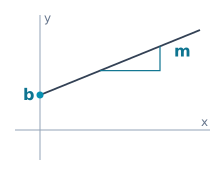
The slope-intercept form directly shows the slope (m) and the y-intercept (b) of a line. Given m, x, and b, you can compute y for any point on the line.
y = mx + b
This calculator covers three fundamental line equations used in coordinate geometry. The slope formula computes the steepness between two points. The distance formula uses the Pythagorean theorem to find the straight-line distance between two points. The slope-intercept form (y = mx + b) evaluates y for a given x along a line with known slope and intercept.
Find the slope and distance between points (1, 2) and (4, 8).
Slope quantifies the rate of change between two points — a slope of 2 means y increases by 2 for every 1-unit increase in x. The distance formula is a direct application of the Pythagorean theorem in the coordinate plane. The slope-intercept form y = mx + b is the most common way to express a linear equation, where m controls steepness and b shifts the line up or down.
Use the slope formula m = (y2 - y1) / (x2 - x1). Subtract the y-coordinates and divide by the difference in x-coordinates. A positive result means the line rises from left to right.
The distance formula d = sqrt((x2-x1)^2 + (y2-y1)^2) calculates the straight-line distance between two points. It comes from the Pythagorean theorem applied to the horizontal and vertical differences.
The y-intercept is the point where the line crosses the y-axis (where x = 0). If b = 3, the line passes through the point (0, 3). Changing b shifts the entire line up or down without changing its slope.
The denominator becomes zero, so the slope is undefined. That means the line is vertical and cannot be written with a finite slope value.
A positive slope means the line rises from left to right. A negative slope means it falls from left to right. A zero slope is horizontal.
Yes. It is used in mapping, CAD, surveying, animation, robotics, and physics whenever you need the straight-line distance between two known coordinates.
Reference:
Reference: Coordinate geometry identities from standard algebra and analytic geometry texts.
These three formulas cover the most common line-equation tasks: measuring slope, finding the straight-line distance between two points, and evaluating y in slope-intercept form.
Slope
m = (y₂ − y₁) / (x₂ − x₁)
Distance
d = √((x₂ − x₁)² + (y₂ − y₁)²)
Slope-Intercept
y = mx + b
Coordinate Geometry
Mapping
Algebra