Square Root
Find the principal square root of a non-negative real number. The result r satisfies r × r = x and is always reported as the positive root for x ≥ 0; the square root of a negative number has no real value.
√x = x^(1/2)
Cube Root
Find the real cube root of any real number, including negatives. ∛(-8) = -2 because (-2)³ = -8. Unlike square roots, every real number has exactly one real cube root.
∛x = x^(1/3)
Nth Root
Find the principal nth root for any positive integer n ≥ 2. Odd roots of negative numbers are real and negative; even roots of negative numbers have no real value.
ⁿ√x = x^(1/n)
How It Works
A root is the inverse of a power. If r raised to the nth power equals x, then r is the nth root of x: ⁿ√x = x^(1/n). The square root reverses squaring, the cube root reverses cubing, and the nth root reverses raising to the nth power. This calculator uses high-precision arithmetic for square roots (exact for perfect squares), Newton-Raphson iteration for cube roots (so very large numbers don't overflow), and a general iterative scheme for arbitrary nth roots. Negative inputs are supported for odd roots; even roots of negative numbers return 'no real result' because no real number raised to an even power can be negative.
Example Problem
Find √144 using guess-and-check, then verify with Newton-Raphson.
- Look for a perfect square: try r = 10 → 10² = 100 (too small).
- Try r = 13 → 13² = 169 (too big), so the answer is between 10 and 13.
- Try r = 12 → 12² = 144 — an exact match.
- Verify the result: r² = 12 × 12 = 144 = x ✓
- Newton-Raphson refinement (for irrational roots): r_{k+1} = (r_k + x/r_k) / 2 converges quadratically from any positive seed.
- Final answer: √144 = 12 (a perfect square, no decimal expansion needed).
Therefore, √144 = 12 exactly.
Key Concepts
Perfect roots are exact integer results: √144 = 12, ∛27 = 3, ⁴√81 = 3 are all 'perfect'. Irrational roots have non-repeating decimal expansions: √2 ≈ 1.41421356... and ∛2 ≈ 1.25992105... continue forever without a pattern. Even root of negative is undefined in the real numbers — √(-1) has no real value, though it equals the imaginary unit i in the complex plane. The principal root is the non-negative answer used by convention; while (-12)² also equals 144, we report √144 = 12 (not ±12). Fractional exponents and roots are equivalent: x^(1/n) is exactly ⁿ√x, so 8^(1/3) = ∛8 = 2.
Applications
- Pythagorean theorem: c = √(a² + b²) gives the hypotenuse of a right triangle
- Standard deviation: σ = √(variance) — the standard deviation is the square root of the variance
- Distance formula: d = √((x₂-x₁)² + (y₂-y₁)²) measures distance between two points
- Quadratic formula: roots of ax² + bx + c = 0 include a ±√(b² - 4ac) discriminant term
- Kinematics: time to fall from rest a height h is t = √(2h/g)
- Geometric mean: the geometric mean of n numbers is their product raised to the 1/n power
- RMS values: alternating-current voltage and signal magnitudes are reported as root-mean-square values
Common Mistakes
- Forgetting that the principal square root is only the positive value — √144 = 12, not ±12 (the ± appears when solving x² = 144, not when evaluating √144 directly)
- Treating √(-1) as a real number — the square root of a negative number has no real value; it equals the imaginary unit i in the complex plane
- Assuming ⁴√16 = ±2 — the principal fourth root is 2 only; the ± sign appears only when solving x⁴ = 16
- Confusing √(a+b) with √a + √b — these are NOT equal; √(9+16) = √25 = 5, but √9 + √16 = 3 + 4 = 7
- Forgetting to verify with the inverse operation — always check by raising the result to the nth power
Frequently Asked Questions
What is the square root of 144?
The square root of 144 is 12, because 12 × 12 = 144. This is a perfect square — the result is an exact whole number with no decimal expansion.
How do you calculate a square root?
For perfect squares, find an integer r such that r × r equals the input. For irrational square roots, use Newton-Raphson iteration: starting from any positive guess r, repeatedly replace r with (r + x/r)/2. This calculator handles both cases automatically using high-precision arithmetic.
What is the cube root of a number?
The cube root of x, written ∛x or x^(1/3), is the number r such that r³ = x. Unlike square roots, cube roots of negative numbers are real: ∛(-8) = -2 because (-2)³ = -8. Every real number has exactly one real cube root.
How do you find the nth root of a number?
The nth root of x, written ⁿ√x or x^(1/n), is the number r such that r^n = x. For n ≥ 4, compute it as x^(1/n) using fractional exponents, or iterate using Newton's method: r_{k+1} = ((n-1)r_k + x/r_k^(n-1)) / n. This calculator's Nth Root mode handles any positive integer n ≥ 2.
Can you take the square root of a negative number?
Not in the real numbers — √(-1) has no real value because no real number squared can be negative. In the complex numbers, √(-1) is defined as the imaginary unit i, and √(-n) = i × √n for any positive n. This calculator returns 'no real result' for the square root (or any even root) of a negative number.
What is √2 and why is it irrational?
√2 ≈ 1.41421356237... is the diagonal of a unit square. It is irrational because no fraction p/q exactly equals √2 — Pythagoras's school proved this around 500 BCE. The decimal expansion continues forever without repeating.
What is the difference between a root and a fractional exponent?
They are exactly the same thing. ⁿ√x = x^(1/n), so √x = x^(1/2), ∛x = x^(1/3), and ⁴√x = x^(1/4). Fractional exponents are often easier to manipulate algebraically, while root notation is more compact for whole-number indices.
What is the principal root?
The principal root is the conventional 'preferred' root when multiple roots exist. For square roots, it's the non-negative value: √144 = 12 (not -12). For even roots, it's always the non-negative root. For odd roots of any real number, the principal root is the real-valued root with the same sign as the input.
Reference:
Root and radical definitions from standard pre-calculus and real analysis: a real nth root r of x satisfies r^n = x; the principal root is the non-negative root for even n and the real root with the same sign as x for odd n.
Worked Examples
Perfect Square
What is the square root of 169?
Find an integer r such that r × r = 169 by testing perfect squares.
- Knowns: x = 169
- Formula: √x = r where r² = x
- Try r = 12 → 12² = 144 (too low)
- Try r = 13 → 13² = 169 ✓
- Verify: 13 × 13 = 169
√169 = 13
169 is a perfect square (13²), so the result is an exact integer — no decimal expansion needed.
Cube Root of Negative
What is the cube root of -125?
Unlike square roots, cube roots of negative numbers are real-valued. Find r such that r³ = -125.
- Knowns: x = -125
- Formula: ∛x = x^(1/3)
- Test r = -5 → (-5)³ = -5 × -5 × -5 = -125 ✓
- Verify: -5 × -5 = 25; 25 × -5 = -125
∛(-125) = -5
Odd roots of negative numbers always exist in the real numbers; the result keeps the same sign as the input.
Nth Root
What is the fourth root of 625?
Find r such that r⁴ = 625 using the Nth Root mode with n = 4.
- Knowns: x = 625, n = 4
- Formula: ⁴√x = x^(1/4)
- Try r = 5 → 5² = 25; 25² = 625 ✓
- Verify: 5⁴ = 5 × 5 × 5 × 5 = 625
⁴√625 = 5
Even roots are reported as the principal (non-negative) root. Although (-5)⁴ also equals 625, the convention is to return 5.
Root Formula
A root is the inverse operation of raising to a power. The principal nth root of x is the real number r satisfying r raised to the nth power equals x:
√x = x^(1/2)
∛x = x^(1/3)
ⁿ√x = x^(1/n)
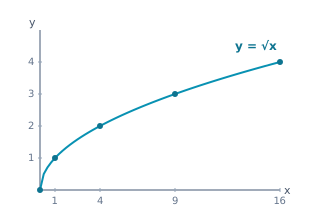
Where:
- x — the radicand (the number whose root we want)
- n — the index of the root (positive integer ≥ 2)
- r = ⁿ√x — the principal nth root, satisfying r^n = x
Even roots of negative numbers have no real value because no real number raised to an even power can be negative. Odd roots of negatives are real and keep the input's sign.
Related Calculators
- Exponent Calculator — raise any base to a power — the inverse operation of taking a root
- Quadratic Equation Calculator — solve ax² + bx + c = 0 with a discriminant term that uses a square root
- Logarithm Calculator — compute logarithms for any base — the inverse of exponentiation
- Factorial Calculator — compute n! with step-by-step multiplication
- Z-Score Calculator — convert raw scores to z-scores using a standard-deviation (square-root) denominator
Related Sites
- Percent Error Calculator — Calculate percent error between experimental and theoretical values
- Temperature Tool — Temperature unit converter
- Medical Equations — Hemodynamic, pulmonary, and dosing calculators
- OptionsMath — Options trading profit and loss calculators
- Hourly Salaries — Hourly wage to annual salary converter
- BOGO Discount — Buy-one-get-one discount calculator