
Compute x^n
Raise base x to the power n. Works for any real base and any real exponent — positive, negative, fractional, or zero. Integer exponents are computed exactly using arbitrary-precision arithmetic; fractional exponents fall back to standard floating-point math.
x^n
Solve for base x
Given the exponent n and the result of x^n, find the base x. Equivalent to taking the nth root of the result. Useful when you know a final value and the power that produced it but need to recover the original base.
x = result^(1/n)
Solve for exponent n
Given the base x and the result of x^n, find the exponent n. Uses the change-of-base logarithm identity. Useful for growth problems where you know the starting value, the ending value, and the per-step multiplier.
n = log(result) / log(x)
How It Works
Exponentiation is repeated multiplication: x^n means multiplying x by itself n times. For example, 2^4 = 2 × 2 × 2 × 2 = 16. Negative exponents take the reciprocal: x^(-n) = 1 / x^n, so 2^(-3) = 1/8 = 0.125. Fractional exponents correspond to roots: x^(1/n) is the nth root of x, so 9^(1/2) = √9 = 3. The two special edge cases are 0^0, which is defined as 1 by convention (matching JavaScript and most math libraries), and any base raised to 0, which is always 1.
Example Problem
Compute 2^10:
- Identify the base and exponent: x = 2, n = 10.
- Write the expansion: 2^10 = 2 × 2 × 2 × 2 × 2 × 2 × 2 × 2 × 2 × 2.
- Multiply pairs: 2 × 2 = 4, so 2^2 = 4.
- Square that: 4 × 4 = 16, so 2^4 = 16.
- Square again: 16 × 16 = 256, so 2^8 = 256.
- Multiply by the remaining two factors: 256 × 4 = 1,024.
- Therefore 2^10 = 1,024. This is also known as 1 kibi (≈ 1K in computing).
Therefore, 2^10 = 1,024.
When to Use Each Variable
- Compute x^n — when you know the base and the exponent, and want the resulting power.
- Solve for base x — when you know the exponent and the final result, and want the base that produced it (an nth-root problem).
- Solve for exponent n — when you know the base and the final result, and want the power that produced it (a logarithm problem).
Key Concepts
The laws of exponents let you combine and simplify powers without expanding everything: x^a · x^b = x^(a+b), x^a / x^b = x^(a−b), (x^a)^b = x^(a·b), (xy)^a = x^a · y^a, and x^(−a) = 1/x^a. Fractional exponents are roots: x^(1/n) is the nth root of x, and x^(m/n) is the nth root of x raised to the mth power. Exponentiation is the inverse operation of taking a logarithm — if x^n = y, then n = log_x(y) and x = y^(1/n). Scientific notation is exponents in disguise: 6.022 × 10^23 is just a base of 10 raised to an integer power.
Applications
- Compound interest: a principal P growing at rate r for t periods becomes P × (1 + r)^t, an exponent calculation at the heart of finance
- Computer science: memory and storage capacities scale by powers of 2 (a kilobyte is 2^10 bytes, a megabyte is 2^20, a gigabyte is 2^30)
- Physics and chemistry: radioactive decay follows N(t) = N₀ × (1/2)^(t/T), with a fractional exponent governing how much of a sample remains
- Population growth: doubling, tripling, or exponential decay models all use x^n with x as the per-step multiplier and n as the number of steps
- Scaling and similarity: when a linear dimension scales by k, area scales by k^2 and volume by k^3 — the famous square-cube law
Common Mistakes
- Treating x^n as x × n — exponentiation is repeated multiplication of x by itself n times, not x times n. 2^10 = 1,024, not 20
- Forgetting that (−x)^n depends on the parity of n: when n is even the result is positive ((−3)^4 = 81), when n is odd the result is negative ((−3)^3 = −27)
- Assuming 0^0 is 0 or undefined — by widely used convention (including JavaScript and most calculators) 0^0 = 1, because that choice makes power-series and combinatorial formulas behave consistently
- Confusing x^(1/n) with x/n — a fractional exponent is a root, not a division. 9^(1/2) = 3, not 4.5
Frequently Asked Questions
How do you calculate exponents?
Multiply the base by itself the number of times specified by the exponent. For example, 3^4 = 3 × 3 × 3 × 3 = 81. For negative exponents, take the reciprocal: x^(−n) = 1 / x^n. For fractional exponents, take the corresponding root: x^(1/n) is the nth root of x.
What is the formula for an exponent?
The basic formula is x^n = x × x × x × … × x (n factors of x). The three laws you use most often are x^a · x^b = x^(a+b), (x^a)^b = x^(a·b), and x^(−n) = 1 / x^n. Together with x^(m/n) = (nth root of x)^m, these cover almost every algebra problem.
What is 2 to the 10th power?
2^10 = 1,024. This is one of the most common exponents in computing — a kibibyte is 2^10 bytes, a mebibyte is 2^20 bytes, and a gibibyte is 2^30 bytes. Doubling 10 times multiplies the original value by 1,024.
What is x to the 0 power?
Any nonzero number raised to the 0 power equals 1: x^0 = 1 for x ≠ 0. This keeps the law x^a / x^a = x^(a−a) = x^0 consistent with the fact that any nonzero quantity divided by itself is 1.
How do you do negative exponents?
A negative exponent is the reciprocal of the positive power: x^(−n) = 1 / x^n. For example, 2^(−3) = 1 / 2^3 = 1 / 8 = 0.125. A negative exponent does NOT make the result negative — it inverts it.
What is 0^0?
By convention 0^0 = 1, which is the value JavaScript, most calculators, and most algebra textbooks use. Mathematically it is an indeterminate form (different limit paths give different answers), but the value 1 makes combinatorial formulas, power series, and binomial expansions work cleanly at the boundary.
How do you compute fractional exponents?
A fractional exponent is a root. x^(1/n) is the nth root of x: x^(1/2) is the square root, x^(1/3) is the cube root, and so on. For mixed numerators, x^(m/n) = (x^(1/n))^m. For example, 8^(2/3) = (cube root of 8)^2 = 2^2 = 4.
Can the base of an exponent be negative?
Yes for integer exponents — (−3)^4 = 81 and (−2)^5 = −32. But for fractional exponents with a negative base, the result is generally not a real number (e.g., (−2)^(1/2) = √(−2) has no real solution), so this calculator shows no real result for those inputs.
Exponent Formula
Exponentiation is repeated multiplication. The expression x^n means multiplying the base x by itself n times:
xn = x × x × x × … × x (n factors)
Where:
- x — the base (any real number)
- n — the exponent (any real number; integer, fractional, positive, or negative)
- x^n — the result, also called the nth power of x
For negative exponents, x−n = 1 / xn. For fractional exponents, x1/n is the nth root of x. By convention x0 = 1 for any nonzero x, and 00 is also defined as 1 in JavaScript and most calculators.
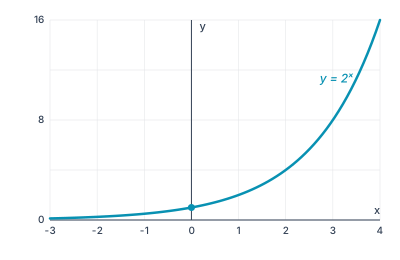
Exponential Growth Curve
The curve y = 2x illustrates the shape of every exponential function: slow growth on the left, an anchor point of (0, 1) where any base meets the y-axis, then rapid acceleration. The same shape appears in compound interest, viral spread, and Moore's law for transistor density.
Worked Examples
Compound Interest
What does $1,000 grow to in 30 years at 7% annual interest, compounded yearly?
Compound interest is FV = P × (1 + r)^t. With P = $1,000, r = 0.07, t = 30:
- Compute the growth factor: 1 + 0.07 = 1.07
- Raise to the 30th power: 1.07^30 ≈ 7.6123
- Multiply by the principal: $1,000 × 7.6123 ≈ $7,612.26
FV ≈ $7,612.26
The same $1,000 only doubles to $2,000 in roughly 10 years — the magic happens once the exponent gets large.
Computer Science
How many bytes are in a gibibyte (the binary, exact form of a gigabyte)?
Binary memory units scale by powers of 2. A gibibyte (GiB) is exactly 2^30 bytes:
- Identify the exponent: GiB = 2^30
- Compute step-by-step using doubling: 2^10 = 1,024 (KiB)
- Square that: 2^20 = 1,048,576 (MiB)
- Multiply by 2^10 again: 2^30 = 1,073,741,824
1 GiB = 1,073,741,824 bytes
Marketing 'gigabytes' use base-10 (10^9 = 1,000,000,000), which is why a 1 TB drive shows up as ~931 GiB in your operating system.
Radioactive Decay
How much of a 100 g cobalt-60 sample remains after 16 years (half-life ≈ 5.27 years)?
Radioactive decay follows N(t) = N₀ × (1/2)^(t/T). With t = 16 years and T = 5.27 years:
- Number of half-lives elapsed: 16 / 5.27 ≈ 3.036
- Fraction remaining: (0.5)^3.036 ≈ 0.1219
- Mass remaining: 100 g × 0.1219 ≈ 12.19 g
≈ 12.19 g remaining
A fractional exponent (3.036, not 3) lets the model give a smooth answer instead of jumping in half-life increments.
Related Calculators
- Logarithm Calculator — the inverse of exponentiation — solve for the exponent given x^n = result
- Natural Log Calculator — log base e — companion to e^x exponentials in growth models
- Factorial Calculator — n! grows even faster than exponentials and appears alongside x^n in Taylor series
- Quadratic Equation Calculator — solve ax² + bx + c = 0 — the simplest equation involving a non-trivial exponent
- Compound Interest Loan Comparison — applies x^n directly to compare loan growth at different rates
Related Sites
- CameraDOF — Depth of field calculator for photographers
- Percent Off Calculator — Discount and sale price calculator
- Hourly Salaries — Hourly wage to annual salary converter
- InfantChart — Baby and child growth percentile charts
- Dollars Per Hour — Weekly paycheck calculator with overtime
- BOGO Discount — Buy-one-get-one discount calculator