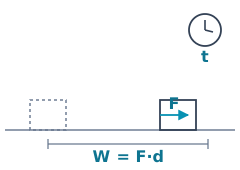
How It Works
Power from work is the average rate at which energy is transferred or work is done over a time interval: P = W / t. Given the total work W (in joules) and the elapsed time t (in seconds), the result is the average power in watts (1 W = 1 J/s). This is the most general definition of mechanical power and applies whenever you know how much energy was used and how long it took.
Example Problem
An electric motor lifts a 100 kg crate 5 m straight up in 10 seconds. What is the average power output? Use g = 9.81 m/s².
- Compute the work against gravity: W = m·g·h = 100 × 9.81 × 5 = 4905 J.
- Identify the elapsed time: t = 10 s.
- Apply the formula: P = W / t = 4905 / 10 = 490.5 W.
- Convert to horsepower if needed: 490.5 / 745.7 ≈ 0.66 HP.
- So the motor delivers about half a kilowatt of useful lifting power on average.
P = W / t gives the average power. Instantaneous power can be higher or lower at different moments during the lift.
Key Concepts
Power is the time rate of energy transfer; it is not the same as energy itself. Energy is measured in joules; power is measured in joules per second (watts). A 100 W bulb uses 100 J of energy every second. The kilowatt-hour (1 kWh = 3.6 MJ) is an energy unit even though its name contains 'watt' — it represents 1 kW running for one hour. Doubling the work done in the same time doubles the power; doubling the time for the same work halves the power.
Applications
- Sizing an electric motor for an elevator: the motor must deliver enough power to lift the cabin in a reasonable time.
- Rating a battery or generator: how much energy can it deliver per second under load.
- Calculating fitness power output: how many watts a cyclist produces during a measured time interval.
- Designing heating systems: matching a heater's wattage to the energy needed to raise room temperature in a target time.
- Estimating data-centre cooling loads from the total work an array of servers does per hour.
Common Mistakes
- Confusing energy with power — 'this device uses 100 watts' means 100 J/s, not 100 J total.
- Mixing units — using kilojoules with seconds gives the answer in kW, not W; convert to consistent SI units first.
- Forgetting efficiency — the input electrical power is always larger than the useful mechanical output because of friction and heat losses.
- Using instantaneous force on a moving object as 'work over time' — P = W/t is the average, not the peak.
- Treating a kilowatt-hour as a power unit. kWh measures energy; kW measures power.
Frequently Asked Questions
How do you calculate power from work?
Divide the total work done by the elapsed time: P = W / t. Use joules and seconds for an answer in watts. A 1000 J task completed in 10 s averages 100 W.
What is the formula for average power?
P = W / t, where W is the work done in joules and t is the time taken in seconds. The result is the average power in watts (1 W = 1 J/s).
What is the difference between power and energy?
Energy is the total amount transferred (joules). Power is how fast it is transferred (joules per second, or watts). A 1 kW heater running for one hour uses 1 kWh = 3.6 MJ of energy.
How do you convert watts to horsepower?
One mechanical horsepower equals 745.7 watts. Divide watts by 745.7 to get horsepower. For example, 5000 W ÷ 745.7 ≈ 6.7 HP.
Is P = W/t the same as P = Fv?
They are equivalent when the force is constant and motion is in the direction of the force. Work equals force times displacement (W = Fd), so W/t = Fd/t = F·(d/t) = F·v. P = W/t is the more general expression.
What is a typical human power output?
A trained cyclist can sustain about 300 W for an hour and peak above 1500 W for a few seconds. Everyday activities (walking, climbing stairs) generate roughly 50-200 W of mechanical power.
Reference: Lindeburg, Michael R. 1992. Engineer In Training Reference Manual. Professional Publication, Inc. 8th Edition.
Worked Examples
Mechanical Engineering
How much power does it take to lift a 100 kg crate 5 m in 10 seconds?
- Work against gravity: W = m·g·h = 100 × 9.81 × 5 = 4905 J
- P = W / t = 4905 / 10
- P ≈ 490.5 W — about 0.66 horsepower.
A 600 W rated hoist motor would handle this load comfortably with margin for friction losses.
Fitness Science
What average power does a cyclist who burns 720 kJ in 30 minutes produce?
- Convert: W = 720,000 J, t = 30 × 60 = 1800 s
- P = W / t = 720,000 / 1800
- P = 400 W — solid amateur-racer effort.
That 720 kJ figure is the mechanical work at the pedals; total food-calorie expenditure is ~3-4× higher because human cycling efficiency is around 22-25 %.
Home Energy
What is the average power of a 3.6 MJ space heater running for one hour?
- Convert: W = 3,600,000 J, t = 3600 s
- P = W / t = 3,600,000 / 3600
- P = 1000 W = 1 kW — exactly one kilowatt-hour of energy.
This is the canonical conversion: 1 kWh = 3.6 MJ. A 1 kW heater running for one hour uses exactly 1 kWh of electricity.
Related Calculators
- Power from Force and Velocity — the equivalent steady-motion form: P = F × v
- Power Hub (Work, Force-Velocity, Voltage, Displacement) — the full power calculator with all four equation families
- Work Calculator — find the work done by a force over a displacement
- Horsepower Calculator — convert between watts and mechanical horsepower
- Power Unit Converter — switch between watts, kilowatts, horsepower, and BTU/hr
Related Sites
- Temperature Tool — Temperature unit converter
- Z-Score Calculator — Z-score, percentile, and probability calculator
- InfantChart — Baby and child growth percentile charts
- Dollars Per Hour — Weekly paycheck calculator with overtime
- OptionsMath — Options trading profit and loss calculators
- Medical Equations — Hemodynamic, pulmonary, and dosing calculators