Power from Force and Velocity Calculator
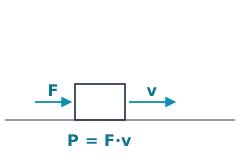
Power equals force multiplied by velocity
When a constant force acts on an object moving with constant velocity in the same direction as the force, the instantaneous power equals the product of the two: P = F × v. This is the steady-state form of P = W/t — substituting W = F·d and v = d/t produces P = F·v. It is the cleanest expression to use when you know the force needed and the speed of motion, e.g., for engines, motors, and conveyor belts.
A car's engine has to overcome a 600 N drag force at a steady 30 m/s on the motorway. What power does the engine deliver to the wheels at that speed?
Real motorway cruising loads are higher because of accessory loads, transmission losses, and grade — but this gives the wheel-side power baseline.
P = F × v is the instantaneous-power form of the work-energy equation. If force and velocity are not aligned, only the component of velocity along the force counts (use P = F·v·cos θ, or the dot product). The formula is most useful at constant velocity, where acceleration is zero and the applied force equals the resistive force. Doubling either F or v doubles the power; doubling both quadruples it — which is why fast vehicles consume disproportionately more fuel at high speed.
Multiply the force by the velocity in the same direction: P = F × v. Use newtons and metres per second to get the answer in watts.
It is the steady-motion form of the power equation, used when a constant force moves an object at a constant velocity — e.g., engines maintaining cruise speed, conveyor belts, lifts, and tow cables.
Use the dot product: P = F·v·cos θ, where θ is the angle between the force vector and the velocity vector. When they're perpendicular (e.g., centripetal force on circular motion), the power is zero.
They are the same equation expressed two ways. W = F·d (work equals force times displacement) and v = d/t (velocity is displacement over time), so W/t = F·(d/t) = F·v. P = F × v is the instantaneous form; P = W/t is the average form.
Aerodynamic drag rises with v², so the power needed to overcome it (drag force × velocity) rises with v³. Doubling cruise speed roughly multiplies aerodynamic power loss by eight.
It gives the instantaneous power at one snapshot in time. To find total energy used during an acceleration, integrate F·v over time, or use the work-energy theorem on the kinetic-energy change.
Reference:
Lindeburg, Michael R. 1992. Engineer In Training Reference Manual. Professional Publication, Inc. 8th Edition.
Automotive Engineering
Engine crank power is higher than this because of drivetrain efficiency losses (typically 10-15 %).
Industrial
Account for gear-reducer and bearing losses by upsizing the motor by roughly 15-25 % over the belt-side number.
Cycling Physics
On a real bike, drivetrain losses are about 2-3 %, so the rider's pedal power is only a few percent above the rear-wheel figure.
