Inductor Design Calculator
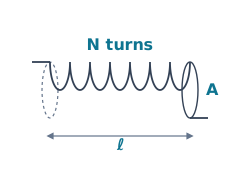
Inductance equals permeability times turns squared times area divided by coil length
The solenoid (cylindrical coil) formula calculates inductance from permeability, number of turns, cross-sectional area, and coil length. Inductance scales with the square of the number of turns.
L = μN²A / l
Wheeler’s approximation for a flat (pancake) spiral coil uses mean radius, turns, and coil depth. It is widely used for PCB trace inductors and RFID antenna coils. All dimensions are in meters and the result is in henries.
L = r²n² / ((2r + 2.8d) × 10⁵)
This calculator covers two inductor geometries. The solenoid (cylindrical coil) formula uses permeability, turns, cross-sectional area, and coil length. The flat spiral air core coil uses Wheeler’s approximation with mean radius, turns, and coil depth (winding width). Both let you solve for any variable.
Design a 1 mH air-core solenoid with 200 turns and a 0.001 m² cross-section. What coil length is needed?
Flat spiral example: A coil with mean radius r = 0.025 m, 10 turns, and depth d = 0.01 m gives L = 0.025² × 100 / ((0.05 + 0.028) × 10⁵) ≈ 8.013 × 10⁻⁶ H (8 μH).
Inductance measures a coil's ability to store energy in a magnetic field. For solenoids, inductance scales with the square of the number of turns because each turn both creates and links flux. Wheeler's approximation handles flat spiral (pancake) coils where the standard solenoid formula is inaccurate. Core material permeability dramatically affects inductance — iron cores can increase it by 1,000x or more over air.
Each turn of wire both creates and links magnetic flux. Doubling the turns doubles the flux created and doubles the flux linked, giving a quadratic (N²) relationship.
μ₀ = 4π × 10⁻⁷ H/m ≈ 1.2566 × 10⁻⁶ H/m. Iron cores have relative permeabilities of 1,000–10,000, dramatically increasing inductance.
It assumes a long, tightly wound single-layer coil. For short coils (length < 2× diameter), toroidal shapes, or multi-layer windings, use Wheeler’s approximation or Nagaoka’s correction factor.
Wheeler’s approximation for a flat spiral air-core coil is L = r²n² / ((2r + 2.8d) × 10⁵), where r is the mean coil radius, n is the number of turns, and d is the coil depth (winding width). It is widely used for PCB inductors and RFID antennas where the coil is wound in a single plane.
Inductors are used in power supply filters, RF circuits, transformers, impedance matching networks, and energy storage. Switching regulators depend on inductors to smooth output current.
Ferromagnetic cores hold a maximum flux density (typically 0.3-2 tesla) above which permeability collapses toward μ₀. Past saturation, the inductor's value drops sharply and current rises uncontrolled — a common failure mode in switching power supplies. Air-core inductors do not saturate but require more turns for the same inductance.
Solenoids favor compact, high-inductance values and are easy to wind around a bobbin or core; they suit power-supply chokes and audio crossovers. Flat spirals are the natural shape for printed-circuit-board traces, RFID tags, and wireless-charging coils where a planar geometry is required.
N² captures the self-coupling of flux through every other turn, A sets the flux carried per amp-turn (more cross-section = more flux for the same H field), and dividing by coil length l accounts for how the field strength along the axis falls off as the coil stretches out.
SMPS Power Inductor — Iron-Loaded Solenoid
A buck-converter power stage needs a power-inductor with a soft-saturating iron-powder toroid (relative permeability μr ≈ 1000, so μ ≈ 1.257 × 10⁻³ H/m). The build target is 200 turns wound to a 5 cm² (0.0005 m²) cross-section across a 10 cm (0.1 m) effective length. Compute the inductance to compare against the converter's calculated minimum.
L ≈ 0.251 H ≈ 251 mH
Real power inductors saturate well before this idealized value when DC bias pushes the core past its linear region. The formula assumes the operating B-field is well below saturation; iron-powder cores roll off gradually, while ferrite cores cut off sharply at Bsat.
PCB-Etched RFID Antenna — Flat Spiral
A 13.56 MHz NFC/RFID reader antenna is etched directly into the PCB as an 8-turn flat spiral with a mean radius r ≈ 15 mm (0.015 m) and a 5 mm-wide annular winding (depth d = 0.005 m). Use the Wheeler short-coil approximation to predict the inductance so the parallel tuning capacitor can be sized.
L ≈ 3.27 × 10⁻⁶ H ≈ 3.27 μH
At 13.56 MHz a 3.3 μH coil tunes to resonance with a 41 pF parallel capacitor (C = 1/(ω²L)). Wheeler's formula is accurate to within ~5% for flat spirals where 2r ≫ d; very tight spirals or single-turn loops need different formulas.
Reverse-Engineering an Unknown Ferrite Slug
An RF engineer measures 5 mH on a hand-wound 150-turn coil around an unmarked ferrite slug (A = 1 cm² = 1 × 10⁻⁴ m², coil length 4 cm = 0.04 m). Back-calculate the effective permeability μ to identify the ferrite mix and compare against datasheets.
μ ≈ 8.89 × 10⁻⁵ H/m (μr ≈ 70.7)
Relative permeability μr ≈ 70 is consistent with a low-permeability iron-powder mix (Micrometals -2 or -8 material), used where DC-bias stability matters more than peak inductance per turn. Higher-μr ferrites (μr 1000+) would have given far more inductance for the same turn count.
Two geometries cover the most common air-core and bobbin-wound inductors: the long cylindrical solenoid and the flat spiral coil used in PCB layouts and RFID antennas.
Where:
The solenoid formula is exact for an infinitely long, uniformly wound coil; it stays within a few percent of measured values when the length is at least twice the diameter. For shorter or thicker coils, Nagaoka's correction factor or Wheeler's short-coil formula gives a better fit. Wheeler's flat-spiral approximation is accurate to about 5% when 2r ≫ d and is the standard for PCB-trace inductors at HF/UHF.
