Pentagonal Prism Calculator
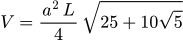
Volume equals one quarter times the square root of twenty-five plus ten square root of five, all times a squared times L
Use this form when the pentagonal edge a and prism length L are known and you need the enclosed volume — columns, packaging, architectural elements with a regular pentagonal cross-section.
V = (1/4)·√(25 + 10√5) · a² · L
Use this form to compute total surface area — two pentagonal caps plus five rectangular lateral faces. Useful for coating, cladding, or material estimates.
S = (1/2)·√(25 + 10√5)·a² + 5·a·L
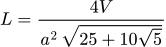
Use this rearrangement when the volume and the pentagonal edge are known and you need the missing prism length.
L = 4V / (a² · √(25 + 10√5))
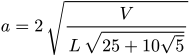
Use this rearrangement when the volume and the prism length are known and you need the missing pentagonal edge.
a = 2·√(V / (L · √(25 + 10√5)))
A regular pentagonal prism has a regular pentagonal cross-section (five equal edges, five 108° interior angles) extruded along a straight length L. The cross-sectional area Apent = (1/4)·√(25 + 10√5)·a² ≈ 1.7204774·a² depends only on the edge a; volume is just that area times the prism length, V = Apent · L. The surface area is the two pentagonal end caps plus five identical rectangular lateral faces: S = 2·Apent + 5·a·L = (1/2)·√(25 + 10√5)·a² + 5·a·L. Inverse solves recover the missing edge or length when the volume is known.
A solid bar has a regular pentagonal cross-section with edge a = 2 m and length L = 5 m. Compute its volume, total surface area, and lateral surface area.
The lateral area (S_lat) is what you need when the end caps are open or not coated — e.g., a pentagonal tube. Total area (S) includes both pentagonal caps.
A regular pentagonal prism has seven faces total: two pentagonal end caps and five rectangular lateral faces, all of width a (the pentagon edge) and length L. The apothem (incircle radius) is (a/2)·√(5 + 2√5)/√5 ≈ 0.6882·a — the perpendicular distance from the center of the pentagon to the middle of an edge. The regular pentagon is closely tied to the golden ratio φ = (1 + √5)/2: any diagonal of the pentagon has length φ·a, and the area coefficient √(25 + 10√5)/4 itself simplifies to (5/4)·tan(54°)·a², linking the pentagon's geometry to φ. Two surface-area numbers matter: total area S includes both caps, and lateral area S_lat = 5aL covers only the five rectangular sides.
Multiply the regular pentagonal cross-section area by the prism length: V = (1/4)·√(25 + 10√5)·a²·L, where a is the pentagon edge and L is the prism length. For a = 2 m, L = 5 m: V = (1/4)·√(25 + 10√5)·4·5 = 5·√(25+10√5) ≈ 34.41 m³.
Total surface area is the two pentagonal caps plus five rectangular lateral faces: S = 2·(1/4)·√(25 + 10√5)·a² + 5·a·L = (1/2)·√(25 + 10√5)·a² + 5·a·L. For a = 2 m, L = 5 m: S = 2·√(25 + 10√5) + 50 ≈ 13.76 + 50 ≈ 63.76 m².
Lateral area S_lat = 5·a·L counts only the five rectangular side faces. Total area S = (1/2)·√(25 + 10√5)·a² + 5·a·L adds the two pentagonal end caps. Use lateral when the ends are open or not being finished; use total when you need to wrap, paint, or coat the whole solid.
Rearrange V = (1/4)·√(25 + 10√5)·a²·L: L = 4V / (a² · √(25 + 10√5)). Given the edge a and the target volume, this returns the required prism length. For V ≈ 34.41 m³ and a = 2 m: L = 4·34.41 / (4·√(25+10√5)) ≈ 137.64 / 27.53 ≈ 5 m.
The area of a regular pentagon with edge a is A = (1/4)·√(25 + 10√5)·a² ≈ 1.7204774·a². It can also be written as (5/4)·a²·cot(π/5), and is the value used as the cross-section in the pentagonal prism's volume formula.
Every diagonal of a regular pentagonal cross-section has length d = φ·a, where φ = (1 + √5)/2 ≈ 1.6180 is the golden ratio. The pentagram drawn inside the pentagon further subdivides into smaller golden-ratio similar pentagons. This makes pentagonal prisms common in art, architecture, and mathematics demonstrations focused on φ.
A pentagonal prism has 7 faces (2 pentagonal caps + 5 rectangular lateral faces), 15 edges (5 on each cap + 5 lateral), and 10 vertices (5 on each cap). Euler's formula confirms it: V − E + F = 10 − 15 + 7 = 2.
The apothem of the regular pentagon is the perpendicular distance from its center to the middle of one of its edges: apothem = (a/2)·√(5 + 2√5)/√5 ≈ 0.6882·a. It equals half the flat-to-flat distance across the pentagon.
Reference:
Weisstein, Eric W. "Pentagonal Prism." MathWorld — A Wolfram Web Resource. https://mathworld.wolfram.com/PentagonalPrism.html
Pentagonal Bar Stock
A solid bar has a regular pentagonal cross-section with edge a = 2 m and length L = 5 m. Compute its volume.
Volume ≈ 34.41 m³
Pentagonal bar stock is uncommon outside specialty fabrication — most pentagonal-prism objects are decorative or tamper-resistant fasteners.
Plating
A pentagonal security nut blank has edge a ≈ 8 mm and thickness L ≈ 8 mm. Compute total surface area for electroplating estimates.
Surface area ≈ 540.22 mm² (≈ 5.40 cm²) per nut blank
Real pentagonal security nuts have a central through-hole that subtracts from each cap and adds an inner surface — this estimate is for a solid blank.
Inverse Solve
A decorative pentagonal column must hold 0.5 m³ of concrete and stand L = 2 m tall. Find the required edge length.
Edge ≈ 0.38 m (flat-to-flat across the pentagon ≈ 0.53 m)
Across-flats (2·apothem ≈ 1.376·a) is the dimension most useful for formwork planning.
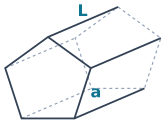
A regular pentagonal prism is defined by two lengths: the pentagonal edge a and the prism length L. Volume, surface area, and inverse solves all follow:
Where: