Hexagonal Prism Calculator
Volume equals three square root of three over two times a squared times L
Use this form when the hexagonal edge a and prism length L are known and you need the enclosed volume — nuts, pencils, honeycomb cells, hex bar stock.
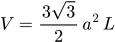
V = (3√3 / 2) · a² · L
Use this form to compute the total surface area — two hexagonal caps plus six rectangular lateral faces. Useful for coating, plating, or material estimates.
S = 3√3·a² + 6·a·L
Use this rearrangement when the volume and the hexagonal edge are known and you need the missing prism length.
L = 2V / (3√3 · a²)
Use this rearrangement when the volume and the prism length are known and you need the missing hexagonal edge.
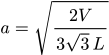
a = √(2V / (3√3 · L))
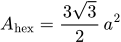
A regular hexagonal prism has a regular six-sided polygon as its cross-section, extruded along a straight length L. The cross-sectional area Ahex = (3√3 / 2)·a² depends only on the edge a; volume is just that area times the prism length, V = Ahex · L. The surface area is the two hexagonal end caps plus six identical rectangular lateral faces: S = 2·Ahex + 6·a·L = 3√3·a² + 6·a·L. Inverse solves recover the missing edge or length when the volume is known.
A solid hex bar has a regular hexagonal cross-section with edge a = 2 m and length L = 5 m. Compute its volume, total surface area, and lateral surface area.
The lateral area (S_lat) is what you need when the end caps are open or not coated — e.g., a hex tube. Total area (S) includes both hexagonal caps.
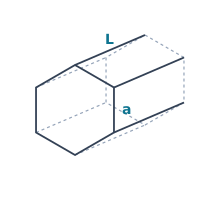
A regular hexagonal prism has eight faces total: two hexagonal end caps and six rectangular lateral faces, all of width a (the hexagon edge) and length L. The apothem (incircle radius) is a√3/2 — the perpendicular distance from the center of the hexagon to the middle of an edge. The circumradius (vertex-to-center) equals the edge length a for a regular hexagon, which is why a hexagon tessellates into six equilateral triangles. Two surface-area numbers matter: total area S includes both caps, and lateral area S_lat = 6aL covers only the six rectangular sides.
Multiply the hexagonal cross-section area by the prism length: V = (3√3 / 2)·a²·L, where a is the hexagonal edge and L is the prism length. For a hex bar with a = 2 m, L = 5 m: V = (3√3/2)·4·5 = 30√3 ≈ 51.96 m³.
Total surface area is the two hexagonal caps plus six rectangular lateral faces: S = 2·(3√3/2)·a² + 6·a·L = 3√3·a² + 6·a·L. For a = 2 m, L = 5 m: S = 12√3 + 60 ≈ 80.78 m².
Lateral area S_lat = 6·a·L counts only the six rectangular side faces (the curved area if the prism were a tube). Total area S = 3√3·a² + 6·a·L adds the two hexagonal end caps. Use lateral when the ends are open or not being finished; use total when you need to wrap, paint, or plate the whole solid.
Rearrange V = (3√3/2)·a²·L: L = 2V / (3√3·a²). Given the edge a and the target volume, this returns the required prism length. For V = 30√3 m³ and a = 2 m: L = 60√3 / (3√3·4) = 5 m.
Most nuts and bolt heads are hexagonal prisms — six flats let a wrench grip from any of three angles. Pencils are hexagonal so they don't roll. Bees build their honeycomb out of hexagonal-prism wax cells because the shape tiles the plane with the least wall area. Hex bar stock is a standard machinist input for parts that need a positive anti-rotation grip.
The apothem is the perpendicular distance from the center of the hexagonal cross-section to the middle of one of its edges: apothem = a·√3 / 2 ≈ 0.866·a. It equals half the flat-to-flat distance across the hexagon, which is the dimension a wrench sizes to.
For a regular hexagon, the circumradius (center-to-vertex) equals the edge: R = a. The flat-to-flat distance (across opposite edges) is 2·apothem = a√3 ≈ 1.732·a. The corner-to-corner distance (long diagonal) is 2a. Hex wrenches and sockets are sized by the flat-to-flat dimension, not the edge.
A hexagonal prism has 8 faces (2 hexagonal caps + 6 rectangular lateral faces), 18 edges (6 on each cap + 6 lateral), and 12 vertices (6 on each cap). Euler's formula confirms it: V − E + F = 12 − 18 + 8 = 2.
Reference:
Weisstein, Eric W. "Hexagonal Prism." MathWorld — A Wolfram Web Resource. https://mathworld.wolfram.com/HexagonalPrism.html
Hex Bar Stock
A solid steel hex bar has a regular hexagonal cross-section with edge a = 2 m and length L = 5 m. Compute its volume.
Volume ≈ 51.96 m³ (about 408,000 kg at 7,850 kg/m³ steel density)
Real hex bar stock is sized in millimeters or inches — typical machine-shop hex stock has edges of 5–50 mm.
Plating
An M10 hex nut blank has edge a ≈ 8 mm and thickness L ≈ 8 mm. Compute total surface area (both caps + 6 sides) for electroplating estimates.
Surface area ≈ 716.55 mm² (≈ 7.17 cm²) per nut
Real M10 nuts have a through-hole that subtracts ~50 mm² from each cap and adds a cylindrical inner surface — this estimate is for a solid blank.
Inverse Solve
A decorative hexagonal column must hold 0.5 m³ of concrete and stand L = 2 m tall. Find the required edge length.
Edge ≈ 0.31 m (across-flats ≈ 0.54 m)
Across-flats (2·apothem = a√3) is the dimension most useful for formwork planning.
A regular hexagonal prism is defined by two lengths: the hexagonal edge a and the prism length L. Volume, surface area, and inverse solves all follow:
Where: