Pendulum Period Calculator
Period equals 2 pi times the square root of length divided by gravity
The period (T) of a simple pendulum is the time it takes to complete one full swing, and depends only on the string length (L) and the local gravitational acceleration (g). The relationship is T = 2π√(L/g) — note that the mass of the bob does not appear. A longer string gives a longer period; stronger gravity gives a shorter period. The formula assumes small swing angles (below ~15°), where sin(θ) ≈ θ; larger amplitudes require an elliptic-integral correction.
A grandfather clock pendulum is 1 m long. What is its period on Earth, where g = 9.81 m/s²?
The 2-second period is why grandfather clocks are built around a roughly 1-metre pendulum: it matches the natural swing of a one-second tick.
T = 2π√(L/g) is the small-angle simple-pendulum equation. It is independent of bob mass (Galileo's discovery) and independent of swing amplitude as long as the amplitude is small. The frequency is the reciprocal of the period: f = 1/T. For larger angles, the true period exceeds the small-angle value by a few tenths of a percent at 15°, but more dramatically as the amplitude grows.
Use T = 2π√(L/g). Divide the string length L by the gravitational acceleration g, take the square root, then multiply by 2π. The result is the time for one complete swing in seconds.
T = 2π√(L/g), where L is the string length in metres and g is the local gravitational acceleration in m/s². The bob's mass does not appear in the formula.
No. For a simple pendulum at small angles, the period depends only on the string length and gravity — not on how heavy the bob is. A bowling ball and a tennis ball on identical 1 m strings swing at the same rate.
Rearranging T = 2π√(L/g) gives L = g(T/2π)². For T = 1 s on Earth, L = 9.81 × (1/(2π))² ≈ 0.248 m, or about 24.8 cm.
T = 2π√(L/g) is exact only for infinitesimally small swings. For 15° amplitudes the error is below 0.5%, but it grows quickly: a 45° amplitude pendulum has a period about 4% longer than the small-angle formula predicts.
A pendulum on the Moon (g ≈ 1.62 m/s²) swings about √(9.81/1.62) ≈ 2.46× slower than the same pendulum on Earth. Stronger gravity (a denser planet) speeds up the swing.
Reference:
Lindeburg, Michael R. 1992. Engineer In Training Reference Manual. Professional Publication, Inc. 8th Edition.
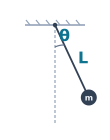
A simple pendulum is a point mass on a massless string of length L, free to swing through small angles under gravity g. The period only depends on the string length and the gravitational field — not on the bob's mass or, for small angles, the amplitude.
L — length from pivot to bob center of mass · m — bob mass (cancels out of T) · θ — swing angle from vertical (must be small for T = 2π√(L/g) to be accurate) · g — local gravitational acceleration.
Seismology
In 1851 Léon Foucault hung a 28 kg brass bob from the Panthéon dome on a 67 m wire to prove Earth's rotation. Compute the swing period at Paris's local g ≈ 9.81 m/s².
T ≈ 16.42 s
The slow swing made it easy to mark each plane traversal in chalk on a sand ring; the plane of swing appeared to rotate by about 11° per hour at Paris's latitude (sin 49°). Modern seismometers use much shorter pendulums but the same T = 2π√(L/g) relation.
Planetary Science
Imagine a wall clock with a 1.5 m pendulum mounted inside a future Mars surface habitat. Mars has a surface gravity of g ≈ 3.72 m/s² — calculate the natural swing period.
T ≈ 3.99 s
An Earth-tuned pendulum clock would run roughly √(9.81/3.72) ≈ 1.62× slower on Mars, losing about 9 hours per Earth day. Habitat clocks would need physically shorter pendulums (≈ 0.57 m for a 1-second tick) or electromechanical timekeeping.
Clockmaking
Before the metre was standardised by Earth-quadrant measurement, French scientists proposed defining it as the length of a pendulum whose half-period equals 1 second. Plug L = 0.994 m and standard gravity g = 9.80665 m/s² into Kater's formula and confirm T = 2 s.
T ≈ 2.000 s
Each half-swing is exactly one second — that's why it's called the "seconds pendulum." The proposal was eventually dropped because g varies with latitude and altitude, but high-precision pendulum gravimeters used the same principle to map Earth's gravity field through the 20th century.
For small swing angles, the period of a simple pendulum depends only on its length and the local gravitational acceleration — not on the bob's mass and (to first order) not on the amplitude. This makes a pendulum one of the simplest practical ways to measure g.
Where:
The formula assumes a massless string, a point-mass bob, and small-angle motion (θ ≲ 15°), where sin θ ≈ θ. At larger amplitudes the period lengthens slightly — the leading correction adds about θ²/16 to T, so a 30° swing is roughly 1.7% slower than the small-angle result. The mass of the bob cancels out entirely; this is why Galileo could conclude that all pendulums of equal length keep time the same way.
