Pendulum Length Calculator
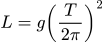
Length equals gravity times the quantity period divided by 2 pi, squared
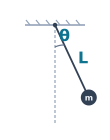
The pendulum length calculator inverts T = 2π√(L/g) to give L in terms of the target period and local gravity: L = g(T/2π)². It tells you how long a simple-pendulum string must be to produce a chosen tick rate. The result is the effective length — the distance from the pivot to the centre of mass of the bob — so a long thin rod with a heavy bob has a slightly larger effective length than the visible string.
How long does a simple pendulum need to be on Earth (g = 9.81 m/s²) to have a period of exactly 2 seconds — the classic grandfather-clock tick?
Real clock movements use a slightly shorter rod (closer to 0.994 m) and tune to exact pitch with a small adjustment nut at the bottom of the bob.
L = g(T/2π)² is the inverse of the small-angle simple-pendulum equation. It depends on g, so the same target period gives different required lengths on different planets — a 2-second pendulum on the Moon would be over 6× shorter than on Earth. The formula assumes the bob is a point mass and the string is massless; for a real bob with finite size, use the physical-pendulum formula instead.
Use L = g(T/2π)². Divide the target period T by 2π, square the result, then multiply by the local gravitational acceleration g. The output is the required string length in metres.
L = g(T/2π)². It is the inverse of T = 2π√(L/g), the small-angle simple-pendulum period equation.
On Earth (g = 9.81 m/s²), a 1-second pendulum is L = 9.81 × (1/(2π))² ≈ 0.248 m, or about 24.8 cm.
On Earth, L = 9.81 × (2/(2π))² ≈ 0.994 m — just under one metre. This is why grandfather clocks are about a metre tall in the pendulum case.
Only for small swings (below about 15°). For larger amplitudes the true period is longer than the small-angle prediction, so the formula gives a length that is slightly too long for the desired period.
L scales linearly with g for the same target period: doubling g doubles the required length. A 2-second pendulum on the Moon (g = 1.62 m/s²) is only 0.164 m long, versus 0.994 m on Earth.
Reference:
Lindeburg, Michael R. 1992. Engineer In Training Reference Manual. Professional Publication, Inc. 8th Edition.
Horology
Clock movements typically include a fine-pitch adjustment nut so the pendulum can be tuned to drift no more than a few seconds per day.
Earth Sciences
Long Foucault pendulums minimise air-drag corrections; the original 1851 installation at the Panthéon used a 67 m wire.
Lunar Physics
The same 1-second period pendulum on Earth requires about 0.248 m of string — six times longer.