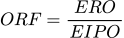
Oil Recovery Factor Equation
The oil recovery factor is recoverable oil divided by total oil in place. It tells engineers what fraction of a reservoir's petroleum can actually be brought to the surface. Typical values range from 5–15% for primary depletion up to 60%+ with enhanced oil recovery methods.
ORF = ERO / EIPO
Recoverable Oil from Recovery Factor
Rearranges the formula to compute how many barrels are ultimately producible given a target recovery factor and in-place volume. Used for reserves bookings and production forecasts.
ERO = ORF × EIPO
Oil In Place from Recoverable Volume
Back-solves for the original oil-in-place estimate given known recoverable reserves and a field-level recovery factor. Useful when validating seismic and volumetric reservoir models against actual production data.
EIPO = ERO / ORF
How It Works
The oil recovery factor (ORF) is recoverable oil divided by total oil in place. It tells engineers what fraction of a reservoir's petroleum can actually be brought to the surface. Typical values range from 5–15% for primary depletion up to 60%+ when enhanced oil recovery (EOR) methods such as steam injection or CO₂ flooding are used. The recovery factor is one of the two biggest levers on reserves value — the other is the original oil-in-place volume itself.
Example Problem
A reservoir contains an estimated 500 million barrels of oil in place (EIPO). Engineering studies predict 175 million barrels can be recovered (ERO) using a waterflood. Calculate the recovery factor and interpret it.
- Identify the formula: ORF = ERO / EIPO.
- Write down the known values: ERO = 175 MMbbl, EIPO = 500 MMbbl.
- Check that both are in the same volume unit (here, barrels).
- Divide: 175,000,000 / 500,000,000 = 0.35.
- Convert to percentage: 0.35 × 100 = 35%.
- Interpret: a 35% recovery factor is typical for secondary waterflood — adding a CO₂ miscible flood could push recovery above 50% with 15 percentage points of uplift.
Recovery factors are almost always reported as percentages in published reserves reports (SEC 10-K filings, CPR reports) even though the underlying number is a dimensionless fraction.
When to Use Each Variable
- Solve for Recovery Factor — when you know both recoverable oil and oil in place, to evaluate reservoir performance or compare fields.
- Solve for Recoverable Oil — when you know the recovery factor and total oil in place, to estimate expected production and book reserves.
- Solve for In-Place Oil — when you know the recovery factor and recoverable volume, to back-calculate the total oil in place for reservoir characterization.
Key Concepts
The oil recovery factor is the ratio of recoverable oil to total oil in place, expressed as a fraction or percentage. Recovery depends on the recovery mechanism: primary (natural pressure depletion), secondary (water or gas injection), and tertiary/enhanced (thermal, chemical, or miscible flooding). Each successive stage mobilizes additional trapped oil at increasing cost. The technical recovery factor assumes all oil can be extracted regardless of cost; the economic recovery factor — what reserves auditors actually book — is always lower because production must remain profitable at prevailing oil prices.
Applications
- Reservoir engineering: evaluating field performance and comparing recovery efficiency across reservoirs
- Production forecasting: estimating total recoverable reserves for investment and long-range planning
- EOR project screening: determining whether enhanced recovery methods are economically justified
- Regulatory reporting: documenting proved and probable reserves for SEC filings and SPE-PRMS categorization
- Acquisition due diligence: benchmarking a target asset's recovery factor against analog fields
- Carbon storage planning: modeling CO₂-EOR projects where incremental recovery offsets sequestration cost
Common Mistakes
- Confusing oil in place (OOIP) with recoverable reserves — only a fraction of oil in place can be economically extracted
- Applying a single recovery factor to an entire field — different zones and reservoir types within the same field can have very different recovery factors
- Ignoring the economic cutoff — technical recovery factor assumes all oil can be extracted regardless of cost; the economic recovery factor is always lower
- Using inconsistent units — ERO and EIPO must be in the same volume unit or the ratio is meaningless
- Assuming shale reservoirs will behave like conventional fields — tight oil typically recovers only 5–10% regardless of stimulation intensity
Frequently Asked Questions
What percentage of oil is actually extracted from a reservoir?
Globally, the average recovery factor is around 35%, but it varies widely. Primary recovery alone typically extracts 5–15% of the original oil in place. Secondary methods such as waterflood and gas injection add another 15–25 percentage points. Enhanced oil recovery (EOR) techniques — thermal, chemical, or CO₂ miscible flooding — can push recovery above 60% in favorable reservoirs. Tight oil and shale plays are the major exception, rarely exceeding 10%.
How do you calculate oil recovery factor?
Use the formula ORF = ERO / EIPO, where ERO is the estimate of recoverable oil and EIPO is the estimate of oil in place. Both must be in the same volume units (barrels, cubic meters, etc.). Multiply the resulting fraction by 100 to express as a percentage. For example, a reservoir with 150 MMbbl recoverable and 500 MMbbl in place has a recovery factor of 150 / 500 = 0.30, or 30%.
What is a good oil recovery factor?
There is no single 'good' value — it depends on the reservoir. Conventional sandstone under waterflood typically achieves 30–45%. Carbonate reservoirs average 15–30% due to their more complex pore structure. Heavy oil requires thermal EOR and often recovers 10–25%. Shale rarely exceeds 10%. What matters most is whether the recovery factor makes the project economic at current oil prices.
How is oil in place estimated?
Geologists combine seismic surveys, well logs, and core samples to estimate reservoir volume, porosity, and oil saturation. The volumetric method multiplies rock volume × porosity × net-to-gross ratio × oil saturation, then adjusts for the formation volume factor (B₀) to convert reservoir-conditions volume to surface-conditions barrels. Material balance and decline-curve methods provide independent checks once a field is on production.
What is enhanced oil recovery (EOR)?
EOR refers to techniques that go beyond water or gas injection to mobilize trapped oil. Common methods include steam injection and in-situ combustion (thermal), polymer, surfactant, or alkaline flooding (chemical), and CO₂ miscible flooding. EOR can add 10–30 percentage points to a reservoir's recovery factor but requires significant capital investment in injection infrastructure and gas supply.
Why does shale oil have such a low recovery factor?
Shale and tight oil reservoirs have matrix permeability measured in nanodarcies — thousands of times lower than conventional sandstone. Oil can only flow into hydraulically fractured stimulated rock volume (SRV) near the well, leaving most of the matrix oil trapped. Recovery factors are typically 5–10%, and traditional EOR methods are generally ineffective because injected fluids bypass the matrix through the fracture network.
What units are used for oil volume?
The petroleum industry reports oil in barrels (1 barrel = 42 US gallons ≈ 0.159 m³). One million barrels is abbreviated MMbbl and one billion barrels is Bbbl. Metric producers often report in cubic meters (m³) or metric tons of oil equivalent (MTOE). This calculator supports barrels, cubic meters, liters, gallons, and other volume units with automatic conversion.
Oil Recovery Factor Formula
The oil recovery factor is the dimensionless ratio of the oil volume that can ultimately be produced to the original oil volume in place:
ORF = ERO / EIPO
Where:
- ORF — oil recovery factor, dimensionless (reported as a fraction or percentage)
- ERO — estimate of recoverable oil, in reservoir volume (bbl, m³, etc.)
- EIPO — estimate of oil in place (OOIP), in the same volume unit as ERO
ERO and EIPO must be expressed in the same volume units for the ratio to be dimensionless. The calculator handles unit conversions automatically — for example, enter ERO in barrels and EIPO in cubic meters, and the tool converts internally.
Worked Examples
Conventional Oil — Primary Recovery
A sandstone reservoir holds 800 MMbbl OOIP. How much is recoverable by natural depletion?
A conventional onshore sandstone reservoir contains an estimated 800 million barrels of oil in place. Reservoir engineering predicts a primary-depletion recovery factor of 12%.
- ERO = ORF × EIPO = 0.12 × 800 MMbbl
- Remaining trapped oil: 704 MMbbl — candidates for secondary or tertiary recovery
ERO = 96 MMbbl
Primary drive alone leaves the majority of oil behind. Operators plan waterflood or gas-injection projects years in advance to keep production economic as natural pressure declines.
Enhanced Oil Recovery (EOR)
What recovery factor does a CO₂ miscible flood achieve on a 1.2 Bbbl field?
A mature light-oil field with 1,200 MMbbl OOIP has already produced 420 MMbbl through primary and waterflood stages. Engineers add a CO₂ miscible flood that is projected to recover an additional 240 MMbbl.
- Cumulative recovered (ERO) = 420 + 240 = 660 MMbbl
- ORF = ERO / EIPO = 660 / 1,200
- Incremental uplift from CO₂ EOR: 20 percentage points
ORF = 0.55 (55%)
CO₂ miscible flooding is most effective in light-oil reservoirs deeper than ~3,000 ft. Typical incremental recovery is 8–20 percentage points, with a CO₂ utilization of 3–10 Mcf per incremental barrel.
Shale / Tight Oil
Why does a Bakken shale section with 50 MMbbl OOIP recover only 4 MMbbl?
A 1,280-acre Bakken drilling spacing unit holds an estimated 50 million barrels of oil in place. Primary production with multi-stage hydraulic fracturing is expected to recover 4 million barrels over the well's producing life.
- ORF = ERO / EIPO = 4 / 50
- Recovery is one-fifth of a typical conventional sandstone field
ORF = 0.08 (8%)
Unconventional shale and tight-oil reservoirs have very low permeability, so even with extensive hydraulic fracturing recovery factors usually range from 5% to 10%. Most field-level uplift comes from closer well spacing and refracturing older wells rather than traditional EOR.
Related Calculators
- Soil Resistivity Calculator — measure subsurface electrical resistivity for geophysical surveys
- Seismic Geophone Calculator — determine layer depth and velocity from seismic refraction data
- Electrodialysis Calculator — size membrane stacks for water treatment and desalination
- Geotextile Calculator — design geotextile filtration for subsurface applications
- Darcy's Law Calculator — calculate fluid flow through porous media in reservoir analysis
- Volume Unit Converter — convert between barrels, gallons, and cubic meters
Related Sites
- CameraDOF — Depth of field calculator for photographers
- LoanChop — Loan prepayment calculator
- Compare 2 Loans — Side-by-side loan comparison calculator
- InfantChart — Baby and child growth percentile charts
- Medical Equations — Hemodynamic, pulmonary, and dosing calculators
- Dollars Per Hour — Weekly paycheck calculator with overtime