Solve for Current
Calculate the electrical current required for an electrodialysis stack given Faraday's constant, solution normality, flow rate, removal efficiency, number of cells, and current efficiency.
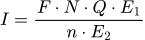
I = F × N × Q × E₁ / (n × E₂)
Solve for Flow Rate
Find the maximum flow rate an ED stack can treat given the available current, cell count, and efficiencies.
Q = I × n × E₂ / (F × N × E₁)
Solve for Number of Cells
Determine how many cell pairs are needed in the membrane stack for a given current and operating conditions.
n = F × N × Q × E₁ / (I × E₂)
Solve for Current Efficiency
Back-calculate the current efficiency of an operating ED stack from measured current, flow, and ion removal data.
E₂ = F × N × Q × E₁ / (I × n)
Solve for Normality
Find the solution normality required to match measured stack current and geometry.
N = I × n × E₂ / (F × Q × E₁)
Solve for Removal Efficiency
Determine the ion removal efficiency achieved by an ED stack from its electrical and hydraulic operating parameters.
E₁ = I × n × E₂ / (F × N × Q)
How It Works
Electrodialysis (ED) uses an electric field to pull dissolved ions through ion-selective membranes, separating salts from water. The current equation I = F × N × Q × E₁ / (n × E₂) ties Faraday's constant (96,487 C/eq) to the solution strength, flow rate, and membrane efficiency so you can size the electrical supply for a given stack.
Example Problem
A brackish-water ED stack has 200 cell pairs. The feed is 0.05 eq/L at 0.5 L/s. Removal efficiency is 0.70 and current efficiency is 0.90. What current is needed?
- Identify the known values: F = 96,487 C/eq, N = 0.05 eq/L, Q = 0.5 L/s, E₁ = 0.70, n = 200, E₂ = 0.90.
- We are solving for current I using the formula I = F × N × Q × E₁ / (n × E₂).
- Write the formula and substitute the values: I = 96,487 × 0.05 × 0.5 × 0.70 / (200 × 0.90).
- Calculate the numerator: 96,487 × 0.05 × 0.5 × 0.70 = 1,688.5 C/s.
- Calculate the denominator: 200 × 0.90 = 180.
- Divide to get the result: I = 1,688.5 / 180 = 9.38 amperes.
When to Use Each Variable
- Solve for Current — when you know the feed properties, flow rate, and stack geometry and need to size the electrical supply — the most common design calculation.
- Solve for Flow Rate — when you have a fixed power supply and need to find the maximum treatable flow rate.
- Solve for Number of Cells — when you are sizing a new ED stack and need to determine how many cell pairs to include.
- Solve for Current Efficiency — when you want to back-calculate efficiency from measured operating data on an existing stack.
- Solve for Normality — when you need to find the feed ion concentration that matches observed stack performance.
- Solve for Removal Efficiency — when you want to determine the fraction of ions removed under given operating conditions.
Key Concepts
Electrodialysis uses alternating cation-exchange and anion-exchange membranes in a stack of cell pairs, driven by a DC electric field. Ions migrate through the selective membranes, concentrating in reject channels and depleting in product channels. Faraday's law relates current to ion transport: I = F*N*Q*E1 / (n*E2), where F is Faraday's constant (96,487 C/eq). Current efficiency accounts for back-diffusion, osmotic water transport, and electrical leakage.
Applications
- Brackish water desalination: cost-effective salt removal for drinking water with TDS below 5,000 mg/L
- Food and beverage processing: demineralizing whey, wine, and fruit juice without thermal damage
- Pharmaceutical manufacturing: producing purified water and removing ionic impurities from drug formulations
- Industrial wastewater: recovering valuable ions like lithium, copper, and nickel from process streams
- Table salt production: concentrating seawater brine before evaporation in solar salt works
Common Mistakes
- Confusing current efficiency with removal efficiency — current efficiency (E₂) measures how much current actually moves ions, while removal efficiency (E₁) measures the fraction of ions removed from the feed
- Forgetting to use equivalents (eq/L) for normality — molar concentration must be multiplied by the ion valence
- Ignoring membrane fouling and scaling — real-world stacks require periodic cleaning or reversal (EDR) to maintain performance
- Assuming linear scaling — doubling cells does not always halve the required current because of increased electrical resistance and leakage
Frequently Asked Questions
How does electrodialysis remove salt from water?
ED applies a DC voltage across a stack of alternating cation- and anion-exchange membranes. Dissolved ions migrate through the selective membranes toward the electrodes, concentrating in reject channels and leaving purified water in the product channels. No high pressure is needed, unlike reverse osmosis.
When is electrodialysis preferred over reverse osmosis?
ED is generally preferred for brackish water below 5,000 mg/L TDS where it uses less energy than RO. ED is also better when selective ion removal is needed (e.g., nitrate removal while keeping calcium), when the feed has high fouling potential, or when brine recovery is important.
What is Faraday's constant and why does it appear in the ED equation?
Faraday's constant (F = 96,487 C/eq) is the electric charge carried by one mole of monovalent ions. It converts the chemical demand (equivalents of ions to remove per second) into the electrical demand (amperes of current) that the stack must supply.
What is a typical current efficiency for an ED stack?
Current efficiency typically ranges from 0.80 to 0.95. Losses come from back-diffusion of ions, water transport through the membranes, and electrical leakage between cells. Well-maintained stacks with tight seals usually exceed 0.90.
How many cell pairs does a commercial ED stack typically have?
Small laboratory or pilot stacks may have 10–50 cell pairs, while full-scale commercial stacks typically contain 200–600 cell pairs. The number depends on the target ion removal, available current, and space constraints.
What maintenance does an electrodialysis system require?
Periodic polarity reversal (electrodialysis reversal, or EDR) prevents membrane scaling. Chemical cleaning-in-place (CIP) with acids and alkalis removes fouling every few weeks to months. Membrane replacement is typically needed every 5–10 years depending on feed quality.
Can electrodialysis treat seawater?
ED can concentrate seawater brine for salt production, but it is not cost-effective for full seawater desalination (35,000 mg/L TDS). RO is preferred for high-salinity feeds because ED energy consumption scales linearly with TDS, while RO energy scales with pressure and is less dependent on salinity at high concentrations.
Electrodialysis Current Formula
The electrodialysis design equation relates the electrical current to the feed properties and membrane stack geometry:
I = F × N × Q × E₁ / (n × E₂)
Where:
- I — electric current (amperes)
- F — Faraday's constant (96,487 C/eq)
- N — solution normality (eq/L)
- Q — volumetric flow rate (L/s)
- E₁ — removal efficiency (fraction, 0 to 1)
- n — number of cell pairs in the stack
- E₂ — current efficiency (fraction, 0 to 1)
Worked Examples
Desalination
How much current does a brackish water ED stack need?
A municipal water plant treats brackish groundwater with 0.02 eq/L salinity at 50 L/s through a 200-cell ED stack. Target removal is 80% with 90% current efficiency.
- N = 0.02 eq/L, Q = 50 L/s, E₁ = 0.80, n = 200, E₂ = 0.90
- Numerator: 96,487 × 0.02 × 50 × 0.80 = 77,189.6
- Denominator: 200 × 0.90 = 180
I = 77,189.6 / 180 = 428.8 A
Real stacks may require higher current to overcome membrane resistance and non-ideal ion transport.
Food Industry
What flow rate can a dairy whey demineralization stack handle?
A dairy plant operates an ED stack with 150 cell pairs at 300 A. The whey has 0.05 eq/L normality. Current efficiency is 0.85 and target removal is 0.70.
- Q = I × n × E₂ / (F × N × E₁)
- Q = 300 × 150 × 0.85 / (96,487 × 0.05 × 0.70)
- Q = 38,250 / 3,377.0
Q = 11.33 L/s
Whey fouling may reduce effective flow capacity over time; periodic cleaning-in-place is required.
Pharmaceutical
How many cell pairs are needed for ultrapure water production?
A pharmaceutical plant needs 99% ion removal from 0.01 eq/L feed water at 10 L/s. The rectifier supplies 500 A with 0.92 current efficiency.
- n = F × N × Q × E₁ / (I × E₂)
- n = 96,487 × 0.01 × 10 × 0.99 / (500 × 0.92)
- n = 9,552.2 / 460
n = 20.8 → 21 cell pairs
Multiple ED stages with electrodeionization (EDI) polishing are typical for pharmaceutical-grade water.
Related Calculators
- Soil Resistivity Calculator — measure soil electrical resistivity with the Wenner four-pin method
- Geotextile Calculator — calculate hydraulic permittivity and transmissivity for drainage design
- Oil Recovery Factor Calculator — estimate recoverable petroleum reserves from in-place oil data
- Reverse Osmosis Calculator — design RO membrane systems for water desalination
- Current Converter — convert between amperes, milliamperes, and other current units
Related Sites
- CameraDOF — Depth of field calculator for photographers
- LoanChop — Loan prepayment calculator
- Compare 2 Loans — Side-by-side loan comparison calculator
- InfantChart — Baby and child growth percentile charts
- Medical Equations — Hemodynamic, pulmonary, and dosing calculators
- Dollars Per Hour — Weekly paycheck calculator with overtime