How It Works
Seismic refraction surveys line geophones along the ground surface and record how long it takes a shock wave (from a hammer strike or small explosive) to reach each sensor. When waves cross from a slow layer into a faster layer, they refract along the interface and eventually overtake the direct wave at distant geophones. The crossover distance where direct and refracted arrivals coincide — combined with the two layer velocities — yields the depth to the interface. The method is fast and inexpensive compared to drilling and is the standard first step in characterizing near-surface geology for engineering, mining, and hydrogeology.
Example Problem
A refraction survey finds the crossover distance (d) is 30 m. The upper-layer velocity (v₁) is 500 m/s and the bedrock velocity (v₂) is 2,000 m/s. What is the overburden depth?
- Identify inputs: d = 30 m, v₁ = 500 m/s, v₂ = 2,000 m/s. Verify v₂ > v₁ (refraction is only valid for a faster lower layer).
- Compute the velocity ratio: (v₂ − v₁)/(v₂ + v₁) = (2000 − 500)/(2000 + 500) = 0.6.
- Take the square root: √0.6 ≈ 0.7746.
- Apply the depth formula: t = (d/2) · √ratio = (30/2) · 0.7746 = 15 · 0.7746.
- Multiply: t ≈ 11.62 m.
- Interpret: the soil/weathered overburden is ~11.6 m thick before reaching competent rock — useful for pile design, excavation planning, or mine feasibility.
Combine refraction estimates with one or two control boreholes to confirm the velocity contrast and check for hidden layers.
When to Use Each Variable
- Solve for Layer Depth — when you know the crossover distance and layer velocities, e.g., determining overburden thickness before excavation.
- Solve for Intersection Distance — when you know the layer depth and velocities, e.g., planning geophone spread length for a survey.
- Solve for Upper Layer Velocity — when you know depth, crossover distance, and bedrock velocity, e.g., characterizing soil conditions from partial survey data.
- Solve for Lower Layer Velocity — when you know depth, crossover distance, and surface velocity, e.g., identifying the bedrock type from its seismic velocity.
Key Concepts
Seismic refraction uses the time it takes shock waves to travel from a source to an array of geophones to map subsurface layers. When a wave crosses from a slower layer into a faster one, it refracts along the interface and eventually reaches distant geophones before the direct wave. The crossover distance where direct and refracted waves arrive simultaneously, combined with the velocities of each layer, allows calculation of the interface depth.
Applications
- Construction site investigation: determining depth to bedrock for foundation design and excavation planning
- Water table mapping: locating the saturated zone by detecting the velocity contrast between dry and saturated soil
- Mining exploration: estimating overburden thickness to plan open-pit or strip mining operations
- Road and dam engineering: profiling subsurface layers to assess bearing capacity and stability
Common Mistakes
- Assuming the lower layer is always faster — seismic refraction only works when deeper layers have higher velocities (no velocity inversions)
- Using too short a geophone spread — the spread must extend well beyond the crossover distance to capture refracted arrivals
- Ignoring lateral velocity variations — the method assumes horizontal, uniform layers, which can produce errors in dipping or irregular geology
- Confusing seismic refraction with reflection — refraction uses first-arrival times, while reflection uses later bounced arrivals
Frequently Asked Questions
How do geophones detect underground vibrations?
A geophone is a small spring-mounted magnet inside a coil. When the ground moves, the case shakes with it but the suspended mass lags, so the relative motion generates a tiny voltage proportional to ground velocity. An array of geophones wired to a seismograph turns those voltages into a time-series record of seismic wave arrivals at each station, which is then inverted to image the subsurface.
What frequency range does a seismic geophone capture?
Standard engineering-scale geophones have a natural frequency of 4.5–14 Hz and a usable bandwidth from a couple of hertz up to 250–500 Hz, well matched to the compressional (P) and surface (Rayleigh) waves used in refraction and MASW surveys. Broadband earthquake instruments extend below 0.01 Hz using specialized force-balance designs, while hydrophones and MEMS accelerometers handle higher frequencies for near-source monitoring.
What is seismic refraction used for?
It is used to determine depth to bedrock, map the water table, estimate overburden thickness for mining, and characterize subsurface conditions before construction. The method is fast and inexpensive compared to drilling and works well for shallow targets up to a few tens of meters.
How deep can a seismic refraction survey measure?
The maximum depth is roughly one-third to one-fifth of the total geophone spread length. A typical 120 m spread can resolve layers to about 25–40 m depth. Deeper investigations require longer spreads and a larger energy source such as a weight drop or small explosive charge.
What is the crossover distance in seismic refraction?
The crossover (intersection) distance is where the direct wave and the refracted wave arrive at a geophone at the same time. Beyond this point, the faster refracted wave arrives first because its longer path through a faster medium overtakes the slower direct path. This distance, combined with the two layer velocities, is used to calculate overburden depth.
What are typical seismic velocities for soil and rock?
Loose dry soil: 200–500 m/s. Saturated soil or dense clay: 500–1,500 m/s. Weathered rock: 1,500–3,000 m/s. Sound bedrock (granite, limestone): 3,000–6,000 m/s. The lower layer must be faster than the upper layer for refraction to work — otherwise the interface is a hidden-layer problem and you need reflection or MASW instead.
How is a seismic refraction survey conducted in the field?
A crew lays out 12 or 24 geophones at a constant spacing (commonly 1–5 m) along a straight line. They strike the ground with a sledgehammer or small explosive at multiple shot points — typically both ends of the line and several mid-spread locations — while the seismograph records first arrivals. Plotting travel time against distance produces the direct-wave and refracted-wave slopes that feed directly into this calculator.
Seismic Refraction Formula
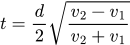
For a two-layer earth model with a faster lower layer, the depth to the refracting interface is:
t = (d / 2) · √((v₂ − v₁) / (v₂ + v₁))
Where:
- t — depth to the refracting interface (m)
- d — crossover (intersection) distance where direct and refracted waves arrive simultaneously (m)
- v₁ — upper-layer (surface) seismic velocity (m/s)
- v₂ — lower-layer (refractor) seismic velocity (m/s), must exceed v₁
The relationship assumes horizontal, uniform layers with a step increase in velocity. In real surveys, reverse profiles and multiple shot points help detect dipping interfaces and lateral variations.
Worked Examples
Oil & Gas Exploration — Subsurface Imaging
How deep is the cap rock if crossover is 600 m with v₁ = 2,000 m/s and v₂ = 4,500 m/s?
A 2D refraction line across a frontier exploration block records a crossover at 600 m. Surface alluvium travels at 2,000 m/s; suspected carbonate cap rock travels at 4,500 m/s.
- (v₂ − v₁)/(v₂ + v₁) = (4500 − 2000)/(4500 + 2000) = 0.3846
- √0.3846 ≈ 0.6202
- t = (600/2) · 0.6202 = 300 · 0.6202
t ≈ 186 m
Refraction gives a quick first-pass cap rock depth before deploying expensive 3D seismic or drilling a pilot hole.
Earthquake Monitoring — Network Site Survey
What geophone spread length is needed to image bedrock 12 m deep?
A seismic network manager is installing a borehole instrument and needs to characterize near-surface site response. Upper layer soil = 400 m/s, bedrock = 2,500 m/s, target bedrock depth = 12 m. What crossover distance (and therefore spread length) is required?
- (v₂ − v₁)/(v₂ + v₁) = (2500 − 400)/(2500 + 400) = 0.7241
- √0.7241 ≈ 0.8510
- d = 2t / √ratio = 2·12 / 0.8510
d ≈ 28.2 m
A typical 2D spread should extend to at least 3–5× the crossover distance (~85–140 m) to capture clean refracted arrivals for inversion.
Civil Engineering — Pre-Construction Foundation Study
What is the overburden depth for a bridge abutment site with d = 30 m, v₁ = 500 m/s, v₂ = 2,000 m/s?
A highway bridge designer needs depth-to-refusal before sizing piles. A refraction survey on the west abutment measures a 30 m crossover with 500 m/s surface soil and 2,000 m/s competent rock underneath.
- (v₂ − v₁)/(v₂ + v₁) = (2000 − 500)/(2000 + 500) = 0.6
- √0.6 ≈ 0.7746
- t = (30/2) · 0.7746 = 15 · 0.7746
t ≈ 11.6 m
Combined with borings, this tells the designer to specify ~12 m end-bearing piles that key 2 m into competent rock.
Related Calculators
- Seismometer Calculator — calculate earthquake magnitude, seismic moment, and energy
- Soil Resistivity Calculator — measure soil resistivity using the Wenner four-pin method
- Geotextile Calculator — compute permittivity and transmissivity for drainage fabrics
- Sound Wave Calculator — calculate wave speed, frequency, and wavelength relationships
- Length Unit Converter — convert depth and distance units for geophysical surveys
Related Sites
- CameraDOF — Depth of field calculator for photographers
- LoanChop — Loan prepayment calculator
- Compare 2 Loans — Side-by-side loan comparison calculator
- InfantChart — Baby and child growth percentile charts
- Medical Equations — Hemodynamic, pulmonary, and dosing calculators
- Dollars Per Hour — Weekly paycheck calculator with overtime