Simple Break-Even Formula
If you already know how much your new payment will drop, this is the fastest way to see when the refinance pays for itself. Divide what you'll pay at closing by how much each month's payment shrinks, and you get the number of months you need to stay in the home to come out ahead.
Break-Even (months) = Closing Costs ÷ Monthly Savings
Advanced Break-Even with Payment Calculation
Don't have the new monthly payment yet? Plug in your current loan balance, both interest rates, and both terms. The calculator computes each monthly payment from the standard amortization formula, subtracts to get monthly savings, then divides closing costs by that savings.
Break-Even = Closing Costs ÷ (P_old − P_new), where P = L·r(1+r)ⁿ / ((1+r)ⁿ − 1)
How It Works
Refinancing replaces your current mortgage with a new one — usually at a lower interest rate, sometimes at a different term. You pay closing costs upfront (typically 2–5% of the loan amount), and in exchange you get a lower monthly payment. The break-even point is how many months of lower payments it takes to recoup those closing costs. If you sell or refinance again before break-even, you lose money on the deal; if you stay past break-even, every additional month is pure savings. A good rule of thumb is to plan on staying at least 1.5× the break-even period to make the friction and paperwork worthwhile.
Example Problem
A homeowner has $200,000 remaining on a 30-year mortgage at 6% with 25 years left. Refinancing into a new 30-year loan at 4.5% would cost $4,000 in closing costs. Should they refinance?
- Compute the current monthly payment: P_old = 200,000 × (0.06/12) × (1 + 0.06/12)^300 / ((1 + 0.06/12)^300 − 1) ≈ $1,288.60
- Compute the new monthly payment: P_new = 200,000 × (0.045/12) × (1 + 0.045/12)^360 / ((1 + 0.045/12)^360 − 1) ≈ $1,013.37
- Monthly savings: $1,288.60 − $1,013.37 ≈ $275.23
- Break-even: $4,000 ÷ $275.23 ≈ 14.53 months — about 1.21 years
- Lifetime savings if you stay 25 more years: $275.23 × 300 − $4,000 ≈ $78,569
- Rule of thumb: only refinance if you plan to stay at least 14.53 × 1.5 ≈ 21.8 months. With 25 years of payments left, the refi is a clear win.
The advanced mode does NOT credit the homeowner for the new loan running 5 years longer than the old one. That's an apples-to-oranges comparison — extending the term lowers the payment partly by stretching repayment over more months. If you want a true total-cost comparison, also weigh total interest paid over each loan's full life (use the Mortgage Loan Calculator for that side-by-side).
When to Use Each Variable
- Simple Mode — when your lender or refi offer has already quoted both the closing costs and your new monthly payment — you only need months to break even.
- Advanced Mode — when you're shopping rates and want to model what your new payment WOULD be at a hypothetical rate and term before committing to a lender.
Key Concepts
The break-even point assumes you keep both loans to their nominal end. A common rule of thumb says: refinance only if you'll stay in the home at least 1.5× the break-even period. If your break-even is 24 months, you should plan to keep the new loan at least 36 months for the math to feel comfortable; anything less and you risk paying closing costs you never recoup. Two pitfalls inflate the apparent savings: (1) extending the term — going from 25 years remaining back out to 30 years lowers the monthly payment partly by stretching repayment, not just by cutting the rate; (2) ignoring opportunity cost — the $4,000 you pay at closing could have earned a return elsewhere, so true break-even is slightly longer in real terms. Total lifetime savings = monthly savings × old remaining months − closing costs is the conservative comparison: it measures only the savings during the period you would have been paying the old loan anyway.
Applications
- Deciding whether a refinance offer is worthwhile given your expected time in the home
- Comparing two competing refi offers side-by-side — same closing costs, different rates
- Modeling a no-cost refinance (lender-paid closing costs in exchange for a higher rate)
- Sanity-checking a mortgage broker's break-even claim before signing
- Planning when to refinance: at what rate drop does the math start working?
- Pre-listing decisions: if you're planning to sell within 12 months, even an attractive refi may not break even before the sale
Common Mistakes
- Ignoring closing costs paid at closing — rolling them into the loan looks free but means you're paying interest on those costs for 30 years
- Comparing payments without accounting for term extension — a 25-year remaining loan refinanced into a fresh 30-year stretches the timeline by 5 years
- Assuming the tax deduction on mortgage interest still applies — post-2017 standard deduction changes mean most filers no longer itemize and the deduction has no value
- Forgetting opportunity cost on closing costs — money paid at closing could have earned 5–10% elsewhere over the break-even period
- Planning to refinance again soon — each refi resets the closing-cost clock; serial refinancing rarely pays off
- Counting savings you'd already pay off — if you're 20 months from selling, no refi with a 24-month break-even is worth it
Frequently Asked Questions
How do you calculate refinance break-even?
Divide closing costs by monthly savings. If closing costs are $4,000 and the new mortgage payment is $200 lower per month, break-even is $4,000 ÷ $200 = 20 months. After 20 months of lower payments, you've recouped what you paid at closing; every month past 20 is net savings. The math is simple division — the harder part is knowing how much your payment will actually drop, which is what the advanced mode computes from your loan balance and both interest rates.
What is the break-even point for refinancing?
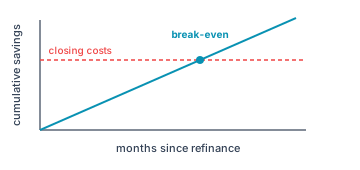
The break-even point is the number of months it takes for cumulative monthly savings to equal what you paid at closing. Typical break-evens are 18–48 months depending on rate drop and closing costs. A 1% rate drop on a $250,000 loan saves around $150–$200/month; with $4,000–$6,000 in closing costs, break-even lands around 20–40 months. Below 24 months is excellent; 48+ months means you should be confident you'll stay in the home long-term.
Is refinancing worth it?
Refinancing is worth it when three things line up: the rate drop is meaningful (commonly 0.75–1% or more), your closing costs are reasonable (2–4% of the loan amount), and you'll stay in the home well past the break-even point. The 1.5× rule of thumb says you should plan to keep the new loan at least 1.5 times the break-even period. Refinancing is rarely worth it if you might move within a year or two, or if the rate drop is under half a percent on a small balance.
What are typical closing costs on a refinance?
Refinance closing costs typically run 2–5% of the loan amount, or $2,000–$8,000 on a typical mortgage. The main components are loan origination fees (0.5–1% of loan), title insurance ($500–$2,000), appraisal ($400–$700), credit report and underwriting fees ($500–$1,000), and prepaid items (per-diem interest, escrow setup). Some lenders offer 'no-cost' refinances that absorb closing costs in exchange for a slightly higher rate — useful if you don't have cash on hand but worth comparing against paying costs upfront.
How long should I plan to stay to make refinancing worthwhile?
The standard rule of thumb is at least 1.5× the break-even period. If your break-even is 24 months, plan to stay at least 36 months. If you're not confident you'll be in the home that long, the math gets risky — a job change, family event, or unexpected move can wipe out the savings. Conservative buyers use a 2× multiplier: only refinance if you're planning to stay at least double the break-even period.
Does refinancing reset my loan term?
Yes — a typical refinance replaces your old mortgage with a fresh 30-year (or 15-year) loan, which means you restart the amortization clock. If you're 5 years into a 30-year loan and refinance into a new 30-year, you've added 5 years to your repayment timeline. This is one of the most common refinance traps: the lower payment looks great month-to-month, but you may end up paying more total interest because you're stretching the loan over more years. To avoid this, refinance into a term that matches your remaining years — many lenders offer 20-, 15-, and 10-year fixed-rate options.
What is a no-cost refinance and is the break-even different?
A no-cost refinance is one where the lender covers your closing costs in exchange for a slightly higher interest rate (typically 0.25–0.5% above the par rate). The break-even calculation flips: instead of recouping $4,000 in closing costs, you're comparing the rate-quoted-with-cost vs. rate-quoted-without-cost over the life of the loan. No-cost refis are good when you don't plan to stay long (no break-even period at all) or don't have cash on hand for closing. They cost more long-term if you keep the loan to maturity.
Should I include taxes and insurance in my monthly savings calculation?
No — taxes and homeowners insurance are based on the home's value, not the mortgage, so they don't change when you refinance. Use only the principal-and-interest (P&I) portion of your payment for break-even math. PMI (private mortgage insurance) does change if the new loan has a different loan-to-value ratio — if refinancing drops you below 80% LTV, you can drop PMI entirely, which is a separate savings that can dramatically shorten break-even.
Reference:
Brealey, R., Myers, S., & Allen, F. Principles of Corporate Finance. McGraw-Hill Education.
Refinance Break-Even Formula
The break-even point on a mortgage refinance is where cumulative monthly savings finally equal what you paid out of pocket to refinance. Until that month you're net negative on the deal; past it, every additional month is real savings.
Break-Even (months) = Closing Costs ÷ Monthly Savings
Where:
- Closing Costs — all upfront costs of the new loan: origination fees, title insurance, appraisal, recording fees, and prepaid interest ($)
- Monthly Savings — the difference between your current monthly principal & interest payment and the new payment under the refinanced loan ($)
In the advanced mode the calculator first derives both monthly payments from the standard amortization formula, M = L · r(1+r)n / ((1+r)n − 1), then subtracts to get the savings before dividing closing costs by that savings.
Related Calculators
- Mortgage Loan Calculator — compute the monthly payment, mortgage amount, or term
- Mortgage Points Calculator — see the upfront cost of buying down the rate with discount points
- Loan Calculator — general loan amortization math
- Loan to Value Calculator — check whether you can drop PMI on the refinance
- Interest Rate Calculator — compare simple vs compound interest scenarios
Related Sites
- LoanChop — Loan prepayment calculator
- Compare 2 Loans — Side-by-side loan comparison calculator
- Dollars Per Hour — Weekly paycheck calculator with overtime
- Hourly Salaries — Hourly wage to annual salary converter
- OptionsMath — Options trading profit and loss calculators
- Percent Off Calculator — Discount and sale price calculator