How It Works
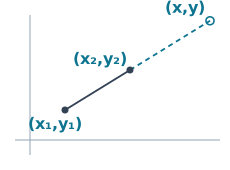
Linear extrapolation estimates a value outside the range of two known data points by extending the straight line through them. You enter (x1, y1) and (x2, y2), then provide a target x beyond that interval; the calculator finds the projected y on the same line.
Example Problem
A pressure sensor reads 20 psi at 10 mA and 28 psi at 30 mA. Estimate the reading at 40 mA if the calibration trend stays linear.
- Identify the known data points: at 10 mA the sensor reads 20 psi, and at 30 mA it reads 28 psi. Assign x1 = 10, y1 = 20, x2 = 30, y2 = 28.
- Identify the extrapolation point: x = 40. Since 40 is greater than both known x-values, this is extrapolation rather than interpolation.
- Write the linear extrapolation formula: y = y1 + (x - x1)(y2 - y1) / (x2 - x1).
- Substitute the known values: y = 20 + (40 - 10)(28 - 20) / (30 - 10).
- Simplify: y = 20 + (30)(8) / 20 = 20 + 12.
- Compute the final result: y = 32 psi, assuming the same straight-line trend continues.
Key Concepts
Linear extrapolation uses the slope between two known points to project beyond them. It is mathematically simple, but the farther x is from the measured range, the more the estimate depends on the assumption that the same linear trend keeps holding.
Applications
- Engineering checks: extending a calibration line slightly beyond a tested point
- Business planning: quick short-range projections from two recent data points
- Science labs: estimating a nearby reading just outside a measured table
- Data analysis: sanity-checking whether a simple linear trend can explain a near-future value
Common Mistakes
- Treating extrapolation as measured data — it is a projection and should be labeled as one
- Extrapolating too far from the known points, where nonlinear behavior can dominate
- Using two noisy points as if they prove a stable trend
- Forgetting that interpolation inside the known interval is usually more reliable than extrapolation outside it
Frequently Asked Questions
How do you calculate linear extrapolation?
Use y = y1 + (x - x1)(y2 - y1) / (x2 - x1). The formula finds the slope between two known points and extends that same straight line to a target x outside the known range.
What is the formula for linear extrapolation?
The linear extrapolation formula is y = y1 + (x - x1)(y2 - y1) / (x2 - x1). It is the same line equation used for linear interpolation, but x is outside the interval between x1 and x2.
What is the difference between linear interpolation and extrapolation?
Interpolation estimates between known data points. Extrapolation estimates beyond the known range, so it depends on the extra assumption that the trend continues outside the measured data.
Is linear extrapolation accurate?
It can be reasonable for short extensions of a genuinely linear trend, but it becomes risky as you move farther away from the known data. Curved, capped, seasonal, or noisy data can make a linear extrapolation misleading.
When should I avoid linear extrapolation?
Avoid it when the relationship is strongly nonlinear, when the target x is far outside the known range, or when the two known points are noisy or unrepresentative. In those cases, collect more data or use a model that matches the underlying process.
Can this calculator also do interpolation?
Yes. The same formula works if x falls between x1 and x2, but then the result is interpolation rather than extrapolation. The calculator labels that state in the result detail.
Linear Extrapolation Formula
Linear extrapolation uses the same straight-line equation as interpolation, but the target x lies outside the known data range:
Where:
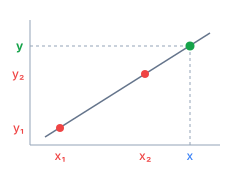
- x₁, y₁ — the first known data point
- x₂, y₂ — the second known data point
- x — the outside-range x-value where you want to estimate y
- y — the extrapolated result (the estimated y at x)
The formula assumes the same slope observed between the two known points continues beyond the measured range. Keep extrapolation close to the known data unless you have a reason to trust the trend.
Worked Examples
Engineering
How do you extrapolate a calibration reading just beyond a test range?
A pressure sensor reads 20 psi at 10 mA and 28 psi at 30 mA. Estimate the reading at 40 mA for a short-range commissioning check.
- Knowns: x₁ = 10, y₁ = 20, x₂ = 30, y₂ = 28; extrapolation point x = 40
- y = 20 + (40 − 10)(28 − 20) / (30 − 10)
- y = 20 + (30)(8) / 20 = 20 + 12
y ≈ 32 psi
This is a short extrapolation from the tested range. For safety-critical calibration, verify with an actual measurement beyond 30 mA.
Finance
How do you project next month's value from a short linear trend?
A simple metric was 4.2 in month 1 and 5.0 in month 3. Estimate month 4 using the same straight-line trend.
- Knowns: x₁ = 1, y₁ = 4.2, x₂ = 3, y₂ = 5.0; extrapolation point x = 4
- y = 4.2 + (4 − 1)(5.0 − 4.2) / (3 − 1)
- y = 4.2 + (3)(0.8) / 2 = 4.2 + 1.2
y ≈ 5.4
Short trend extensions can be useful for quick planning, but one extra data point does not prove the future trend will stay linear.
Data Science
How do you extrapolate from two time-series samples?
A sensor reads 15.2°C at hour 0 and 17.4°C at hour 2. Estimate the hour-3 reading if the same linear rate continues.
- Knowns: x₁ = 0, y₁ = 15.2; x₂ = 2, y₂ = 17.4; extrapolation point x = 3
- y = 15.2 + (3 − 0)(17.4 − 15.2) / (2 − 0)
- y = 15.2 + (3)(2.2) / 2 = 15.2 + 3.3
y ≈ 18.5°C
This is extrapolation, not gap filling. It is most defensible when the forecast horizon is short and the variable has been changing almost linearly.

Related Calculators
- Line Equation Calculator — find slope, distance, and slope-intercept form
- Linear Interpolation Calculator — estimate values inside the known data range
- Statistics Calculator — compute mean, median, and standard deviation
- Quadratic Equation Calculator — fit a polynomial to three data points
- Logarithm Calculator — model nonlinear growth with logarithms
Related Sites
- CameraDOF — Depth of field calculator for photographers
- Percent Off Calculator — Discount and sale price calculator
- Hourly Salaries — Hourly wage to annual salary converter
- InfantChart — Baby and child growth percentile charts
- Dollars Per Hour — Weekly paycheck calculator with overtime
- BOGO Discount — Buy-one-get-one discount calculator