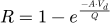
Solve for Collection Efficiency
Calculate the fraction of particles removed by the ESP using the Deutsch-Anderson equation.
R = 1 - e^(-A × Vd / Q)
Solve for Drift Velocity
Find the particle drift velocity from known efficiency, gas flow rate, and electrode area.
Vd = -Q / A × ln(1 - R)
Solve for Electrode Area
Determine the collecting electrode area needed to achieve a target efficiency.
A = -Q × ln(1 - R) / Vd
Solve for Gas Flow Rate
Find the maximum gas flow rate an ESP can handle while maintaining a target collection efficiency.
Q = -A × Vd / ln(1 - R)
How It Works
An electrostatic precipitator (ESP) charges airborne particles with a high-voltage electrode, then collects them on grounded plates. The Deutsch-Anderson equation predicts collection efficiency based on the ratio of collecting-plate area and gas flow rate, scaled by the particle drift velocity toward the plates. Increasing electrode area or reducing gas flow improves efficiency. Drift velocity depends on particle size, charge, and gas properties — typical values range from 0.03 to 0.2 m/s.
Example Problem
An ESP has 5,000 m² of collecting area, handles 50 m³/s of gas, and the drift velocity is 0.05 m/s. What is the collection efficiency?
- Identify the known values: A = 5,000 m², Q = 50 m³/s, Vd = 0.05 m/s.
- We are solving for collection efficiency R using the Deutsch-Anderson equation R = 1 − e^(−A·Vd/Q).
- Calculate the exponent: −A × Vd / Q = −5,000 × 0.05 / 50 = −5.
- Evaluate the exponential: e^(−5) = 0.00674.
- Subtract from 1: R = 1 − 0.00674 = 0.99326.
- Express as a percentage: R = 99.3% collection efficiency.
When to Use Each Variable
- Solve for Collection Efficiency — when you know the electrode area, drift velocity, and gas flow rate — e.g., predicting whether an ESP meets emissions limits.
- Solve for Drift Velocity — when you have measured efficiency and flow data and need to back-calculate the effective drift velocity for a given particle type.
- Solve for Electrode Area — when you are designing a new ESP and need to determine the collecting plate area required for a target efficiency.
- Solve for Gas Flow Rate — when you have a fixed ESP size and need to find the maximum gas throughput that maintains the required efficiency.
Key Concepts
The Deutsch-Anderson equation models ESP collection efficiency as an exponential approach to 100%: R = 1 - e^(-A*Vd/Q). The key ratio is A*Vd/Q — collecting area times drift velocity divided by gas flow. Increasing this ratio drives efficiency higher. Drift velocity depends on particle size, charge, and gas properties. Real ESPs may deviate from the ideal equation due to non-uniform flow, re-entrainment, and sneakage around baffles.
Applications
- Coal-fired power plants: removing fly ash from flue gas to meet particulate emission standards
- Cement manufacturing: controlling kiln dust emissions during clinker production
- Steel mills: capturing iron oxide fume from electric arc furnaces and basic oxygen furnaces
- Pulp and paper: collecting sodium sulfate fume from recovery boilers
- Oil refining: removing catalyst fines from fluid catalytic cracker exhaust
Common Mistakes
- Assuming the Deutsch-Anderson equation is exact — real ESPs have sneakage, re-entrainment, and non-uniform flow that reduce actual efficiency
- Using a single drift velocity for all particle sizes — fine particles (< 1 micron) have much lower drift velocities than coarse particles
- Forgetting to convert units — area, flow rate, and velocity must all be in consistent SI or Imperial units
- Ignoring temperature effects — hot gas increases volume flow, reducing the A/Q ratio and lowering efficiency
Frequently Asked Questions
How efficient are electrostatic precipitators at removing particulates?
Modern ESPs routinely achieve 99–99.9% collection efficiency for particulate matter. Large coal-fired power plants may use ESPs with collecting areas exceeding 10,000 m² to meet stringent emissions standards of less than 30 mg/Nm³.
What is the Deutsch-Anderson equation?
The Deutsch-Anderson equation R = 1 − e^(−A·Vd/Q) predicts ESP collection efficiency as an exponential function of three variables: collecting electrode area (A), particle drift velocity (Vd), and gas volumetric flow rate (Q). It was independently derived by Walther Deutsch (1922) and Evald Anderson (1924).
What determines the drift velocity of particles in an ESP?
Drift velocity depends on the electric field strength, particle size, particle charge, and gas viscosity. Larger particles and stronger electric fields produce higher drift velocities. Typical values range from 0.03 m/s for fine submicron particles to 0.2 m/s for coarse fly ash.
How does gas temperature affect ESP performance?
Higher temperatures increase gas volume (reducing the A/Q ratio) and change particle resistivity. Both effects can lower collection efficiency. Gas conditioning with moisture or SO₃ injection helps control resistivity in high-temperature applications.
What is back-corona and how does it affect ESP operation?
Back-corona occurs when high-resistivity dust on the collecting plates creates a voltage drop that generates a reverse electric discharge. This re-entrains collected particles and severely reduces efficiency. It is controlled by gas conditioning, pulse energization, or using wider plate spacing.
How do you size an ESP for a new installation?
Start with the required efficiency and gas flow rate. Estimate the drift velocity for the specific dust type (from published data or pilot tests). Then calculate the electrode area using A = −Q × ln(1 − R) / Vd. Add 10–20% safety margin for non-ideal conditions.
What is the difference between a dry ESP and a wet ESP?
Dry ESPs collect particles on dry plates and remove them by rapping. Wet ESPs use a water film on the collecting surfaces, which prevents re-entrainment and can also capture acid gases and fine mists. Wet ESPs are preferred for sticky, hygroscopic, or high-resistivity particles.
Deutsch-Anderson Equation
The Deutsch-Anderson equation predicts electrostatic precipitator collection efficiency as an exponential function of electrode area, drift velocity, and gas flow rate:
R = 1 − e−A · Vd / Q
Where:
- R — collection efficiency (fraction, 0 to 1)
- A — total collecting electrode area (m²)
- Vd — particle drift velocity toward the plates (m/s)
- Q — volumetric gas flow rate (m³/s)
The equation assumes uniform gas flow, no re-entrainment, and a single particle drift velocity. Real ESPs may require a modified Deutsch equation with an empirical exponent to account for non-ideal conditions.
Worked Examples
Power Generation
What efficiency does a coal plant ESP achieve for fly ash capture?
A 500 MW coal-fired power plant ESP has 8,000 m² of collecting area, handles 120 m³/s of flue gas, and the drift velocity for fly ash is 0.08 m/s.
- R = 1 − e^−(8000 × 0.08 / 120)
- R = 1 − e^−5.333
- R = 1 − 0.00483
R = 99.52%
Most modern coal plant ESPs exceed 99.5% efficiency. Adding more collecting area or reducing gas velocity can push efficiency above 99.9%.
Cement Manufacturing
How large must the electrode area be for a cement kiln ESP?
A cement kiln produces 80 m³/s of dusty exhaust. The drift velocity of kiln dust is 0.06 m/s. The plant needs 99% collection efficiency.
- A = −Q × ln(1 − R) / V_d
- A = −80 × ln(1 − 0.99) / 0.06
- A = −80 × (−4.6052) / 0.06
A = 6,140 m²
High-resistivity kiln dust may require flue gas conditioning (SO₃ injection) to maintain drift velocity.
Steel Mill
What gas flow rate can a steel mill fume extraction ESP handle?
An electric arc furnace ESP has 4,000 m² of plates and achieves a drift velocity of 0.12 m/s for iron oxide fume. The target efficiency is 98%.
- Q = −A × V_d / ln(1 − R)
- Q = −4000 × 0.12 / ln(1 − 0.98)
- Q = −480 / (−3.912)
Q = 122.7 m³/s
Steel mill fumes are highly conductive, giving high drift velocities that allow smaller ESPs relative to coal plant applications.
Related Calculators
- Cyclone Calculator — pre-separate coarse particles upstream of the ESP
- Venturi Scrubber Calculator — wet scrubbing alternative for particulate and gas removal
- Atmospheric Dispersion Calculator — model stack emissions after treatment
- Trommel Screen Calculator — size rotating screens for solid waste separation
- Voltage Converter — convert between volts, kilovolts, and millivolts for electrode design
Related Sites
- CameraDOF — Depth of field calculator for photographers
- Medical Equations — Hemodynamic, pulmonary, and dosing calculators
- Hourly Salaries — Hourly wage to annual salary converter
- RN Calc — Nursing dosage and calculation tools
- InfantChart — Baby and child growth percentile charts
- Z-Score Calculator — Z-score, percentile, and probability calculator