Distance Calculator
d equals the square root of the quantity x two minus x one squared plus the quantity y two minus y one squared
The 2D distance formula returns the straight-line (Euclidean) distance between two points (x₁, y₁) and (x₂, y₂) on a flat coordinate plane. It is a direct application of the Pythagorean theorem: the horizontal and vertical differences are the legs of a right triangle whose hypotenuse is the distance.
d = √((x₂ − x₁)² + (y₂ − y₁)²)
The 3D distance formula extends the Pythagorean idea into three dimensions. Use it whenever your two points have an x, y, and z coordinate — for example, positions in a 3D modelling space, voxel coordinates, or stations on a topographic survey.
d = √((x₂ − x₁)² + (y₂ − y₁)² + (z₂ − z₁)²)
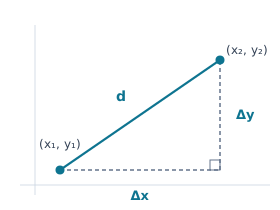
The distance formula comes directly from the Pythagorean theorem. Pick two points on a coordinate plane and draw the horizontal segment Δx = x₂ − x₁ and the vertical segment Δy = y₂ − y₁. Together with the straight line between the two points, those segments form a right triangle. The Pythagorean theorem then gives d² = Δx² + Δy², so d = √(Δx² + Δy²). Extending to three dimensions, the right triangle becomes a right-angled box and the formula gains a Δz² term: d = √(Δx² + Δy² + Δz²). The calculator also returns the midpoint — the average of the two coordinates along each axis — and Δx, Δy (and Δz in 3D mode) so you can see the legs of the triangle that the answer was built from.
Find the distance between (1, 2) and (4, 6).
Euclidean distance is the straight-line ('as the crow flies') distance and is the default meaning of 'distance' on a coordinate plane. Two other distance metrics show up often in computing and pathfinding: Manhattan (taxicab) distance |Δx| + |Δy| measures movement constrained to a grid, and Chebyshev distance max(|Δx|, |Δy|) measures the worst single-axis difference (think of a king on a chessboard). The Euclidean formula generalises cleanly to any number of dimensions — in n dimensions, d = √(Δx₁² + Δx₂² + … + Δxₙ²). Signed differences matter inside the formula (they are squared, so the sign disappears), but their signs still tell you the direction from point 1 to point 2 along each axis.
Use the distance formula d = √((x₂ − x₁)² + (y₂ − y₁)²). Subtract the x-coordinates and the y-coordinates, square each difference, add them, then take the square root. The result is the straight-line distance between the two points.
The distance formula is d = √((x₂ − x₁)² + (y₂ − y₁)²) in two dimensions and d = √((x₂ − x₁)² + (y₂ − y₁)² + (z₂ − z₁)²) in three dimensions. It returns the Euclidean (straight-line) distance between two coordinate points.
Plot two points on a coordinate plane and connect them with a straight line. Drop a horizontal segment of length Δx = x₂ − x₁ and a vertical segment of length Δy = y₂ − y₁; together with the connecting line they form a right triangle. The Pythagorean theorem says d² = Δx² + Δy², so d = √(Δx² + Δy²).
In three dimensions the distance between (x₁, y₁, z₁) and (x₂, y₂, z₂) is d = √((x₂ − x₁)² + (y₂ − y₁)² + (z₂ − z₁)²). It extends the 2D formula by adding the squared difference of the z-coordinates inside the square root.
The midpoint of (x₁, y₁) and (x₂, y₂) is ((x₁ + x₂) / 2, (y₁ + y₂) / 2) — the average of the x-coordinates and the average of the y-coordinates. In three dimensions, average each of x, y, and z. The midpoint always lies exactly halfway along the straight line between the two points.
Read off the (x, y) coordinates of both points from the grid, then plug them into d = √((x₂ − x₁)² + (y₂ − y₁)²). Sign matters inside the parentheses (negative coordinates are allowed), but once you square the differences the signs drop out, so the answer is always non-negative.
No. Distance is symmetric: the distance from A to B is the same as the distance from B to A. Swapping x₁ and x₂ flips the sign of Δx, but squaring it removes the sign, so the final answer is unchanged.
Euclidean distance is the straight-line, 'as the crow flies' distance computed by this calculator. Manhattan (or taxicab) distance |Δx| + |Δy| is the distance you would travel along a grid of streets. For the same two points, Manhattan distance is always greater than or equal to Euclidean distance.
Reference:
Reference: Euclidean distance and the midpoint formula are standard results in analytic geometry; see any introductory coordinate-geometry text (for example, Stewart's Calculus appendix on coordinate geometry).
The distance formula gives the straight-line (Euclidean) distance between two coordinate points. The 2D form is a direct application of the Pythagorean theorem; the 3D form extends it with a third squared difference.
2D Distance
d = √((x₂ − x₁)² + (y₂ − y₁)²)
3D Distance
d = √((x₂ − x₁)² + (y₂ − y₁)² + (z₂ − z₁)²)
The distance d is the hypotenuse of a right triangle whose legs are Δx and Δy.
Coordinate Geometry
Mapping
3D Modeling
