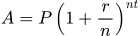
Final Amount (A)
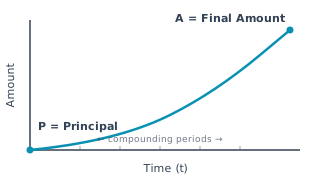
The classic compound interest formula. Given the starting principal P, annual rate r, compounding frequency n, and time t in years, find the future balance A. Each period the prior balance earns interest, so growth is exponential rather than linear.
A = P(1 + r/n)^(nt)
Principal (P)
Inverse of the compound-amount factor. Use when you know a future target balance A and want to know the starting deposit P required at rate r and frequency n over t years — a common question for college funds, retirement targets, and zero-coupon bond pricing.
P = A / (1 + r/n)^(nt)
Interest Rate (r)
Recover the annual interest rate from observed growth. If you know how a principal P became A over t years compounded n times per year, this returns the constant equivalent annual rate r — useful for comparing CD offers, savings products, or historical investment performance.
r = n · ((A/P)^(1/(nt)) − 1)
Time (t)
Solve for how many years it takes a principal P to reach a target A at rate r compounded n times per year. Answers planning questions like 'How long until my savings double?' or 'When will the college fund hit $100,000?'
t = ln(A/P) / (n · ln(1 + r/n))
How It Works
Compound interest is interest on interest. With each compounding period, the prior balance earns interest at rate r/n, and that interest is added to the balance before the next period begins. After nt periods of stacking, the principal P has grown to A = P(1 + r/n)^(nt). This is why long-horizon savings accelerate so dramatically: the same nominal rate compounded many times per year — or continuously, in the limit n → ∞, where the formula becomes A = P·e^(rt) — produces noticeably larger balances than simple interest on the same principal. Choose a solve target above (final amount, principal, rate, or time), pick a compounding frequency, and enter the remaining three inputs.
Example Problem
You deposit $1,000 in a savings account paying 5% annual interest, compounded monthly. What is the balance after 10 years?
- Identify the inputs: P = 1,000, r = 5% = 0.05, n = 12 (monthly), t = 10 years.
- Write the compound interest formula: A = P(1 + r/n)^(nt).
- Substitute the values: A = 1,000 × (1 + 0.05/12)^(12 × 10).
- Compute the periodic rate r/n = 0.05/12 ≈ 0.0041667 and the total periods nt = 120.
- Evaluate the growth factor: (1.0041667)^120 ≈ 1.647009.
- Multiply: A = 1,000 × 1.647009 ≈ $1,647.01.
- Interest earned = A − P = 1,647.01 − 1,000 = $647.01. After 10 years, monthly compounding turns $1,000 into about $1,647.
Make sure the rate and the compounding frequency match the time unit. The formula uses an annual rate and time in years; the n parameter takes the period count per year. If a bank quotes a monthly rate already, set r = monthly rate × 12 first, or restructure the equation accordingly.
When to Use Each Variable
- Solve for Final Amount (A) — when you have a starting deposit and want to project the balance at the end of a savings or investment horizon.
- Solve for Principal (P) — when you have a future target (college fund, retirement nest egg) and need to back out how much to deposit today.
- Solve for Rate (r) — when you observe a growth from P to A over a known horizon and want the implied constant annual rate.
- Solve for Time (t) — when you want to know how many years a deposit needs to compound at a given rate to reach a target.
Key Concepts
Two ideas matter most. First, compounding frequency affects how fast P grows: at the same nominal annual rate, daily compounding outperforms annual compounding because interest is added (and starts earning interest) more often. The limit n → ∞ is continuous compounding, A = P·e^(rt), which puts a hard ceiling on how much more frequent compounding can buy you. Second, compound interest differs from simple interest in that simple interest computes only P × r × t — it ignores interest earning interest, so it underestimates growth on multi-year horizons by an amount that itself grows exponentially with t. A related shortcut is the Rule of 72: the doubling time at rate r% is roughly 72/r years (e.g., 6% doubles in about 12 years). It's a rule of thumb derived from ln(2)/ln(1 + r/100) for small r and is accurate to within a percent or two for rates between 4% and 12%.
Applications
- Savings accounts and money-market funds — project the balance under quoted APY or APR
- Certificates of deposit (CDs) — verify the maturity value advertised by the bank
- Retirement accounts (IRAs, 401(k)s) — long-horizon compound growth of a lump-sum rollover
- Mortgage and loan amortization — the same compound-amount factor underlies amortization schedules
- Inflation modeling — apply an annual inflation rate to project future prices or purchasing power
- Bond pricing — zero-coupon bonds are priced as the present value of a future amount under compound discounting
- Exponential growth in biology and epidemiology — the same equation describes population growth, bacterial doubling, and the early phase of an epidemic curve
Common Mistakes
- Confusing nominal annual rate with effective annual rate (EAR). A nominal 6% APR compounded monthly is an EAR of about 6.17%; quoting one when the other is required produces a small but real error in long-horizon calculations.
- Mixing time units — using an annual rate with monthly time or vice versa. Either keep everything annual (r is annual, t in years, n = periods/year) or restate the rate to match the time basis.
- Forgetting to divide r by n inside the parentheses. The per-period rate is r/n, not r — using the annual rate directly with monthly periods enormously overstates the result.
- Entering the rate as a percent instead of a decimal in formulas that expect a decimal. This calculator accepts a percent for convenience and converts internally, but textbook formulas use decimals.
- Ignoring tax drag in taxable accounts. The pre-tax compounded balance overstates after-tax wealth; for taxable accounts, use the after-tax rate of return.
- Assuming simple interest and compound interest converge — they diverge faster as t and r grow. Over a 30-year horizon, compounding can roughly double the simple-interest result.
Frequently Asked Questions
What is compound interest?
Compound interest is interest computed on the original principal plus all interest previously earned. Unlike simple interest, which only ever earns interest on the original deposit, compound interest reinvests each period's interest so it begins earning interest of its own. Over multi-year horizons this produces exponentially faster growth.
How do you calculate compound interest?
Use A = P(1 + r/n)^(nt), where P is the principal, r is the annual rate as a decimal, n is the number of compounding periods per year, and t is the time in years. Interest earned is A − P. Example: $1,000 at 5% compounded monthly for 10 years gives A = 1,000 × (1 + 0.05/12)^120 ≈ $1,647.01, with about $647.01 in interest.
What is the compound interest formula?
A = P(1 + r/n)^(nt). It rearranges to solve for any of the four variables. For continuous compounding (the n → ∞ limit), the formula simplifies to A = P·e^(rt).
What is the difference between simple and compound interest?
Simple interest computes I = P · r · t — interest only on the original principal, paid out (or accrued) each period and not reinvested. Compound interest reinvests each period's interest, so future interest is computed on a growing balance. On a 10-year, 5%, $1,000 deposit, simple interest accrues $500 total; compound interest at monthly compounding produces about $647 — roughly 30% more.
What is continuous compounding?
Continuous compounding is the limit of compound interest as the compounding frequency n approaches infinity. The formula becomes A = P·e^(rt), where e ≈ 2.71828. In practice, the gap between daily compounding (n = 365) and continuous compounding is tiny — usually less than a basis point per year — but the closed-form e^(rt) is convenient in finance theory and option pricing.
How does compounding frequency affect interest?
More frequent compounding produces slightly higher growth at the same nominal annual rate. At 5% annual rate over 10 years, $1,000 grows to $1,628.89 with annual compounding, $1,647.01 with monthly, $1,648.66 with daily, and $1,648.72 with continuous. The marginal gain shrinks fast: going from monthly to daily adds about $1.65 over the decade, while monthly to continuous adds only $1.71.
What is the Rule of 72?
The Rule of 72 is a mental-math shortcut: at an annual rate of r%, a sum doubles in approximately 72/r years. At 6%, money doubles in roughly 12 years; at 9%, in about 8 years. It is derived from the exact doubling time ln(2)/ln(1 + r/100) and is accurate within about 1% for rates between 4% and 12%. For an exact doubling time at any rate, set A = 2P in this calculator and solve for time.
Should I enter the interest rate as a percent or a decimal?
This calculator accepts the annual interest rate as a percent (for example, type 5 for 5%). The math inside converts to a decimal before applying A = P(1 + r/n)^(nt). If you are working through a textbook formula by hand, use the decimal form (0.05) instead.
Compound Interest Formula
One equation describes compound growth and rearranges to solve for any of its four variables. The continuous-compounding limit (n → ∞) drops out as A = P · e^(rt).
A = P × (1 + r/n)ntFuture balance after compound growth
P = A / (1 + r/n)ntStarting principal needed to reach a target A
r = n × ((A/P)1/(nt) − 1)Annual rate implied by growth from P to A
t = ln(A/P) / (n × ln(1 + r/n))Years to grow P to A at rate r and frequency n
A = P · ertContinuous compounding (n → ∞)
Where:
- A — final amount (principal plus accumulated interest)
- P — principal (initial deposit at time 0)
- r — annual interest rate as a decimal (this calculator accepts a percent for convenience and converts internally)
- n — number of compounding periods per year (1 annually, 4 quarterly, 12 monthly, 365 daily, or n → ∞ continuous)
- t — time in years
Interest earned over the period is simply A − P. The effective annual rate (EAR) reported alongside the solution is (1 + r/n)n − 1, or er − 1 for continuous compounding — the rate that would produce the same one-year growth with annual compounding.
Worked Examples
Retirement Savings
What does a $10,000 IRA deposit grow to in 30 years at 7% compounded monthly?
A 35-year-old maxes out an IRA with a $10,000 rollover and lets it compound at a long-run 7% annualized return for 30 years until age 65. No additional contributions, all dividends reinvested.
- P = $10,000
- r = 7% = 0.07 per year
- n = 12 (monthly compounding)
- t = 30 years
- A = P(1 + r/n)^(nt) = 10,000 × (1 + 0.07/12)^360
- (1.005833)^360 ≈ 8.1165
- A ≈ 10,000 × 8.1165
Final amount A ≈ $81,165
This is a single lump sum with no further contributions. Adding even $500/month of new contributions would more than triple the result — that's the annuity-future-value equation, linked in the related calculators.
Bank Certificate of Deposit
How much will a $5,000 5-year CD at 4% compounded daily pay out?
You lock $5,000 into a 5-year CD with a 4% APR, compounded daily (n = 365). The bank's advertised APY will be slightly higher than 4% — daily compounding lifts the effective annual rate.
- P = $5,000
- r = 4% = 0.04 per year
- n = 365 (daily compounding)
- t = 5 years
- A = 5,000 × (1 + 0.04/365)^(365 × 5)
- (1.0001096)^1825 ≈ 1.2214
- A ≈ 5,000 × 1.2214
Final amount A ≈ $6,107
The bank's quoted APY for this CD would be (1 + 0.04/365)^365 − 1 ≈ 4.081%. APR (the nominal rate) and APY (the effective rate) only line up when n = 1.
Doubling Time
How long until $1,000 doubles to $2,000 at 6% compounded monthly?
Rule of 72 says about 12 years (72 / 6). The exact compound-interest formula refines that estimate using the time-solve inverse t = ln(A/P) / (n · ln(1 + r/n)).
- P = $1,000, A = $2,000 (double)
- r = 6% = 0.06 per year, n = 12 monthly
- t = ln(A/P) / (n · ln(1 + r/n))
- t = ln(2) / (12 · ln(1.005))
- t = 0.6931 / (12 × 0.004988)
- t ≈ 11.58 years
Time t ≈ 11.58 years
Rule of 72 estimated 12 years — within about 4% of the exact answer. The rule gets less accurate at higher rates (above 12%) but is excellent for typical savings rates.
Related Calculators
- Future Value Calculator — F = P(1+i)^n compound growth using per-period rates
- Present Value Calculator — discount a future amount back to today's value
- Interest Rate Calculator — solve for the implied periodic interest rate
- Rule of 72 Calculator — quick estimate of how long money takes to double
- Compounding & Discount Factors — all six engineering-economy equations in one switcher
- Annuity Future Value Calculator — future value of equal periodic deposits
Related Sites
- LoanChop — Loan prepayment calculator
- Compare 2 Loans — Side-by-side loan comparison calculator
- Dollars Per Hour — Weekly paycheck calculator with overtime
- Hourly Salaries — Hourly wage to annual salary converter
- OptionsMath — Options trading profit and loss calculators
- Percent Off Calculator — Discount and sale price calculator