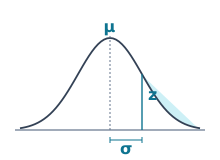
Z Score Formula
A Z score measures how many standard deviations a data point is from the mean. A score of 0 means the value equals the mean; positive scores are above, negative scores are below.
z = (x − μ) / σ
How It Works
A Z score measures how many standard deviations a data point is from the mean using z = (x − μ) / σ. A score of 0 means the value equals the mean; positive scores are above, negative scores are below. You can rearrange the formula to solve for any of the four variables.
Example Problem
A test has mean 100 and standard deviation 15. A student scores 130. What is their Z score?
- Identify the known values: observed value x = 130, population mean μ = 100, standard deviation σ = 15.
- Determine what to solve for: the z-score.
- Write the z-score formula: z = (x − μ) / σ.
- Substitute the numerator: x − μ = 130 − 100 = 30.
- Divide by the standard deviation: z = 30 / 15 = 2.0.
- Interpret the result: the student scored 2 standard deviations above the mean, placing them at approximately the 97.7th percentile.
When to Use Each Variable
- Solve for Z Score — when you know the value, mean, and standard deviation, e.g., finding how many standard deviations a test score is from the class average.
- Solve for Value (x) — when you know the Z score, mean, and standard deviation, e.g., finding what raw score corresponds to the 95th percentile.
- Solve for Mean — when you know the Z score, value, and standard deviation, e.g., back-calculating the population mean from a known percentile and its raw value.
- Solve for Standard Deviation — when you know the Z score, value, and mean, e.g., determining the spread of a distribution from a known data point and its percentile rank.
Key Concepts
The Z score standardizes any normally distributed value into a universal scale where the mean is 0 and the standard deviation is 1. This allows direct comparison across different measurement scales — for example, comparing SAT scores to GPA. Z scores also connect directly to cumulative probabilities through the standard normal distribution table.
Applications
- Academic testing: converting raw exam scores to percentile ranks for fair comparison across test versions
- Quality control: identifying defective products using control chart limits set at Z = ±2 or ±3
- Finance: measuring portfolio returns relative to benchmark performance in terms of standard deviations
- Medical diagnostics: interpreting lab results by comparing patient values to population reference ranges
- Research statistics: conducting hypothesis tests using Z-test methodology for large samples
Common Mistakes
- Using sample standard deviation when the population standard deviation is known (or vice versa) — the Z score formula assumes the population parameter sigma
- Applying Z scores to non-normal distributions — percentile interpretations are only valid when the underlying data is approximately normally distributed
- Confusing Z score direction — a negative Z score means below the mean, not an error or invalid result
- Using standard deviation of zero — division by zero is undefined, and a zero standard deviation means all values are identical (no variation to standardize against)
Frequently Asked Questions
How do you calculate a z-score?
Use the formula z = (x − μ) / σ. Subtract the mean (μ) from the observed value (x), then divide by the standard deviation (σ). For example, if x = 85, μ = 100, and σ = 15, then z = (85 − 100) / 15 = −15 / 15 = −1.0.
What is the z-score formula?
The z-score formula is z = (x − μ) / σ, where x is the observed value, μ is the population mean, and σ is the population standard deviation. You can rearrange it to solve for any variable: x = zσ + μ, μ = x − zσ, or σ = (x − μ) / z.
What does a z-score tell you about a data point?
A z-score tells you how far a data point is from the mean in terms of standard deviations. A z-score of 1.5 means the value is 1.5 standard deviations above the mean. A z-score of −2 means it is 2 standard deviations below. This lets you compare values from completely different scales on a common footing.
How many standard deviations is 'unusual' in statistics?
Values beyond ±2 standard deviations (|z| > 2) are generally considered unusual — only about 5% of normally distributed data falls outside this range. Values beyond ±3 (|z| > 3) are rare (0.3% of data) and often flagged as outliers. In quality control, ±3σ limits are standard.
What does a Z score of 1.5 mean?
A Z score of 1.5 means the value is 1.5 standard deviations above the mean. In a normal distribution, roughly 93.3% of values fall below this point, so it is at about the 93rd percentile.
When should you use Z scores instead of raw values?
Z scores standardize data so you can compare values across different scales. For instance, comparing a test score (mean 500, SD 100) with a GPA (mean 3.0, SD 0.5) requires converting both to Z scores first. They are also essential for hypothesis testing and identifying outliers.
What Z score is considered an outlier?
Values with |z| > 3 are commonly flagged as outliers. In a normal distribution, only about 0.3% of data falls beyond 3 standard deviations from the mean. Some fields use |z| > 2 for a looser threshold or |z| > 4 for an extremely strict one.
Z-Score Formula
The z-score formula standardizes any data point relative to a distribution's center and spread:
Where:
- z — z-score (number of standard deviations from the mean)
- x — observed value (raw data point)
- μ — population mean (average)
- σ — population standard deviation (spread)
A positive z-score means the value is above the mean; negative means below. A z-score of 0 means the value equals the mean exactly. In a normal distribution, about 68% of values fall within z = ±1, 95% within z = ±2, and 99.7% within z = ±3.
Worked Examples
Quality Control
Is a bolt with 10.08 mm diameter outside spec if the mean is 10 mm and σ = 0.02 mm?
A manufacturing process produces bolts with mean diameter 10 mm and standard deviation 0.02 mm. A bolt measures 10.08 mm. How unusual is this?
- z = (x − μ) / σ
- z = (10.08 − 10) / 0.02
- z = 0.08 / 0.02
- z = 4.0
A z-score of 4 is far beyond the ±3 threshold. This bolt is almost certainly defective — only 0.003% of parts should be this far from spec.
Academic Testing
What percentile is a 720 SAT score if the mean is 500 and σ = 100?
The SAT math section has a mean of 500 and standard deviation of 100. A student scores 720. Where does this fall?
- z = (720 − 500) / 100
- z = 220 / 100
- z = 2.2
A z-score of 2.2 corresponds to roughly the 98.6th percentile — the student scored better than about 98.6% of test-takers.
Finance
How unusual is a −3% daily stock return if the mean is 0.05% and σ = 1.2%?
A stock's daily returns have a historical mean of 0.05% and standard deviation of 1.2%. Today it dropped 3%. How extreme is this move?
- z = (−3 − 0.05) / 1.2
- z = −3.05 / 1.2
- z ≈ −2.54
A z-score of −2.54 means this drop is about 2.5 standard deviations below average — a move this extreme occurs less than 1% of trading days.
Related Calculators
- Statistics Calculator — compute mean, median, standard deviation, and variance.
- Linear Interpolation Calculator — estimate values between known data points.
- Percent Error Calculator — measure how far a value deviates from the expected result.
- Logarithm Calculator — compute log transformations common in statistical normalization.
- Natural Log Calculator — evaluate ln functions used in probability distributions.
Related Sites
- CameraDOF — Depth of field calculator for photographers
- Percent Off Calculator — Discount and sale price calculator
- Hourly Salaries — Hourly wage to annual salary converter
- InfantChart — Baby and child growth percentile charts
- Dollars Per Hour — Weekly paycheck calculator with overtime
- BOGO Discount — Buy one get one deal savings calculator