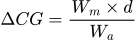
Weight Shift Formula
The weight shift formula calculates how an aircraft's center of gravity (CG) moves when cargo or passengers are repositioned. It divides the moment created by the moved weight by total airplane weight.
ΔCG = W_m × d / W_a
How It Works
The weight shift formula calculates how an aircraft's center of gravity (CG) moves when cargo or passengers are repositioned. It divides the moment created by the moved weight (weight times arm distance) by total airplane weight. If the CG drifts outside the aircraft's approved envelope, the plane becomes dangerously unstable.
Example Problem
A light aircraft weighs 2,400 lbs. A 150 lb bag is moved from arm station 40 to arm station 100. How far does the CG shift?
- Identify the known values: weight moved W_m = 150 lb, old arm = 40 in, new arm = 100 in, airplane weight W_a = 2,400 lb.
- Determine what we are solving for: the CG shift (ΔCG) in inches.
- Calculate the distance between arms: d = 100 − 40 = 60 inches.
- Write the weight shift equation: ΔCG = W_m × d / W_a.
- Substitute the known values: ΔCG = 150 × 60 / 2,400.
- Compute the result: ΔCG = 9,000 / 2,400 = 3.75 inches aft. A shift of 3.75 inches may sound small, but it can move the CG outside the approved envelope on a small trainer.
Always measure arm distances from the aircraft datum and verify the CG stays within the manufacturer's limits.
When to Use Each Variable
- Solve for CG Shift — when you know the moved weight, arm distance, and airplane weight, e.g., checking how far the CG moves when repositioning cargo.
- Solve for Airplane Weight — when you know the CG shift, moved weight, and arm distance, e.g., determining the maximum gross weight that keeps CG within limits.
- Solve for Weight Moved — when you know the CG shift, airplane weight, and arm distance, e.g., finding how much cargo you can relocate without exceeding CG limits.
- Solve for Arm Distance — when you know the CG shift, airplane weight, and weight moved, e.g., determining how far to move weight to achieve a target CG position.
Key Concepts
The weight shift formula is a moment-balance equation derived from the principle that total moment about the datum must remain constant. Moving weight creates a moment change equal to weight times distance, and dividing by total aircraft weight gives the CG displacement. Pilots must verify the CG stays within the manufacturer's approved envelope before every flight.
Applications
- Preflight planning: verifying center of gravity after loading passengers, baggage, and fuel
- Cargo aircraft loading: positioning freight to maintain CG within narrow limits for safe flight
- Flight instruction: teaching student pilots weight-and-balance calculations for cross-country flights
- Aircraft maintenance: accounting for equipment additions or removals that shift the empty-weight CG
Common Mistakes
- Using the wrong datum reference — all arm stations must be measured from the same datum point specified in the aircraft's weight and balance data
- Forgetting to recalculate after fuel burn — as fuel is consumed, the CG shifts because fuel tanks are rarely at the CG location
- Confusing weight shifted with total weight — the formula uses only the weight that moved, not the total weight in the new position
- Ignoring moment arms for passengers — moving a 180 lb passenger from the front seat to the rear in a Cessna 172 can shift the CG by several inches
Frequently Asked Questions
How does weight shift affect a vehicle's handling during braking?
During braking, weight transfers forward due to deceleration. This increases front axle loading and reduces rear axle grip. In aircraft, an aft CG makes the tail heavy and can cause pitch-up instability. In cars, forward weight transfer compresses front suspension and improves front tire grip, which is why brake bias is set front-heavy on most vehicles.
Why do front tires wear faster than rear tires?
Front tires carry more weight in most front-engine vehicles (about 55-60% of total weight), and weight transfers forward during every braking event. This additional loading causes more friction and heat, accelerating wear. The weight shift formula shows that heavier braking or a more forward CG increases front axle load proportionally.
What is a weight shift calculation in aviation?
It determines how far the center of gravity moves when weight is relocated inside an aircraft. Pilots use ΔCG = W_m × d / W_a before every flight to confirm the CG stays within the manufacturer's approved limits.
Why does center of gravity matter for flight safety?
A CG that is too far forward makes the nose heavy and increases fuel consumption. A CG that is too far aft can make the aircraft uncontrollable. Most light aircraft have an allowable CG range of only a few inches, so even small weight shifts matter.
How do you calculate weight and balance for a Cessna 172?
List every item (empty weight, fuel, pilot, passengers, baggage) with its weight and arm station. Multiply each weight by its arm to get a moment, sum all moments, then divide by total weight. For a typical Cessna 172 at 2,300 lbs gross weight, the CG must fall between about 35 and 47 inches aft of datum.
What units are used in weight shift calculations?
In the US, weight is in pounds and arm distances are in inches. Internationally, newtons and meters or centimeters are common. The calculator supports both systems with automatic unit conversion.
Can this formula be used for boats and trailers?
Yes. The same moment-balance principle applies to any vehicle. For boat trailers, shifting cargo changes the tongue weight (CG position relative to the axle). Too little tongue weight causes trailer sway at highway speeds. The formula works identically: ΔCG = weight moved × distance / total weight.
Weight Shift Formula
The weight shift formula calculates how far an aircraft's center of gravity moves when weight is repositioned:
ΔCG = Wm × d / Wa
Where:
- ΔCG — change in center of gravity position, in inches or meters
- Wm — weight of the item being moved, in lbf or N
- d — distance between the old and new arm stations, in inches or meters
- Wa — total airplane weight (gross weight), in lbf or N
The formula is a moment-balance equation: moving weight creates a moment change equal to weight times distance. Dividing by total aircraft weight converts this moment into a CG displacement. Pilots must verify the CG stays within the manufacturer's approved envelope before every flight.
Worked Examples
Racing
How does brake bias setup change with ballast placement in a race car?
A race team moves 50 lbs of ballast from the front axle to the rear axle of a 2,800 lb car. The axles are 108 inches apart. How far does the CG shift rearward?
- W_m = 50 lbf, d = 108 in, W_a = 2,800 lbf
- ΔCG = 50 × 108 / 2,800
- ΔCG = 5,400 / 2,800
ΔCG = 1.93 inches rearward
A 1.93-inch rearward CG shift transfers roughly 1.7% of weight to the rear axle, which can meaningfully change brake bias and corner exit traction.
Truck Loading
How does shifting cargo affect axle weight distribution on a delivery truck?
A 12,000 lb delivery truck has a 2,000 lb pallet moved from the front cargo area to the rear (180 inches apart). How far does the CG shift?
- W_m = 2,000 lbf, d = 180 in, W_a = 12,000 lbf
- ΔCG = 2,000 × 180 / 12,000
- ΔCG = 360,000 / 12,000
ΔCG = 30 inches rearward
A 30-inch CG shift on a truck significantly increases rear axle loading. Overloading the rear axle beyond its GAWR rating is illegal and dangerous.
Motorcycle
How does a passenger change the CG of a motorcycle?
A 500 lb motorcycle picks up a 180 lb passenger who sits 24 inches behind the solo CG. Total weight becomes 680 lb. How far does the CG shift rearward?
- W_m = 180 lbf, d = 24 in, W_a = 680 lbf
- ΔCG = 180 × 24 / 680
- ΔCG = 4,320 / 680
ΔCG = 6.35 inches rearward
A 6.35-inch rearward shift significantly reduces front wheel traction, which is why wheelies are easier with a passenger and rear preload adjustment is critical.
Related Calculators
- Seismometer Calculator — calculate earthquake magnitude, seismic moment, and energy release
- Seismic Geophone Calculator — determine subsurface layer depth and velocity from seismic refraction data
- Wing Lift Calculator — compute aerodynamic lift force affected by weight and balance
- Moment Calculator — calculate moments and lever arms for center-of-gravity analysis
- Mass Unit Converter — convert aircraft weight between pounds and kilograms
Related Sites
- CameraDOF — Depth of field calculator for photographers
- LoanChop — Loan prepayment calculator
- Compare 2 Loans — Side-by-side loan comparison calculator
- InfantChart — Baby and child growth percentile charts
- Medical Equations — Hemodynamic, pulmonary, and dosing calculators
- Dollars Per Hour — Weekly paycheck calculator with overtime