Body Mass Index (BMI)
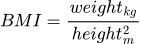
BMI screens body fat from height and weight. A BMI of 18.5–24.9 is normal, 25–29.9 overweight, and 30+ obese. It does not distinguish muscle from fat.
BMI = weight_kg / height_m²
Basal Metabolic Rate (BMR)
The Harris-Benedict equation estimates calories burned at rest based on weight, height, and age. Female and male versions use different coefficients.
BMR = 66 + 13.7w + 5h − 6.8a (male)
How It Works
This calculator bundles five weight-management equations. BMI screens body fat from height and weight. The Harris-Benedict BMR equations estimate calories burned at rest. Body fat percentage compares lean mass to total weight. TDEE multiplies your BMR by an activity factor to estimate total daily calorie needs.
Example Problem
A 30-year-old male weighs 80 kg and is 180 cm tall. What is his BMI and BMR?
- Identify the knowns. Sex = male, weight w = 80 kg, height h = 180 cm (1.80 m), age a = 30 years.
- Identify what we're solving for. We want BMI (body mass index), BMR (basal metabolic rate), and TDEE (total daily energy expenditure) at moderate activity.
- Write each formula in symbols. BMI = w_kg / h_m² (height in meters). Male Harris-Benedict BMR = 66 + 13.7w + 5h − 6.8a (weight in kg, height in cm, age in years). TDEE = BMR × activity factor; moderate activity ≈ 1.55×.
- Substitute the known values. BMI = 80 / (1.80)². BMR = 66 + (13.7 × 80) + (5 × 180) − (6.8 × 30). TDEE = BMR × 1.55.
- Simplify each line. BMI: 1.80² = 3.24, so BMI = 80 / 3.24 ≈ 24.7 — in the normal range (18.5–24.9). BMR: 66 + 1,096 + 900 − 204 = 1,858 kcal/day. TDEE: 1,858 × 1.55 ≈ 2,880 kcal/day.
- **BMI ≈ 24.7 (normal), BMR ≈ 1,858 kcal/day, TDEE ≈ 2,880 kcal/day.** To lose about 1 pound per week, eat roughly 500 kcal below TDEE (≈ 2,380 kcal/day) since 1 lb of fat ≈ 3,500 kcal.
Key Concepts
BMI provides a quick population-level screen for body fat but cannot distinguish muscle from fat. The Harris-Benedict BMR equations estimate resting energy expenditure from weight, height, age, and sex. TDEE multiplies BMR by an activity factor to approximate total daily calorie needs, forming the basis for weight management planning.
Applications
- Clinical nutrition: establishing calorie targets for hospital patients and post-surgical recovery plans
- Weight management: calculating calorie deficits for safe, sustainable fat loss at 0.5-1 kg per week
- Sports nutrition: estimating energy requirements for athletes in training and competition phases
- Public health screening: using BMI to identify overweight and obesity trends in population studies
Common Mistakes
- Treating BMI as a definitive measure of health — muscular athletes often have high BMIs without excess body fat
- Using the wrong BMR equation for sex — male and female Harris-Benedict coefficients differ significantly, and swapping them gives errors of 100-200 calories per day
- Overestimating activity level when calculating TDEE — most sedentary office workers should use a factor of 1.2, not 1.55
- Creating extreme calorie deficits — eating more than 1,000 calories below TDEE risks muscle loss, nutrient deficiency, and metabolic adaptation
Frequently Asked Questions
What is a healthy BMI range?
A BMI of 18.5–24.9 is considered normal weight by WHO. Below 18.5 is underweight, 25–29.9 is overweight, and 30 or above is classified as obese. BMI does not distinguish between muscle and fat, so muscular athletes may score in the overweight range without excess body fat. Output here is informational only, not a substitute for clinical judgment.
How many calories should I eat to lose weight?
A common starting guideline is to eat 500 fewer calories per day than your TDEE, which produces about 1 pound of fat loss per week (3,500 kcal ≈ 1 lb of fat). Losing more than 2 lbs per week is generally not recommended without medical supervision, as steeper deficits risk muscle loss, nutrient deficiency, and metabolic adaptation.
What is the difference between BMR and TDEE?
BMR (basal metabolic rate) is the calories your body burns at complete rest just to keep organs functioning. TDEE (total daily energy expenditure) adds the calories burned through daily activity and exercise, calculated as BMR × activity factor (1.2 sedentary to 1.9 very active). TDEE is always higher than BMR.
What is a healthy body fat percentage?
For men, 10–20% body fat is considered fit; for women, 18–28%. Essential fat minimums are roughly 3–5% for men and 10–13% for women. These ranges vary by age, athletic level, and measurement method (DEXA, bioimpedance, skinfolds). Athletes routinely sit at the lower end of the fit range.
What is the formula for BMI?
BMI = weight (kg) / height (m)². For US units: BMI = weight (lb) × 703 / height (in)². Example: a 70 kg adult at 1.70 m has BMI = 70 / (1.70)² = 70 / 2.89 ≈ 24.2 kg/m², which falls in the normal range.
What is the Harris-Benedict equation for BMR?
The classic Harris-Benedict equations are: male BMR = 66 + 13.7 × kg + 5 × cm − 6.8 × age; female BMR = 655 + 9.6 × kg + 1.8 × cm − 4.7 × age, both returning kilocalories per day. The revised Mifflin-St Jeor equation is now considered more accurate for modern populations but Harris-Benedict remains the most widely referenced.
Which activity multiplier should I use for TDEE?
Sedentary (×1.2) for desk-job and minimal movement; lightly active (×1.375) for light exercise 1–3 days/week; moderately active (×1.55) for moderate exercise 3–5 days/week; very active (×1.725) for hard exercise 6–7 days/week; extra active (×1.9) for very hard exercise plus a physical job. Most office workers overestimate their activity level — use ×1.2 unless you log structured exercise.
Why does BMI fail for muscular people?
BMI is a height-weight ratio with no information about body composition. A 100 kg bodybuilder at 1.80 m has BMI = 30.9 (obese category) despite carrying very little fat, because muscle is denser than fat. Body fat percentage, waist circumference, or DEXA scans are better measures of body composition for athletic populations. Informational only; not a substitute for clinical assessment.
Worked Examples
Dietitian Consult — BMI
How is BMI used as a starting point in a weight-management consult?
A 30-year-old female client meets with a dietitian for a weight-management consult. She is 162 cm tall and weighs 70 kg. What is her BMI, and where does she fall on the WHO classification chart?
- Knowns: weight w = 70 kg, height h = 162 cm = 1.62 m.
- Apply the BMI formula: BMI = w / h² = 70 / (1.62)².
- Square the height: (1.62)² = 2.6244.
- Divide: 70 / 2.6244 ≈ 26.7.
BMI ≈ 26.7 kg/m² — Overweight under WHO adult thresholds
BMI is a starting screen, not a body-fat measurement. A dietitian will typically pair this with waist circumference, body-composition measurement, and goal-setting before recommending any caloric strategy.
Recreational Lifting — Male BMR
What is the BMR of a 28-year-old recreational male lifter?
A 28-year-old male recreational lifter is 175 cm tall and weighs 82 kg. What is his Harris-Benedict BMR at rest, before any activity multipliers are applied?
- Knowns: sex = male, weight w = 82 kg, height h = 175 cm, age a = 28 years.
- Apply the male Harris-Benedict formula: BMR = 66 + 13.7w + 5h − 6.8a.
- Substitute: BMR = 66 + 13.7 × 82 + 5 × 175 − 6.8 × 28.
- Simplify each term: 66 + 1,123.4 + 875 − 190.4.
- Sum: 66 + 1,123.4 + 875 = 2,064.4; 2,064.4 − 190.4 = 1,874.
Male BMR ≈ 1,874 kcal/day at rest
Harris-Benedict assumes average body composition; very muscular lifters may have a BMR several hundred kcal/day higher than the equation predicts because lean mass drives resting energy use more strongly than body weight alone.
Tactical Athlete — TDEE
What is the TDEE of a tactical athlete in heavy training?
A tactical-fitness athlete has a Harris-Benedict BMR of 1,650 kcal/day. During a heavy training cycle she works out twice a day five days a week. What does TDEE look like across the standard activity-factor table?
- Knowns: BMR = 1,650 kcal/day.
- Apply the formula: TDEE = BMR × activity factor for each of the five standard factors.
- Sedentary (×1.2): 1,650 × 1.2 = 1,980 kcal/day.
- Moderate (×1.55): 1,650 × 1.55 = 2,557.5 ≈ 2,558 kcal/day.
- Very active (×1.725): 1,650 × 1.725 = 2,846.25 ≈ 2,846 kcal/day.
TDEE ≈ 2,846 kcal/day at the very-active factor (heavy training)
The hero box on this page displays the moderate-activity TDEE (≈ 2,558 kcal/day); the table beneath shows all five factors. For tactical training cycles with sustained twice-a-day load, the very-active factor (1.725) is usually the closest fit.
BMI, BMR & TDEE Formulas
Five formulas drive this calculator: BMI for height-weight screening, the male and female Harris-Benedict basal metabolic rate equations, body fat percentage from lean mass, and TDEE as BMR × activity factor:
Body Mass Index
BMI = weight (kg) / height (m)²Height-weight screening ratio (kg/m²)
Basal Metabolic Rate (Harris-Benedict)
BMRmale = 66 + 13.7 × w + 5 × h − 6.8 × aMale BMR in kcal/day (w in kg, h in cm, a in years)
BMRfemale = 655 + 9.6 × w + 1.8 × h − 4.7 × aFemale BMR in kcal/day (same units)
Body Fat & TDEE
BF% = (total weight − lean mass) / total weight × 100Body fat percentage from a known lean-mass measurement
TDEE = BMR × activity factorTotal daily energy expenditure (factors 1.2–1.9)
Where:
- weight, w — body mass (kg in canonical form; the calculator accepts lb and converts)
- height, h — body height (m for BMI, cm for Harris-Benedict)
- a — chronological age (years)
- BMI — body mass index (kg/m²); WHO ranges: < 18.5 underweight, 18.5–24.9 normal, 25–29.9 overweight, ≥ 30 obese
- BMR — basal metabolic rate (kcal/day); resting calorie burn excluding activity
- lean mass — fat-free body mass measured via DEXA, hydrostatic weighing, or skinfolds (kg)
- BF% — body fat percentage (fat-mass fraction of total weight, %)
- activity factor — 1.2 sedentary · 1.375 lightly active · 1.55 moderately active · 1.725 very active · 1.9 extra active
- TDEE — total daily energy expenditure (kcal/day)
Harris-Benedict was first published in 1919 and revised in 1984. The Mifflin-St Jeor equation (1990) is now considered more accurate for contemporary populations, but Harris-Benedict remains the most cited and is what most weight-management resources use. All BMR formulas are population-mean regressions; individual BMR can vary ±10% from the predicted value, mostly with lean mass. Output is informational only and not a substitute for clinical or dietitian advice.
Related Calculators
- BMI Calculator (dedicated) — body mass index with WHO weight categories, by itself
- BMR Calculator (dedicated) — Harris-Benedict basal metabolic rate with male/female toggle
- Body Fat % Calculator (dedicated) — body fat percentage from total weight and lean body mass
- TDEE Calculator (dedicated) — total daily energy expenditure across all five activity levels
- Heart Rate Calculator — find your max HR, reserve, and Karvonen target zones
Related Sites
- Hourly Salaries — Hourly wage to annual salary converter
- Medical Equations — Hemodynamic, pulmonary, and dosing calculators
- BOGO Discount — Buy-one-get-one discount calculator
- CameraDOF — Depth of field calculator for photographers
- Percent Error Calculator — Calculate percent error between experimental and theoretical values
- OptionsMath — Options trading profit and loss calculators