Gradient Future Worth
A uniform gradient is a cash flow pattern where payments increase by a fixed amount (G) each period.
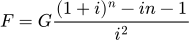
F = G[(1+i)^n − in − 1] / i²
How It Works
A uniform gradient is a cash flow pattern where payments increase by a fixed amount (G) each period. The first payment is 0, the second is G, the third is 2G, and so on. The three gradient factors convert this linearly increasing series into its future value, present value, or an equivalent uniform annuity.
Example Problem
Maintenance costs increase by $100 each year for 5 years at 5% interest. What is the future value?
- Identify the known data points. Gradient amount G = $100 per year (cost increase each year), periodic interest rate i = 0.05 per year, number of periods n = 5 years.
- Identify what we're solving for. We want the future value F at the end of year 5 — the equivalent single lump-sum at the horizon for the linearly increasing cost stream 0, $100, $200, $300, $400.
- Write the gradient future-worth formula: F = G × [(1 + i)^n − i × n − 1] / i².
- Substitute the known values: F = 100 × [(1.05)^5 − 0.05 × 5 − 1] / (0.05)².
- Simplify the numerator and denominator: (1.05)^5 = 1.276282, so the bracket = 1.276282 − 0.25 − 1 = 0.026282, and i² = 0.0025, giving F = 100 × 0.026282 / 0.0025 = 100 × 10.5126.
- **Future worth F = $1,051.26** at the end of year 5.
The same gradient can also be converted to present worth or an equivalent uniform annual amount depending on the comparison you need.
When to Use Each Variable
- Future Worth: Solve for F — when you know the gradient amount, interest rate, and number of periods and need to find the future value of the increasing series.
- Future Worth: Solve for G — when you know the target future value and need to find what annual increment produces it.
- Present Worth: Solve for P — when you need to find today's lump-sum equivalent of a linearly increasing cost or revenue stream.
- Present Worth: Solve for G — when you know the present value budget and need to find the maximum gradient that fits within it.
- Uniform Series: Solve for A — when you need to convert a gradient series into an equivalent level annual amount for comparison with other projects.
- Uniform Series: Solve for G — when you know the equivalent annual amount and need to find the gradient that produces it.
Key Concepts
A uniform gradient in engineering economics models cash flows that increase by a fixed amount G each period: 0, G, 2G, ..., (n−1)G. The three gradient factors — future worth, present worth, and uniform series — convert this linearly increasing series into equivalent single or level amounts at a given interest rate. These are additive with uniform series factors, so a cash flow of A + gradient can be analyzed by computing each part separately and summing the results.
Applications
- Maintenance cost analysis: modeling equipment maintenance that increases by a fixed dollar amount each year as components wear
- Infrastructure planning: evaluating road or bridge maintenance budgets that grow linearly with age and traffic volume
- Salary and benefit projections: analyzing employee costs that increase by a fixed annual raise amount
- Energy cost forecasting: estimating utility expenses that rise by a constant increment each year due to aging equipment inefficiency
Common Mistakes
- Forgetting that the gradient starts at zero in period 1 — the first non-zero gradient payment (G) occurs in period 2, not period 1
- Adding the gradient directly to a base annuity without using the correct factor — the gradient and annuity components must be converted separately, then summed
- Using nominal interest rate instead of the effective rate per period — if payments are monthly, use the monthly effective rate, not the annual nominal rate
- Confusing a geometric gradient (constant percentage increase) with a uniform gradient (constant dollar increase) — they require different formulas
Frequently Asked Questions
What is a uniform gradient in engineering economics?
A uniform gradient is a cash flow series where each payment increases by a constant amount G. The series starts at 0, then G, 2G, and so on. It models linearly growing costs.
How is a gradient different from a uniform series?
A uniform series has equal payments every period. A gradient has linearly increasing payments (0, G, 2G, 3G, ...). You can analyze them separately and add the results.
Why does the gradient start at zero in period 1?
By convention, the gradient amount G represents the increase per period, not the first payment. Period 1 has zero gradient; period 2 has G; period n has (n−1)G.
When would I use the gradient uniform series factor?
Use it to convert a gradient into an equivalent level annuity, useful for comparing projects with growing costs against projects with constant costs.
What is the formula for gradient future worth?
Use F = G[(1+i)^n − in − 1] / i². It converts a linearly increasing series into an equivalent future amount at the end of period n.
When is a uniform gradient model better than a flat annuity?
Use a gradient when each year's cash flow changes by a fixed dollar amount rather than staying constant. Examples include maintenance costs, staffing budgets, and staged tariffs.
Can you combine a base annuity and a gradient?
Yes. Analyze the uniform base series and the gradient separately, then add their present worths, future worths, or equivalent annual amounts.
Reference:
Lindeburg, Michael R. 1992. Engineer In Training Reference Manual. Professional Publication, Inc. 8th Edition.
Uniform Gradient Formulas
Uniform-gradient factors handle cash flows that increase by a constant amount each period: 0, G, 2G, 3G, and so on.
Future Worth
F = G[(1+i)^n − in − 1] / i²
Present Worth
P = G[(1+i)^n − in − 1] / [i²(1+i)^n]
Equivalent Uniform Series
A = G[1/i − n/((1+i)^n − 1)]
Worked Examples
Maintenance Budget
If maintenance rises by $150 per year for 6 years at 5%, what is the future worth?
- Use the gradient future-worth factor.
- Substitute G = 150, i = 0.05, n = 6.
- F ≈ 2,558.87.
Cost Justification
What present worth corresponds to a $200 yearly gradient over 8 years at 4%?
- Use the gradient present-worth factor.
- Substitute G = 200, i = 0.04, n = 8.
- P ≈ 4,467.67.
Equivalent Annual Cost
What equal annual amount matches a $120 gradient at 6% for 7 years?
- Use the uniform-series equivalent factor.
- Substitute G = 120, i = 0.06, n = 7.
- A ≈ 299.80 per year.
Related Calculators
- Compounding and Discount Factors Calculator — single payment and uniform series compound amount factors
- Present Worth Calculator — discount future values back to today
- Interest Rate Calculator — simple and compound interest computations
- Profitability Index Calculator — evaluate project viability using discounted cash flows
- Depreciation Calculator — straight-line and declining balance depreciation methods
Related Sites
- Compare 2 Loans — Side-by-side loan comparison calculator
- LoanChop — Loan prepayment calculator
- Dollars Per Hour — Weekly paycheck calculator with overtime
- OptionsMath — Options trading profit and loss calculators
- Hourly Salaries — Hourly wage to annual salary converter
- Z-Score Calculator — Z-score, percentile, and probability calculator