Dupuit Equation for Unconfined Aquifers
When you pump water from an unconfined aquifer, the water surface forms a cone of depression around the well. The Dupuit equation gives the steady-state pumping rate from hydraulic conductivity K and the water-level heights at two observation distances.
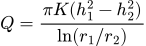
Q = πK(h₁² − h₂²) / ln(r₁/r₂)
How It Works
When you pump water from an unconfined (water-table) aquifer, the water surface forms a cone of depression around the well. The Dupuit–Forchheimer equation calculates the steady-state pumping rate from the hydraulic conductivity K, the saturated-thickness heights h₁ and h₂ at two observation wells, and their distances r₁ and r₂ from the pumping well. The formula Q = πK(h₁² − h₂²) / ln(r₁/r₂) can be rearranged to back-solve for K from pump-test data, or to size a new well for a target capacity.
Example Problem
An unconfined aquifer has hydraulic conductivity K = 0.001 m/s. Two observation wells at distances r₁ = 200 m and r₂ = 100 m from the pumping well show saturated thicknesses h₁ = 20 m and h₂ = 15 m respectively. What steady-state pumping rate (yield) does this imply?
- Identify the formula: Q = π × K × (h₁² − h₂²) / ln(r₁ / r₂).
- Compute the squared-head difference: h₁² − h₂² = 20² − 15² = 400 − 225 = 175 m².
- Compute the natural log of the radius ratio: ln(200 / 100) = ln 2 ≈ 0.6931.
- Multiply numerator terms: π × 0.001 × 175 ≈ 0.5498 m³/s·(unit).
- Divide by ln-ratio: Q = 0.5498 / 0.6931 ≈ 0.7934 m³/s.
- Interpret: Q ≈ 0.793 m³/s (≈ 68,500 m³/day) is the sustainable pumping rate at this drawdown — a very productive well, consistent with coarse sand and a thick saturated zone.
Steady state assumes the cone of depression has stabilized; transient conditions require the Theis or Cooper-Jacob solution instead.
When to Use Each Variable
- Solve for Flow Rate (Q) — when you have observation-well data and aquifer permeability and need to calculate the steady-state pumping rate.
- Solve for Permeability (K) — when you have pump-test data (flow rate and water levels at two observation wells) and need to determine the aquifer's hydraulic conductivity.
- Solve for Water Level h₁ — when you need to predict the water level at a given distance from a pumping well under steady-state conditions.
- Solve for Water Level h₂ — when you need to predict the drawdown at a closer observation well from known conditions at a farther well.
- Solve for Distance r₁ — when you know water levels and need to find the radius of influence or distance to a specific drawdown level.
- Solve for Distance r₂ — when you need the inner observation-well distance given other known parameters from a pump test.
Key Concepts
The Dupuit equation for an unconfined aquifer assumes steady, horizontal, radial flow toward a fully penetrating well in a homogeneous, isotropic aquifer. Because the saturated thickness varies with distance (the water table drops as you approach the well), the heads appear squared — unlike the Thiem equation for confined aquifers, where thickness is constant and the heads appear linearly. Drawdown is defined as s = H − h, where H is the undisturbed water-table height.
Applications
- Water-supply well design: estimating sustainable pumping rates for municipal, residential, and agricultural groundwater wells
- Aquifer testing: back-calculating hydraulic conductivity K from field pump-test data using observation wells
- Construction dewatering: predicting drawdown and required pumping rates to lower the water table below an excavation
- Environmental remediation: designing pump-and-treat capture systems for contaminated groundwater plumes
- Well-interference analysis: spacing nearby wells to keep mutual drawdown within acceptable limits
Common Mistakes
- Applying the Dupuit equation to confined aquifers — confined aquifers use the Thiem equation with linear head difference (h₁ − h₂), not squared
- Using the equation before reaching steady state — the Dupuit equation assumes equilibrium; transient conditions require the Theis or Cooper-Jacob methods
- Ignoring partial-penetration effects — if the well screen does not fully penetrate the aquifer, a correction factor is needed
- Confusing r₁ and r₂ — r₁ is the farther distance (higher water level h₁), r₂ is the closer distance (lower h₂, greater drawdown)
- Measuring drawdown from the ground surface instead of the pre-pumping water table — only drawdown from the static level belongs in h
Frequently Asked Questions
How do you calculate the yield of a water well in an unconfined aquifer?
Use the Dupuit–Forchheimer equation Q = πK(h₁² − h₂²) / ln(r₁/r₂). Measure the aquifer's hydraulic conductivity K plus the saturated thickness h at two observation wells at distances r₁ and r₂ during steady-state pumping. Plug the numbers in directly for the yield Q (in m³/s or your preferred flow-rate unit). The Dupuit equation is the foundation of steady-state well-yield analysis in unconfined aquifers.
What is drawdown and why does it matter for well design?
Drawdown is the vertical drop in the water table at any point around a pumping well, measured relative to the pre-pumping static level. Deeper drawdown means more saturated thickness is lost, reducing the transmissivity of the remaining column and lowering the sustainable pumping rate. Well designers limit maximum drawdown (often to 40–60 % of the saturated thickness for unconfined aquifers) to keep the well screen submerged, prevent cascading air into the pump, and reduce pumping-energy cost.
What is the Dupuit equation for unconfined aquifers?
The Dupuit equation (also called Dupuit–Forchheimer) gives steady-state well flow as Q = πK(h₁² − h₂²) / ln(r₁/r₂). It assumes the aquifer is homogeneous, flow is horizontal, and the well fully penetrates the saturated zone. Heads are squared because the saturated thickness varies with position — unlike the Thiem confined-aquifer equation where thickness is constant.
What is a cone of depression?
A cone of depression is the funnel-shaped drop in the water table around a pumping well. Its shape depends on pumping rate, aquifer permeability, and boundary conditions. At steady state in an unconfined aquifer, the water-table height h(r) satisfies h²(r) = h_w² + (Q/πK)·ln(r/r_w), producing the characteristic logarithmic cone.
How do I determine aquifer permeability from a pump test?
Measure water levels at two or more observation wells during steady-state pumping at a known Q. Plug Q, h₁, h₂, r₁, and r₂ into the rearranged Dupuit equation: K = Q·ln(r₁/r₂) / (π·(h₁² − h₂²)). This gives the aquifer's hydraulic conductivity without the assumptions of transient methods. For strongly transient aquifers use Theis or Cooper-Jacob analysis instead.
What is the difference between confined and unconfined aquifers?
A confined aquifer is bounded above and below by impermeable layers; pumping lowers the piezometric head but not the saturated thickness, so the Thiem equation Q = 2πKb(h₁ − h₂) / ln(r₁/r₂) applies (b is the constant thickness). An unconfined aquifer has a free water table as its upper surface; pumping reduces the saturated thickness, so the squared-head Dupuit equation applies.
How do you use this equation for construction dewatering?
Set h₂ (the water level at the nearest observation point or excavation edge) to the target dewatered level — typically 0.5 to 1 m below the excavation floor. With known K, h₁, r₁, r₂, solve for Q to get the required pumping rate. For multiple wellpoints, scale by the number of wells or use superposition; for rectangular excavations, use an equivalent radius r_w from the excavation dimensions.
Unconfined Aquifer Well Formula (Dupuit)
For steady-state radial flow toward a fully penetrating well in an unconfined (water-table) aquifer:
Q = π × K × (h₁² − h₂²) / ln(r₁ / r₂)
Where:
- Q — steady-state pumping rate, in cubic meters per second (m³/s)
- K — aquifer hydraulic conductivity, in meters per second (m/s)
- h₁ — saturated thickness at distance r₁ from the pumping well (m)
- h₂ — saturated thickness at distance r₂ from the pumping well (m)
- r₁ — distance to the farther observation well (m); h₁ is higher
- r₂ — distance to the closer observation well (m); h₂ is lower
The formula assumes the aquifer is homogeneous and isotropic, flow is horizontal (Dupuit assumption), the well fully penetrates the saturated zone, and a steady-state cone of depression has formed. For transient pumping use Theis or Cooper-Jacob solutions; for confined aquifers use the Thiem equation with linear head difference.
Worked Examples
Water Supply
Will a residential well deliver enough flow for a rural household?
A driller reports K = 5×10⁻⁵ m/s (medium sand) and a pump-test yields h₁ = 12 m at r₁ = 50 m and h₂ = 10 m at r₂ = 5 m. What steady-state flow rate can the well sustain?
- h₁² − h₂² = 144 − 100 = 44 m²
- ln(r₁/r₂) = ln(10) ≈ 2.3026
- Q = π × 5×10⁻⁵ × 44 / 2.3026
Q ≈ 3.00 × 10⁻³ m³/s (≈ 48 gpm)
A typical household needs 2–5 gpm average; 48 gpm is plenty for a residence with comfortable peak-demand headroom.
Agriculture
What is the sustainable yield of an irrigation well in an alluvial aquifer?
An irrigation well taps an alluvial aquifer with K = 0.002 m/s. Observation wells at r₁ = 300 m and r₂ = 50 m show h₁ = 30 m and h₂ = 25 m at steady state. How many hectares can it irrigate?
- h₁² − h₂² = 900 − 625 = 275 m²
- ln(r₁/r₂) = ln(6) ≈ 1.7918
- Q = π × 0.002 × 275 / 1.7918
Q ≈ 0.964 m³/s (≈ 83,300 m³/day)
At 4 mm/day crop water demand, this yield can supply roughly 2,080 hectares — a major irrigation district.
Construction Dewatering
What pump rate is needed to dewater an excavation below the water table?
A 20-m excavation sits in an aquifer with K = 0.0005 m/s. The pre-pumping water level is 18 m. To drop the water table to 12 m at the wellpoint (r₂ = 10 m) while maintaining 17 m at the property line (r₁ = 150 m), what pumping rate is required?
- h₁² − h₂² = 289 − 144 = 145 m²
- ln(r₁/r₂) = ln(15) ≈ 2.7081
- Q = π × 0.0005 × 145 / 2.7081
Q ≈ 0.0841 m³/s (≈ 7,270 m³/day)
Dewatering contractors typically split this between several wellpoints to minimize well loss and local drawdown variability.
Related Calculators
- Permeameter Calculator — measure soil permeability in the lab using Darcy's law
- Rainwater Collection Calculator — supplement well water with harvested rainwater
- Reverse Osmosis Calculator — treat well water with elevated dissolved solids
- Darcy's Law Calculator — calculate groundwater flow rate through porous media
- Volume Unit Converter — convert pumping rates between gallons per minute and liters per second
Related Sites
- CameraDOF — Depth of field calculator for photographers
- Medical Equations — Hemodynamic, pulmonary, and dosing calculators
- Hourly Salaries — Hourly wage to annual salary converter
- RN Calc — Nursing dosage and calculation tools
- InfantChart — Baby and child growth percentile charts
- Z-Score Calculator — Z-score, percentile, and probability calculator