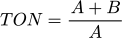
Threshold Odor Number Equation
The Threshold Odor Number measures how much odor-free water you need to add to a sample before the smell becomes barely detectable. A higher TON means a stronger odor.
TON = (A + B) / A
How It Works
The Threshold Odor Number measures how much odor-free water you need to add to a sample before the smell becomes barely detectable. A higher TON means a stronger odor. Drinking water standards typically require a TON of 3 or less. The test follows APHA Standard Methods 2150B, using a trained sensory panel that evaluates heated samples at 60 °C.
Example Problem
A panel detects odor at the threshold when 50 mL of sample is diluted with 150 mL of odor-free water. Determine the Threshold Odor Number and whether it meets drinking water standards.
- Identify the known values: sample volume A = 50 mL and odor-free dilution water B = 150 mL.
- Determine what we are solving for: the Threshold Odor Number (TON) to compare against the EPA limit of 3.
- Write the TON equation: TON = (A + B) / A.
- Substitute the values: TON = (50 + 150) / 50.
- Add the numerator: 50 + 150 = 200 mL total volume.
- Divide: TON = 200 / 50 = 4. This exceeds the EPA secondary standard of 3, indicating an odor problem that warrants investigation.
A TON of 4 exceeds the typical drinking water limit of 3, indicating consumers would likely notice and complain about the taste/odor.
When to Use Each Variable
- Solve for TON — when you know the sample volume and dilution volume from a sensory test and need to calculate the threshold odor number.
- Solve for Sample Volume (A) — when you have a target TON and a fixed amount of odor-free water, and need to determine how much sample to use.
- Solve for Odor-Free Volume (B) — when you know the sample volume and target TON and need to calculate how much dilution water to add.
Key Concepts
The Threshold Odor Number (TON) quantifies odor intensity by measuring the dilution ratio needed to make an odor barely detectable. TON = (A + B) / A, where A is the sample volume and B is the odor-free dilution water. A TON of 1 means no detectable odor. Most drinking water standards set a maximum TON of 3. The test follows Standard Methods 2150B, using a trained sensory panel at 60 °C.
Applications
- Drinking water treatment: monitoring raw water intake and finished water to ensure odor compliance with EPA secondary standards
- Wastewater management: tracking odor levels in effluent to prevent nuisance complaints from nearby residents
- Industrial discharge monitoring: verifying that process water meets permit limits for odor before release
- Source water protection: detecting early signs of algal blooms or contamination events by tracking TON trends over time
Common Mistakes
- Testing at room temperature instead of 60 °C — the standard method heats samples because volatile odor compounds are more perceptible at elevated temperature
- Using tap water instead of true odor-free water for dilution — residual chlorine or minerals in tap water can mask or alter the sample odor
- Confusing TON with a concentration measurement — TON is a dimensionless dilution ratio, not a chemical concentration in mg/L
Frequently Asked Questions
What does a threshold odor number of 3 mean for drinking water?
A TON of 3 means the sample had to be diluted to one-third its original concentration before the odor became barely detectable. This is the EPA secondary drinking water standard limit — water at or above TON 3 typically generates consumer complaints about taste and smell.
How is the threshold odor test performed in a lab?
A trained sensory panel prepares a series of dilutions using measured volumes of sample water and odor-free water. Each flask is heated to 60 °C and compared to an odor-free blank. The threshold dilution is the lowest one at which the panel consistently detects an odor difference from the blank. Standard Methods 2150B specifies the procedure.
What is an acceptable threshold odor number for drinking water?
Most drinking water standards set a maximum TON of 3. Water with TON above 3 typically triggers consumer complaints about taste and smell. The EPA secondary standard is non-enforceable but widely used as a quality benchmark.
What causes odor in drinking water?
Common causes include algal blooms (geosmin and 2-MIB from cyanobacteria), hydrogen sulfide from anaerobic conditions, chlorine or chloramine disinfection byproducts, and industrial contamination. Seasonal algal blooms are the most frequent cause of taste-and-odor episodes in surface water supplies.
How do water treatment plants remove odor?
The most effective method is activated carbon adsorption — either powdered activated carbon (PAC) added during treatment or granular activated carbon (GAC) filters. Oxidation with ozone, potassium permanganate, or chlorine dioxide can also destroy odor-causing compounds. The choice depends on the specific odor compound and treatment plant configuration.
Why is the TON test done at 60 degrees instead of room temperature?
Heating to 60 °C increases the volatility of odor-causing compounds, making them easier for the sensory panel to detect. This gives a more sensitive and reproducible result than testing at room temperature, where some compounds might be present but not volatile enough to smell.
Can TON be used to measure wastewater odor?
Yes, though wastewater applications often use related tests like the D/T (dilution-to-threshold) ratio from dynamic olfactometry. The standard TON test works for liquid samples, while olfactometry measures airborne odors from treatment facilities. Both quantify odor intensity as a dilution ratio.
Threshold Odor Number Formula
The TON test quantifies odor intensity as a dilution ratio:
TON = (A + B) / A
Where:
- TON — Threshold Odor Number (dimensionless)
- A — volume of the odorous water sample (mL)
- B — volume of odor-free dilution water (mL)
A TON of 1 means no detectable odor. A TON of 3 is the EPA secondary drinking water standard limit. Higher values indicate stronger odor requiring more dilution.
Worked Examples
Drinking Water (Taste and Odor Complaints)
Does finished water meet the EPA odor standard?
A water utility receives taste complaints. The lab tests 100 mL of finished water diluted with 200 mL odor-free water. The panel detects odor at this dilution.
- TON = (A + B) / A
- TON = (100 + 200) / 100
TON = 3
A TON of 3 is right at the EPA secondary limit. The utility should investigate the source and consider activated carbon treatment.
Industrial (Process Water Quality)
How much sample volume is needed for a target TON of 5?
A food processing plant measures cooling water odor. They have 400 mL of odor-free water and need to find the sample volume that yields a TON of 5.
- A = B / (TON − 1)
- A = 400 / (5 − 1)
A = 100 mL
Using 100 mL of sample with 400 mL dilution water gives a total of 500 mL, yielding TON = 5.
Environmental Monitoring (Source Water)
How much odor-free water is needed to reach the detection threshold?
A reservoir sample (50 mL) has a known TON of 8 from an algal bloom. How much dilution water is needed for the threshold test?
- B = A × (TON − 1)
- B = 50 × (8 − 1)
B = 350 mL
A TON of 8 indicates a severe odor problem. The treatment plant should increase powdered activated carbon dosing or consider granular activated carbon filters.
Related Calculators
- Biochemical Oxygen Demand Calculator — assess the organic load that can cause odor problems
- Microorganism Disinfection Calculator — balance disinfection with odor-causing byproduct formation
- Swimming Pool Calculator — manage chloramine-related pool odor issues
- Mixing Design Calculator — design rapid mix systems for odor treatment chemicals
- Volume Unit Converter — convert sample volumes between milliliters, liters, and gallons
Related Sites
- CameraDOF — Depth of field calculator for photographers
- Medical Equations — Hemodynamic, pulmonary, and dosing calculators
- Hourly Salaries — Hourly wage to annual salary converter
- RN Calc — Nursing dosage and calculation tools
- InfantChart — Baby and child growth percentile charts
- Z-Score Calculator — Z-score, percentile, and probability calculator