How It Works
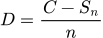
Straight-line depreciation spreads an asset's depreciable cost evenly over its useful life. The annual depreciation expense is D = (C − Sₙ) / n, where C is the original cost, Sₙ is the salvage value (estimated resale or scrap value at the end of life), and n is the useful life in years. The depreciable basis (C − Sₙ) is divided into equal annual chunks, giving the simplest and most widely used method for financial reporting under GAAP and IFRS.
Example Problem
A company buys a delivery truck for $50,000 with an estimated salvage value of $5,000 after 10 years of use. Calculate the annual straight-line depreciation expense.
- Identify cost C = $50,000, salvage value Sₙ = $5,000, useful life n = 10 years.
- Compute the depreciable basis: C − Sₙ = 50,000 − 5,000 = $45,000.
- Apply the straight-line formula: D = (C − Sₙ) / n = 45,000 / 10.
- Annual depreciation D = $4,500 per year for each of the 10 years.
- After 5 years, accumulated depreciation is 5 × 4,500 = $22,500, leaving book value 50,000 − 22,500 = $27,500.
The truck depreciates exactly $4,500 every year until it reaches its $5,000 salvage value in year 10.
Key Concepts
Straight-line depreciation is the default method assumed by both GAAP and IFRS when no other pattern of consumption is justified. The depreciable basis is always cost minus salvage — not the full purchase price — because the asset is expected to retain salvage value at end-of-life. Useful life is set by management estimate, often aligned with IRS Publication 946 recovery periods for tax purposes (e.g., 5 years for vehicles, 7 years for office furniture, 39 years for commercial buildings). The method produces a constant annual expense, which makes net income and tax planning predictable but understates the higher real economic decline that many assets show in early years.
Applications
- Financial reporting: most companies' income statements use straight-line for building, furniture, and equipment depreciation under GAAP and IFRS.
- Tax accounting: certain MACRS classes use straight-line either as the default or as an alternative election (ADS straight-line).
- Lease accounting: ASC 842 and IFRS 16 right-of-use assets are typically amortized straight-line over the lease term.
- Capital budgeting: engineering economics problems usually default to straight-line when computing after-tax cash flows and depreciation tax shields.
- Intangible asset amortization: trademarks, software, and other definite-life intangibles are usually amortized straight-line.
Common Mistakes
- Depreciating the full purchase price instead of the depreciable basis — straight-line uses cost minus salvage, not cost alone.
- Depreciating land — land does not wear out and is never depreciated; only land improvements (paving, fencing, landscaping) are.
- Using the wrong useful life — guessing instead of consulting IRS Publication 946 or industry conventions for the asset class.
- Forgetting to stop at salvage value — annual depreciation should not push book value below salvage in the final year.
- Treating salvage value as a recoverable amount — it's an estimate used only to compute the depreciable basis, not a guaranteed sale price.
Frequently Asked Questions
How do you calculate straight-line depreciation?
Subtract salvage value from cost to get the depreciable basis, then divide by useful life in years: D = (C − Sₙ) / n. For example, a $50,000 asset with $5,000 salvage and 10-year life depreciates ($50,000 − $5,000) / 10 = $4,500 per year.
What is the formula for straight-line depreciation?
D = (C − Sₙ) / n, where D is annual depreciation, C is original cost, Sₙ is salvage value at end of life, and n is useful life in years. This is the simplest depreciation formula and produces equal annual expense.
Why is straight-line depreciation the most common method?
It's simple to compute, easy to explain to non-accountants, and produces predictable expense patterns that match the steady-use pattern of most office, building, and infrastructure assets. GAAP and IFRS both accept it as a default in the absence of evidence supporting a different pattern.
When should you not use straight-line depreciation?
Assets that lose value rapidly in early years (cars, computers, smartphones) are better matched by accelerated methods like double-declining balance or sum-of-years-digits. Assets whose use varies with output (machinery, mining equipment) are better matched by units-of-production methods.
What is salvage value in straight-line depreciation?
Salvage value (also called residual or scrap value) is the estimated amount the asset will be worth when its useful life ends. It's subtracted from cost to form the depreciable basis — straight-line never depreciates an asset below salvage.
How do you depreciate a building using straight-line?
For US tax purposes, residential rental buildings depreciate straight-line over 27.5 years and commercial buildings over 39 years. The depreciable basis excludes the value of the land underneath, since land is never depreciated.
Reference:
Newnan, Donald G., et al. Engineering Economic Analysis. Oxford University Press. IRS Publication 946: How To Depreciate Property.
Worked Examples
Three real-world straight-line depreciation problems. Click 'Load this example' to populate the inputs above.
FLEET ACCOUNTING
Delivery truck depreciation over 10 years
A logistics company buys a delivery truck for $50,000 and expects to sell it for $5,000 after 10 years of service. What is the annual straight-line depreciation expense?
- C = $50,000 (purchase price)
- Sₙ = $5,000 (estimated salvage)
- n = 10 years
- D = (50,000 − 5,000) / 10 = 45,000 / 10
Annual depreciation D = $4,500 per year.
Over 10 years the truck is fully depreciated down to its $5,000 salvage value.
OFFICE EQUIPMENT
Laptop depreciation under a 5-year policy
An accounting firm capitalizes a $2,400 laptop and uses a 5-year straight-line policy with zero salvage value. How much does the firm expense each year?
- C = $2,400, Sₙ = $0, n = 5 years
- Depreciable basis = 2,400 − 0 = $2,400
- D = 2,400 / 5
Annual depreciation D = $480 per year.
Many firms set salvage value to $0 for short-lived office equipment to simplify accounting.
COMMERCIAL REAL ESTATE
Commercial building over the 39-year IRS recovery period
An investor buys a commercial office building (structure only, excluding land) for $1,950,000. Using the IRS 39-year recovery period and no salvage, what is the annual depreciation deduction?
- C = $1,950,000 (building only, land excluded)
- Sₙ = $0 (IRS convention)
- n = 39 years (commercial real property recovery period)
- D = 1,950,000 / 39
Annual depreciation D = $50,000 per year.
Land is never depreciated — only the building portion of the purchase price qualifies.
Related Calculators
- Depreciation Calculator (All Methods) — straight-line, declining balance, and depreciation basis in one tool
- Double-Declining Depreciation Calculator — accelerated method using 2 × straight-line × book value
- Sum-of-Years' Digits Depreciation Calculator — front-loaded depreciation weighted by remaining useful life
- Loan Calculator — payment, principal, interest, and amortization schedule
- Return on Equity Calculator — net income divided by shareholder equity for profitability analysis
Related Sites
- LoanChop — Loan prepayment calculator
- Compare 2 Loans — Side-by-side loan comparison calculator
- Dollars Per Hour — Weekly paycheck calculator with overtime
- Hourly Salaries — Hourly wage to annual salary converter
- Percent Off Calculator — Discount and sale price calculator
- BOGO Discount — Buy-one-get-one discount calculator