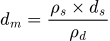
How It Works
This calculator covers four snow-science equations used in hydrology and meteorology: melt depth, heat capacity, heat content, and heat storage change. Enter snowpack properties like density, depth, and temperature to model how much water a snowpack will release or how much energy it can absorb before melting. A 50 cm snowpack has a density of 0.3 g/cm³. How much water will it produce when it melts? So 50 cm of this snow equals about 15 cm (6 inches) of liquid water. Fresh powder has a density of about 0.05–0.10 g/cm³. Settled snow is around 0.2–0.4 g/cm³, and compacted or wind-blown snow can reach 0.5 g/cm³ or higher. Pure water is 1.0 g/cm³.
Example Problem
A 50 cm snowpack has a density of 0.3 g/cm³. How much water will it produce when it melts?
- Identify the knowns. Snowpack depth dₛ = 50 cm (about 20 inches measured with a snow probe), snow density ρₛ = 0.3 g/cm³ (settled mid-season snowpack, denser than fresh powder but lighter than wet spring snow), density of liquid water ρw = 1.0 g/cm³.
- Identify what we're solving for. We want the melt depth dₘ — also called snow water equivalent (SWE) — the depth of liquid water the snowpack will release if it melts completely.
- Write the melt-depth equation: dₘ = (ρₛ × dₛ) / ρw. The snowpack volume stays constant in cross-section, so we just rescale depth by the density ratio when ice converts to water.
- Substitute the known values: dₘ = (0.3 × 50) / 1.0.
- Simplify the arithmetic: dₘ = 15 / 1.0 = 15 cm of water (about 6 inches).
- State the final result: the 50 cm snowpack will produce **15 cm of liquid water** at melt-out. This is the volume hydrologists multiply by watershed area to forecast spring reservoir inflow — the same calculation drives flood warnings during rain-on-snow events.
Fresh powder has a density of about 0.05–0.10 g/cm³. Settled snow is around 0.2–0.4 g/cm³, and compacted or wind-blown snow can reach 0.5 g/cm³ or higher. Pure water is 1.0 g/cm³.
When to Use Each Variable
- Solve for Melt Depth — when you know the snowpack density and depth, e.g., forecasting spring runoff volume for reservoir management.
- Solve for Snowpack Density — when you know the melt depth and snowpack depth, e.g., back-calculating density from field melt measurements.
- Solve for Heat Capacity — when you know snow density, specific heat, temperature, and depth, e.g., estimating energy needed to warm a cold snowpack to 0 degrees C.
Key Concepts
Snow hydrology connects snowpack properties to water supply and flood risk. Melt depth (snow water equivalent) converts snow volume to the liquid water it will release. Heat capacity and heat content describe the energy stored in or required by the snowpack — a sub-zero snowpack must absorb energy to warm to 0 degrees C before any melt occurs. The heat storage change equation accounts for all energy inputs (solar radiation, rain, ground heat, condensation) that drive snowmelt.
Applications
- Water supply forecasting: estimating spring runoff volume from snow survey data for reservoir operations
- Flood risk assessment: predicting peak flows when rapid warming or rain-on-snow events trigger fast melt
- Avalanche forecasting: monitoring snowpack energy balance to assess instability and weak layer development
- Climate research: tracking long-term changes in snow water equivalent as indicators of climate change
- Ski resort operations: estimating natural snowpack water content for grooming and snowmaking decisions
Common Mistakes
- Using a single density for all snow types — fresh powder (0.05 g/cm3) and wind-packed snow (0.5 g/cm3) produce vastly different melt depths
- Forgetting the cold content of the snowpack — sub-zero snow must absorb energy to reach 0 degrees C before producing any liquid water
- Ignoring rain-on-snow events — rain adds both water and energy to the snowpack, greatly accelerating melt beyond what temperature alone predicts
- Confusing snow depth with snow water equivalent — a deep but low-density snowpack may contain less water than a shallow, dense one
Frequently Asked Questions
What is a typical snow density?
Fresh powder has a density of about 0.05–0.10 g/cm³. Settled snow is around 0.2–0.4 g/cm³, and compacted or wind-blown snow can reach 0.5 g/cm³ or higher. Pure water is 1.0 g/cm³.
How many inches of snow equal one inch of rain?
The classic rule of thumb is 10:1 (10 inches of snow per 1 inch of rain), but it varies widely. Light, fluffy snow can be 20:1 or more, while heavy wet snow may be only 5:1.
What is snow water equivalent?
Snow water equivalent (SWE) is the depth of water that would result if the snowpack melted instantly. It equals snowpack depth times snow density divided by water density, which is exactly the melt depth equation in this calculator.
Why must a sub-zero snowpack absorb energy before it melts?
Snow at −5 °C cannot release liquid water until it has been warmed to 0 °C. The energy required is the snowpack's heat capacity (ρ_s × c_s × ΔT × d_s) and is called the cold content. Forecast models that ignore cold content overestimate early-season melt by days.
What is the latent heat of fusion for snow?
L_f for water ice is about 80 cal/g (334 kJ/kg). That's the energy needed to convert ice at 0 °C to liquid water at 0 °C without changing temperature — and it dominates the heat budget of a melting snowpack, far exceeding the energy needed to first warm the snow to 0 °C.
How does rain-on-snow accelerate melt?
Rain falling on snow delivers two effects: it adds liquid water directly, and (more importantly) it releases sensible and latent heat as it cools to 0 °C and refreezes within the pack. A heavy warm rainstorm can release more melt energy in hours than a week of sunny weather.
What is heat storage change in a snowpack?
Heat storage change (ΔH) sums every energy flux into or out of the pack: shortwave solar (H_S), longwave radiation (H_L), convection/sensible heat (H_C), latent heat from condensation or sublimation (H_CS), ground heat (H_G), and rain-borne heat (H_P). The sign of ΔH tells you whether the pack is gaining or losing energy.
Reference:
Wanielista, Kersten & Eaglin. 1997. Hydrology Water Quantity and Quality Control. 2nd ed.
Worked Examples
Hydrology — Spring Runoff
How much water does a 1 m alpine snowpack contain at melt-out?
A late-winter snowpack in the Rockies measures 100 cm deep at a bulk density of 0.25 g/cm³ (snow). What melt depth (water equivalent) does the snowpack hold when it fully transitions to liquid water at density 1.00 g/cm³?
- Knowns: ρs = 0.25 g/cm³, ds = 100 cm, ρd = 1.00 g/cm³
- dm = ρs × ds / ρd
- dm = 0.25 × 100 / 1.00
dm = 25 cm of water equivalent
Snow water equivalent (SWE) is the dominant input to spring runoff models for irrigation, hydropower, and downstream flood forecasting. Bulk snow density of 0.25 is typical for settled mid-season snow; fresh snow can be as low as 0.05.
Snowmelt Energy Balance
How much heat does it take to melt a 5 cm-water-equivalent snowpack?
A snowpack has 5 cm of liquid water equivalent (dw) at 0 °C. The latent heat of fusion (Lf) of ice is 80 cal/g, and liquid water density is 1 g/cm³. What heat content per unit area must be added by solar radiation and condensation to fully melt this snow?
- Knowns: Lf = 80 cal/g, ρw = 1 g/cm³, dw = 5 cm
- H = Lf × ρw × dw
- H = 80 × 1 × 5
H = 400 cal/cm² (≈ 16.7 MJ/m²)
This is the energy a square centimeter of surface must absorb beyond the cold-content fraction to release runoff. On a clear sunny day, peak solar radiation delivers about 1.0 cal/cm²·min — so this snowpack would need about 400 minutes of full-sun-equivalent forcing to melt out.
Cold-Content Estimate
What is the cold content of an 80 cm snowpack at −5 °C?
Before any snowmelt can occur, the pack must first warm to its melting point. A subalpine snowpack at −5 °C has bulk density 0.2 g/cm³, depth 80 cm, and specific heat 0.5 cal/(g·°C). What is the heat capacity (Hc), often called cold content because it must be removed to bring the pack to 0 °C?
- Knowns: ρs = 0.2 g/cm³, cs = 0.5 cal/(g·°C), Ts = −5 °C, ds = 80 cm
- Hc = ρs × cs × Ts × ds
- Hc = 0.2 × 0.5 × (−5) × 80
Hc = −40 cal/cm² (40 cal/cm² of heat required to warm the pack to 0 °C)
The negative sign reflects the convention that the pack must absorb 40 cal/cm² before any energy goes into melting. Sub-zero snowpacks delay snowmelt; even a small cold-content layer can stall runoff for hours after the air temperature passes 0 °C.
Snow & Snowmelt Formulas
Four equations from snow hydrology connect snowpack physical properties to the energy budget that drives melt and to the liquid water the pack will release.
d_m = (ρ_s × d_s) / ρ_wMelt depth / snow water equivalent
H_c = ρ_s × c_s × T_s × d_sHeat capacity (cold content) of the snowpack
H_c = L_f × ρ_w × d_wHeat content needed to melt a layer of ice
ΔH = H_S + H_L + H_C + H_CS + H_G + H_PNet heat storage change in the snowpack
Where:
- d_m — melt depth / snow water equivalent (cm of liquid water)
- ρ_s — snow density (g/cm³)
- d_s — snowpack depth (cm)
- ρ_w — density of liquid water (≈ 1.0 g/cm³)
- H_c — heat capacity or heat content per unit area (cal/cm²)
- c_s — specific heat of snow (≈ 0.5 cal/g·°C)
- T_s — snowpack temperature deficit below 0 °C, expressed positive (°C)
- L_f — latent heat of fusion (≈ 80 cal/g for water)
- d_w — depth of liquid water produced (cm)
- ΔH — net heat storage change in the snowpack (cal/cm²)
- H_S — net shortwave (solar) radiation
- H_L — net longwave radiation
- H_C — sensible (convective) heat flux
- H_CS — latent heat from condensation or sublimation
- H_G — heat conducted from the ground
- H_P — heat advected by precipitation (rain-on-snow)
The melt-depth equation is a simple mass balance: the snowpack's equivalent water volume is conserved when the ice converts to liquid. The energy equations recognize that a sub-zero snowpack must first absorb cold content before any melt occurs, and that melting itself requires the latent heat of fusion (~80 cal/g) regardless of how the energy arrives. Rain-on-snow events contribute through both H_C (sensible heat as rain cools to 0 °C) and H_P (advected heat into the pack).
Reference: Wanielista, Kersten & Eaglin. 1997. Hydrology Water Quantity and Quality Control. 2nd ed.
Related Calculators
- Relative Humidity Calculator — compute humidity from vapor pressure or dewpoint
- Cloud Base Calculator — estimate cloud ceiling altitude
- Wind Chill Calculator — calculate how cold it feels during snow events
- Rainwater Collection Calculator — estimate water equivalent from snowmelt runoff
- Volume Unit Converter — convert snowmelt volume between gallons, liters, and cubic feet
Related Sites
- Hourly Salaries — Hourly wage to annual salary converter
- Medical Equations — Hemodynamic, pulmonary, and dosing calculators
- BOGO Discount — Buy-one-get-one discount calculator
- CameraDOF — Depth of field calculator for photographers
- Percent Error Calculator — Calculate percent error between experimental and theoretical values
- OptionsMath — Options trading profit and loss calculators